How can Europe protect its skies against 'escalating' drone menace? / Photo: © AFP

 Bid by Italy's Intesa bank to take over MPS gets boost

 Stablecoins Are Quietly Becoming Business Infrastructure, NOWPayments Data Shows
 Oil surges, stocks sink as US reportedly eyes new Iran strikes

 Woman in botched US execution walking, mentally 'foggy': lawyer
 Farhan hopes Pakistan's new combination takes off in Sri Lanka T20Is

 Teenager Andreeva seals China Open semi-final with Bartunkova
 Britain's Burnham says open to Germany joining warplane project

 Kovac's tough love has Dortmund dreaming of title charge

 China announces candidate for WHO chief

 South Korea test-fires its first homegrown hypersonic weapon: presidency

 ONAR Advances Nasdaq Listing Preparation Following Advertise Purple Acquisition and Financing

 Thailand opens extradition process for reporter sought by China

 France struggles to wean social housing off gas

 Germany lifts GDP forecast as economy withstands Iran war

 Sri Lanka appoints Kusal Mendis as Test captain
 Norris confident McLaren can shine in Singapore

 Alex Bodi pushes ahead with expansion: ALIX LASERS showroom planned for Bucharest
 Fossil fuels off COP31 agenda as global output keeps rising

 Haze not 'a threat' to Singapore F1 race: organisers
 COP31 organisers say to seek 'ambitious' action with their text
 Bartunkova thrashes Muchova to reach China Open semi-finals
 Drone hits Yandex data centre, in first such attack on Russia
 Oil prices surge and stocks sink on fresh inflation worries

 AI startup Manus raises $500m after Meta acquisition blocked by China

 From refuge to repatriations: Malaysia's Myanmar U-turn

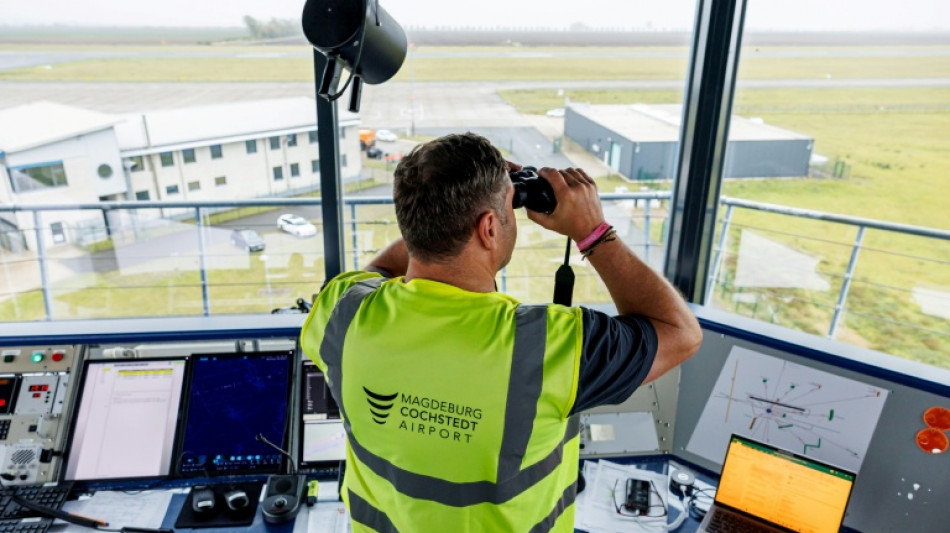
Drones flying over airports, commercial sites and other sensitive infrastructure in Europe is a growing phenomenon which EU leaders blame on Russia, and preventing the disruption they cause will prove a tough technical challenge, observers say.
Detecting the drones, making them non-operational by jamming them, or even shooting them down, are all complex and hazardous tasks. And while Russian involvement is suspected, it is difficult to prove.
Concerns are growing that such disruptions could be part of Russian hybrid war tactics three-and-a-half years into its invasion of Ukraine, as most European countries double down on their support for Kyiv including by delivering military hardware.
In early October, drones spotted over the German city of Munich twice shuttered the city's airport, with Chancellor Friedrich Merz saying "our suspicion is that Russia is behind most of these drone flights".
This followed similar incidents around airports in the Norwegian capital Oslo, Copenhagen and other Danish cities.
In France, several drones were spotted flying over the military base of Mourmelon-le-Grand in the northeast of the country earlier this week, the French military told AFP.
The drones were small and not piloted by French military personnel, the regional branch of the army said, describing the incident as "exceptional".
- 'Trying to humiliate us' -
European Commission head Ursula von der Leyen said the incidents amounted to a "coherent and escalating campaign".
"Two incidents are coincidence, but three, five, 10 -- this is a deliberate and targeted grey-zone campaign against Europe, and Europe must respond," she told EU lawmakers on Wednesday.
French forces earlier this month boarded a tanker off western France that has been linked to the mysterious drone flights.
Its captain and first mate were detained but later released, and the vessel was able to head towards the Suez Canal.
"At this stage, it's just to annoy us, it's part of the Russians' displays of hostility. They're trying to humiliate us," said a French security source, requesting not to be named.
The source emphasised that it was difficult to prove Moscow's involvement.
They said France has seen increased drone overflights of military installations, industrial sites and other sensitive locations over the past few weeks, but authorities are unsure who is controlling them.
In some cases, there could be other explanations.
At Mourmelon, a vast military site, "we could very well have a father who buys a Chinese drone that doesn't include the 'no-fly zone' in its system, who doesn't read the instructions and goes to the nearby forest for the weekend and ends up in the middle of a prohibited zone", said Thierry Berthier, scientific director of the European professional federation for security drones, Drones4Sec.
- 'Not far from confrontation' -
Whatever their origin, countering the drones is not going to be easy.
There are many sites that need to be protected -- not just civilian airports, but also military sites, sensitive industries such as those involved in European support for Ukraine, and power plants.
Jamming is an effective but potentially fraught measure in populated areas. "You risk jamming a lot of things," Berthier warned.
A drone can be shot down or intercepted with another drone, but this is risky. At the end of September, the Danish authorities decided not to shoot them down for the safety of civilians.
There are also legal constraints.
In France, "only a government agency can neutralise a drone," said the security source, meaning that a private company would not be allowed to disable a drone by jamming it.
In Germany, the government must clear up a legal limbo to allow the police to shoot down threatening drones.
Lorenzo, a French naval sailor on an exercise in the Mediterranean who did not give his last name in line with French military custom, told AFP it was "very difficult" to shoot down a drone.
He said this as he stood behind his 12.7-calibre machine gun which has a range of 900 metres (2,950 feet) and fires 500 rounds per minute.
While most European countries strongly support Ukraine, leaders including French President Emmanuel Macron have consistently stressed they are not a "belligerent" party in the conflict.
"We are no longer completely in peacetime because we are both in peacetime and not far from confrontation," Admiral Nicolas Vaujour, chief of staff of the French Navy, said Wednesday, complaining of obstacles preventing the deployment of defence resources.
"At some point, (we have to ask,) are we defending or not?"
B.Shevchenko--BTB