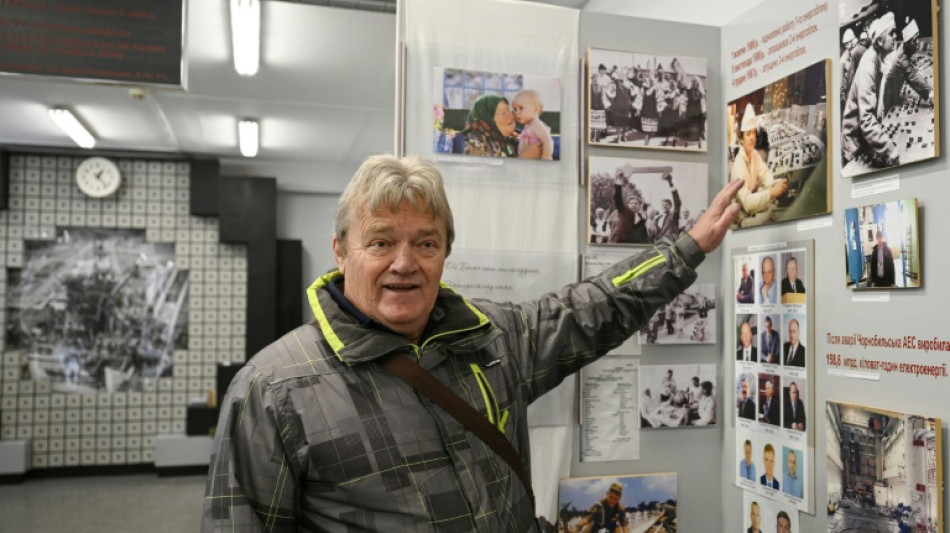
From radiation to invasion: a Chernobyl worker's two wars / Photo: © AFP

 Bid by Italy's Intesa bank to take over MPS gets boost

 Stablecoins Are Quietly Becoming Business Infrastructure, NOWPayments Data Shows
 Oil surges, stocks sink as US reportedly eyes new Iran strikes
 Woman in botched US execution walking, mentally 'foggy': lawyer
 Farhan hopes Pakistan's new combination takes off in Sri Lanka T20Is
 Teenager Andreeva seals China Open semi-final with Bartunkova
 Britain's Burnham says open to Germany joining warplane project
 Kovac's tough love has Dortmund dreaming of title charge
 China announces candidate for WHO chief

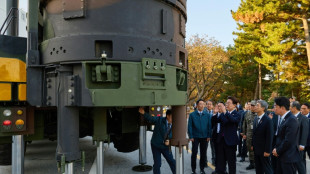 South Korea test-fires its first homegrown hypersonic weapon: presidency

 ONAR Advances Nasdaq Listing Preparation Following Advertise Purple Acquisition and Financing

 Thailand opens extradition process for reporter sought by China
 France struggles to wean social housing off gas
 Germany lifts GDP forecast as economy withstands Iran war
 Sri Lanka appoints Kusal Mendis as Test captain
 Norris confident McLaren can shine in Singapore
 Alex Bodi pushes ahead with expansion: ALIX LASERS showroom planned for Bucharest
 Fossil fuels off COP31 agenda as global output keeps rising
 Haze not 'a threat' to Singapore F1 race: organisers
 COP31 organisers say to seek 'ambitious' action with their text
 Bartunkova thrashes Muchova to reach China Open semi-finals
 Drone hits Yandex data centre, in first such attack on Russia
 Oil prices surge and stocks sink on fresh inflation worries

 AI startup Manus raises $500m after Meta acquisition blocked by China
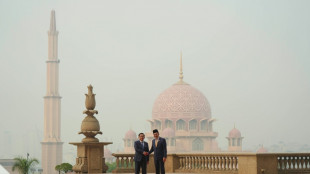 From refuge to repatriations: Malaysia's Myanmar U-turn

Nikolay Solovyov was on shift the night of April 26, 1986 when the Chernobyl nuclear power plant exploded. Instead of fleeing, he chose to fight his "first war" against radiation.
Four decades later, a second war -- Russia's invasion of Ukraine -- has taken his son.
Solovyov, 67, a hard rock fan, still wears his hair long, though it has turned grey.
On the night of the world's worst nuclear accident, he was working as a turbine mechanic in unit number two, a few hundred metres from reactor number four, which exploded during a safety test.
"It felt like an earthquake. I didn't hear the explosion -- the turbines were still running, with a very loud noise," he recalled, his voice quiet and gentle.
The alarms went off. As he rushed towards the exploded reactor, he saw one colleague badly irradiated and vomiting, another being carried out on a stretcher. The third one was slumped in his chair, head in his arms. All of them died soon after.
Only then did the full extent of the disaster become clear. Through the massive hole ripped open by the explosion, he could see "the sky." In the corridors, torrents of water poured from broken pipes.
Firefighters quickly began hosing down the smoking reactor -- "they didn't let the fire spread," Solovyov said. Almost all those firefighters later died from radiation exposure.
At dawn, he and his colleagues discussed how long they had left to live. "We'll last two weeks," said one of them.
After hearing this, Solovyov, who quit smoking five months earlier, lit up a cigarette. "Well, if I'm going to die, at least I'll die young and handsome," he recounted his thought in the moment.
- Seeking praise -
His night shift ended in the morning. The day team took over and the bus drove him back to Pripyat, the workers' town three kilometres (two miles) from the plant.
It was all quiet and business as usual, except for the roaring trucks that were spraying foamy "detergent" on the pavement. Once home, he told his wife to seal the windows.
For days, Soviet authorities hid the catastrophe from the world -- a disaster that further weakened the already crumbling USSR, which collapsed in 1991.
Solovyov stayed at the plant throughout the "liquidation" -- a massive clean-up operation in the aftermath. He later helped build the first sarcophagus covering the reactor, as well as the second one, which was damaged by a Russian drone strike in 2025.
The plant continued producing electricity until 2000 and teams still work there to ensure its safety.
Among the reasons for his decision to stay, Solovyov lists good pay, "generous holidays" and an "interesting" nature of work.
The man, who later became an engineer, believes that the "dangerous" 1986 test was pushed ahead by the plant managers for the sake of winning praise from Soviet leadership.
Hundreds of thousands of people were involved in the massive liquidation operation, which saw hundreds of thousands more evacuated from neighbouring settlements. "Only the USSR" had the resources to carry out such an effort, Solovyov believes.
Dozens of his acquaintances later died of cancer. Of the 22 men on his night shift, only four are still alive.
A 2005 UN report put the number of confirmed and projected deaths at 4,000 in Russia, Belarus and Ukraine. Greenpeace in 2006 estimated that the disaster had caused close to 100,000 deaths.
- 'The other war' -
Solovyov, who received high doses of radiation and has undergone countless medical checks, attributes his longevity to good health, regular sport, a calm temperament and genetics.
"I have to thank God and my parents for giving me good genes," he said.
He now lives in a country house near Slavutych, a town 120 kilometres (70 miles) north of Kyiv, built in 1986 to house people displaced by the disaster.
In the local Chernobyl museum, wreckage from downed Russian drones is displayed in the main hall. "That's the other war," Solovyov said quietly.
Standing on the windswept central square of Slavutych, he said that his first, "nuclear" war was against an invisible, odourless poison.
"When people here say 'before the war' or 'after the war,' they mean April 26, 1986," he said. "And now, as people put it, this is already the second war of our generation."
On the night of February 23-24, 2022, Solovyov set out for the plant as usual. But he never reached it: the two bridges leading there had been destroyed. Russian forces seized Chernobyl and occupied the site for a month.
His youngest son joined the Ukrainian army. In September 2023 he was reported missing in action.
Devastated, Solovyov could no longer find the strength to work and took early retirement.
J.Fankhauser--BTB