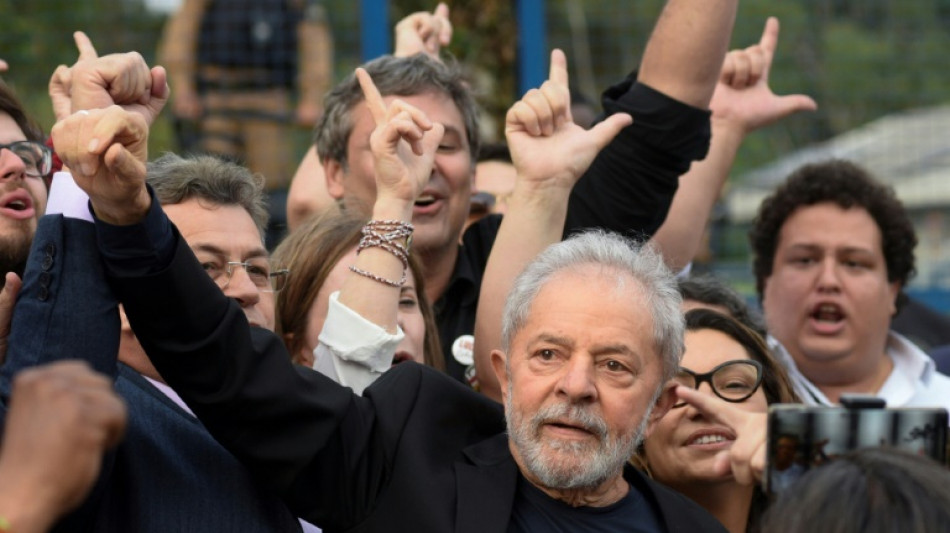
Brazil's youngest voters betting on 76-year-old candidate / Photo: © AFP/File

 UEFA set to withdraw FIFA boycott threat ahead of Champions League draw
 Sumo moves to beat Japan summer heat as temperatures rise
 'Be more honest': Markets crave clarity from cryptic Fed chair

 Climate change leaves its mark on America's largest reservoir
 CIA director warned Russia not to attack NATO members: US media

 Search for missing after Nepal-Tibet floods kills at least 160
 Meta, US states agree $18 bn settlement in landmark teen safety case

 What scientists know so far about Nepal's deadly floods
 US general visits Colombia to discuss war on drugs

 Meta settlement puts social media industry on notice: 'There will be more'

 NFL owners approve record Seahawks sale

 Nigerian armed groups net nearly $6 mn in ransoms: study

 Savio scores on debut as Spurs advance in League Cup

 Mbappe hits treble as Real Madrid thrash Real Sociedad

 At Dollywood, superfans honor the late singer and local hero
 Stocks mixed as oil drops, US inflation stays high

 Bolivia's Paz appoints new economy minister amid bailout talks

 US designates UK-based Palestine Action as foreign 'terrorist group'

 'Rocky Horror Picture Show' star Tim Curry dead at 80

 American Moll wins women's pole vault at Zurich city event
 As Canada takes on US tariffs, what's behind the David and Goliath fight?

 UEFA 'likely' to drop threat to boycott FIFA tournaments: source

 US disrupts platforms allegedly used by Chinese hackers

 The foreign tourists missing in Nepal's flash floods

 Hundreds missing after Nepal-Tibet flood kills 98
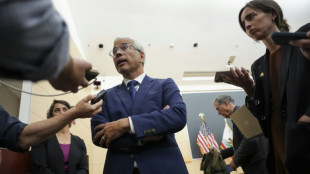
At a samba bar in Rio de Janeiro, three university students are engaged in a vigorous political debate as they count down the days to Brazil's presidential elections.
Their preference? "We are seated in an 'L'" for Lula, Letizia Corvello, a 22-year-old law student, told AFP.
Brazil's youngest voters are staking their future on the oldest of the two frontrunners: 76-year-old leftist Luiz Inacio Lula da Silva, who is hoping for a comeback 12 years after leaving office at the end of two successive presidential terms.
Lula has a strong lead in the polls over far-right incumbent Jair Bolsonaro, 67. The men face off in a first voting round on Sunday.
"The last thing I want is for Jair Bolsonaro to be re-elected," said Corvello.
"We need to fight for our future and for that of the university" where she studies.
Young people have led the anti-Bolsonaro movement in Brazil with protests against his cuts to education spending, his management of the coronavirus epidemic, and police violence.
"Some of the environmental issues, the destruction of the Amazon and just the... egregious policies of Bolsonaro are of concern to a lot of especially younger people," analyst Michael Shifter of the Inter-American Dialogue think tank told AFP.
And they seem to be putting their money where their mouths are.
More than 2.1 million people aged 16 and 17 -- about a fifth in this age group -- have registered to vote ahead of Sunday's first election round -- a 51-percent jump from 2018.
Voting is optional for Brazilians aged 16 and 17, and compulsory from 18 up.
- 'Existential zombies' -
The 2022 youth registration numbers "are unprecedented in the history of Brazil," political scientist Marco Antonio Teixeira of the Getulio Vargas Foundation told AFP.
Under Bolsonaro, young people seem to have learned the importance of having a political voice, he said.
Youths "suffered a lot with the pandemic, (they were) the most affected by unemployment," said Teixeira.
Bolsonaro and his government also managed to repeatedly offend the sensibilities of a younger generation that values respect for cultural and gender diversity.
A case in point: in an address in 2020, Bolsonaro's then education minister Milton Ribeiro referred to young people as "existential zombies" who "no longer believe in anything, from God to politics."
"I never imagined there were still people with such a retrograde beliefs," said Corvello in response.
"Bolsonaro made it possible for people to go out on the street to defend violence and discrimination."
- Lula's legacy -
Polls show 52 percent of voters aged 16 to 24 opting for Lula, compared to 32 percent for Bolsonaro.
Some were not yet born during Lula's last term, others were mere infants, but they all know about Lula's educational legacy: increasing scholarships and introducing quotas to help people from racial and socio-economic minorities gain access to good schools.
"Everyone knows what Lula did," said Adrianny Brasil, 22, a resident of the Mare de Rio slum complex where school attendance depends on there being no shootings and university is an unattainable dream for most.
"I am the only 'favelada' (slum-dweller) in my (university) physics course, all the other students are from the elitist areas of Rio, like Ipanema," said Brasil, who hopes there will be more like her under a new Lula government.
Not everyone is in agreement.
Mateus de Medeiros, an 18-year-old mechanical engineering student, regrets that the choice is limited to "the extreme right or the extreme left".
"I wish there was another candidate and we didn’t have to vote for one just to exclude the other," he told AFP.
Bolsonaro also has ardent supporters among the youth.
Gabriel Lira, a 22-year-old Afro Brazilian who works as a store employee, believes many university students are victims of brainwashing by "leftist professors."
"If they were better informed, they would see that (Lula) resembles Maduro and the left-wing dictators," he told AFP at Campinas on the outskirts of Sao Paulo, referring to Venezuelan President Nicolas Maduro.
And he denied Bolsonaro was racist, despite having once said about a community of Black slave descendents: "They don't do anything. They're no use even to procreate."
"It was an unfortunate statement. But if he really was (racist) he'd be capturing Black people and putting them back into slavery," said Lira.
J.Fankhauser--BTB