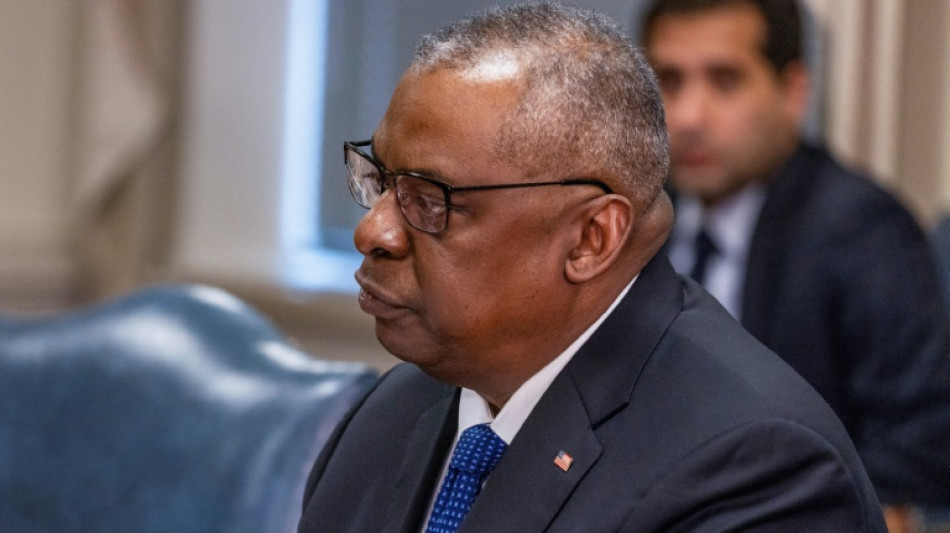
US defense chief vows to help Taiwan defend itself / Photo: © GETTY IMAGES NORTH AMERICA/AFP

 Once a top export, prized Kashmir carpet fades

 Search for 1,000 missing after deadly Nepal-Tibet floods
 Park So-yeon first woman to play for eSports powerhouse South Korea
 Yayoi Kusama: Japan's kaleidoscopic, troubled 'polka dot queen'

 Euro champ Hunt 'on her toes' against world's best in Zurich 100m
 Asian chip firms lifted by Nvidia forecast but broader markets struggle
 Search for missing after Nepal-Tibet floods kill 165
 Qantas says profits slump as fuel costs surge
 Lofty bond yields, Bessent's intervention pose challenge to Fed's Warsh
 The foreigners missing in Nepal's flash floods
 Bond yields are surging: Here's why that could spell trouble

 Fed's Cook rejects Trump mortgage fraud claims
 Police probe 'assault allegations' after Carse's nightclub incident
 How we might hear new Dolly Parton music in the future
 Nvidia doubles revenue, forecasts even more AI spending
 Canada renews push to boycott US products
 Savio scores on debut as Spurs set-up League Cup tie with Liverpool

 Brazil sues Discord over child safety measures, demands $100 mln in damages

 Alberta NDP Urges Smith to Postpone Separation Vote Amid Trade War

 Fenerbahce stun Lyon in Champions League as AEK crush Levski

 Why Global Finance Still Relies on Wall Street Despite Diversification Trends
 Bethlehem Father Seeks Aid for Special Needs Children Amid Health Crisis
 LIV Golf to lay off majority of staff
 How narwhal 'scientists' track Arctic warming
 Iran says US sanctions will achieve nothing

The United States will help Taiwan "develop the capability to defend itself" from a Chinese invasion, Defense Secretary Lloyd Austin said on Sunday, stopping short of President Joe Biden's vow to send troops to the island.
"We're committed to helping Taiwan develop the capability to defend itself," Austin said in an interview with CNN.
Washington has historically maintained a policy of "strategic ambiguity" on whether it would intervene militarily if Taiwan were attacked by China.
Asked in an interview with CBS last month whether US troops would defend Taiwan, Biden said "yes," if it were "an unprecedented attack."
Austin was asked by CNN host Fareed Zakaria whether the US military was preparing to send troops to Taiwan in line with Biden's comments, but he declined to answer directly.
"The American military is always prepared to protect our interests and live up to our commitments. I think the president was clear in providing his answers as he responded to a hypothetical question," Austin said.
"But, again, we continue to work to make sure that we have the right capabilities in the right places to ensure that we help our allies maintain a free and open Indo-Pacific," he said.
Washington's "strategic ambiguity" is designed both to ward off a Chinese invasion and to discourage Taiwan from provoking Beijing by formally declaring independence.
Asked if Biden's comments meant a change in that policy, a White House spokesperson said at the time: "The president has said this before, including in Tokyo earlier this year. He also made clear then that our Taiwan policy hasn't changed. That remains true."
During a visit to Japan in May, Biden was asked whether he would commit US troops to Taiwan and he said "yes."
"That's the commitment we made," he added.
Austin told CNN he saw no "imminent threat" of a Chinese invasion of Taiwan.
But increased military activity on the Taiwan Strait showed that Beijing was moving to establish "a new normal," he said.
Washington cut formal diplomatic relations with Taiwan in 1979, switching recognition to Beijing as the sole representative of China. But at the same time, the US maintained a decisive, if delicate role in supporting Taiwan.
Under a law passed by Congress, the US is required to sell Taiwan military supplies to ensure its self-defense against Beijing's vastly larger armed forces.
K.Thomson--BTB