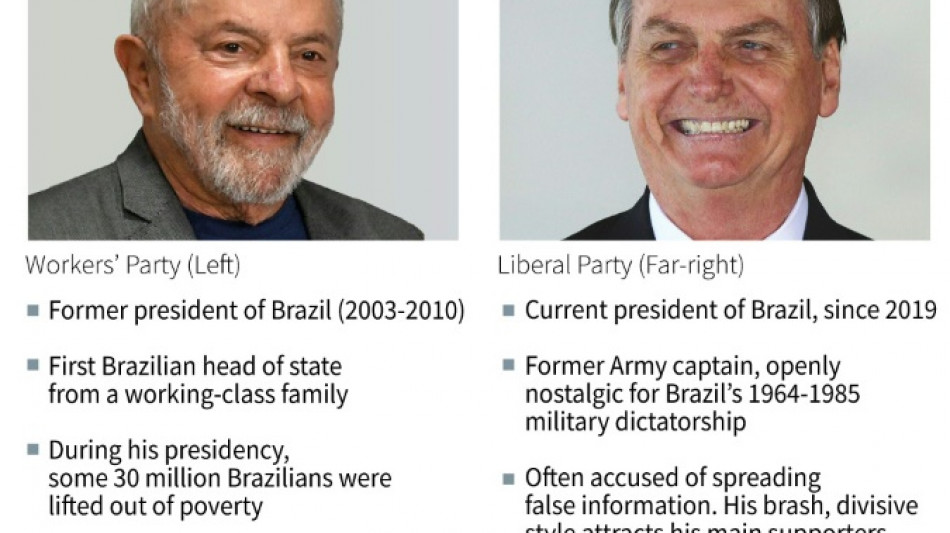
In Brazil election, opinion polls the 'biggest loser' / Photo: © AFP

 Once a top export, prized Kashmir carpet fades

 Search for 1,000 missing after deadly Nepal-Tibet floods

 Park So-yeon first woman to play for eSports powerhouse South Korea

 Yayoi Kusama: Japan's kaleidoscopic, troubled 'polka dot queen'
 Euro champ Hunt 'on her toes' against world's best in Zurich 100m

 Asian chip firms lifted by Nvidia forecast but broader markets struggle
 Search for missing after Nepal-Tibet floods kill 165

 Qantas says profits slump as fuel costs surge
 Lofty bond yields, Bessent's intervention pose challenge to Fed's Warsh

 The foreigners missing in Nepal's flash floods
 Bond yields are surging: Here's why that could spell trouble
 Fed's Cook rejects Trump mortgage fraud claims
 Police probe 'assault allegations' after Carse's nightclub incident
 How we might hear new Dolly Parton music in the future
 Nvidia doubles revenue, forecasts even more AI spending
 Canada renews push to boycott US products
 Savio scores on debut as Spurs set-up League Cup tie with Liverpool

 Brazil sues Discord over child safety measures, demands $100 mln in damages
 Alberta NDP Urges Smith to Postpone Separation Vote Amid Trade War
 Fenerbahce stun Lyon in Champions League as AEK crush Levski

 Why Global Finance Still Relies on Wall Street Despite Diversification Trends
 Bethlehem Father Seeks Aid for Special Needs Children Amid Health Crisis
 LIV Golf to lay off majority of staff
 How narwhal 'scientists' track Arctic warming
 Iran says US sanctions will achieve nothing
Following a trend in recent years of underestimating voter support for Brexit and Donald Trump, opinion polls in Brazil were way off the mark for Sunday's first round of presidential elections.
Incumbent Jair Bolsonaro and many of his far-right allies mustered results much better than pollsters had predicted, catching analysts off guard and shocking supporters of his leftist rival Luiz Inacio Lula da Silva.
"The biggest loser (of Sunday's election) are all the polls," Latin America analyst Michael Shifter of the Inter-American Dialogue think tank told AFP.
- What were the poll predictions? -
Lula amassed 48 percent of the votes cast on Sunday -- within the margin of error of plus or minus two percentage points worked in by pollsters Datafolha and Ipec.
Both had put Lula within arm's reach of taking the election in the first round -- with a prediction of 50 percent of valid votes cast by Datafolha, and 51 percent by Ipec.
Bolsonaro's result came completely out of left field. He managed 43 percent of votes compared to 36 percent predicted by Datafolha.
Instead of a predicted 14-point handicap, he lagged Lula by only five points, or about six million votes.
There was a similar trend for some of Bolsonaro's rightwing allies.
Rio de Janeiro Governor Claudio Castro won reelection in the first round with 58 percent of votes compared to polling expectations of 44 to 47 percent.
And in Sao Paulo, Tarcisio de Freitas entered the gubernatorial runoff race in the lead with 42 percent -- 11 points higher than he had been polled.
- What went wrong? -
Analysts are scratching their heads: was it a last-minute Bolsonaro surge among undecided or opposition voters, or is it that polling institutes with a hitherto reliable reputation have somehow lost the ability to accurately predict voter intention?
"We don't know if Bolsonaro made real advances or whether he already had this support" that polls failed to capture, Leandro Gabiati, director of the Dominium consultancy, told AFP.
According to Mayra Goulart of the Federal University of Rio de Janeiro, there has been an "information blackout" in Brazil due to a pandemic-induced, two-year delay in the population census, held every 10 years.
This may have affected the accuracy of pollsters' population sampling especially in influential segments such as evangelicals -- a growing and right-leaning section of Brazilian society.
"It is likely that the 2022 census will correct some of these inconsistencies for future elections," said Guilherme Casaroes, a political scientist at the Getulio Vargas Foundation.
- Consequences -
"It will definitely hurt the credibility of analysis" by the media and experts such as himself, said Leonardo Paz, Brazil consultant for the International Crisis Group think tank.
"Right now it is more difficult to make analysis because... the numbers are not credible anymore."
The discrepancy between the prediction and Sunday's outcome posed a "big problem for the (polling) institutes and for democracy itself," added Dominium's Gabiati.
"Polls are an important part of the electoral process and it is terrible for democracy that this aspect is called into question."
Bolsonaro has long sought to cast doubt on the accuracy of polls, which he claims work for the left, and could now use this "proof" to further whip up anti-Lula sentiment ahead of the all-important October 30 presidential runoff.
"We defeated the opinion polls' lie," he crowed on Sunday.
For Goulart, this could bolster the Bolsonaro-led negationist discourse.
"Calling into question electoral polls in a context of far-right populism is also to call into question science and reliable sources of information, including the media," she said.
Bolsonaro's congressman son Eduardo said Monday he would collect signatures to open a parliamentary committee investigation into polling companies over the discrepancies.
"Polling agencies will have to reinvent themselves," said Casaroes.
S.Keller--BTB