North Korea fires intermediate-range ballistic missile over Japan / Photo: © AFP

 Once a top export, prized Kashmir carpet fades

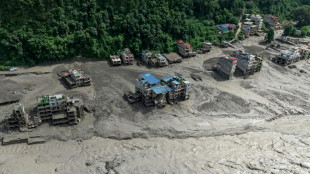
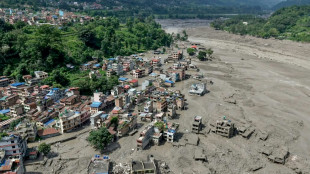
 Search for 1,000 missing after deadly Nepal-Tibet floods
 Park So-yeon first woman to play for eSports powerhouse South Korea
 Yayoi Kusama: Japan's kaleidoscopic, troubled 'polka dot queen'

 Euro champ Hunt 'on her toes' against world's best in Zurich 100m
 Asian chip firms lifted by Nvidia forecast but broader markets struggle

 Search for missing after Nepal-Tibet floods kill 165

 Qantas says profits slump as fuel costs surge

 Lofty bond yields, Bessent's intervention pose challenge to Fed's Warsh
 The foreigners missing in Nepal's flash floods

 Bond yields are surging: Here's why that could spell trouble
 Fed's Cook rejects Trump mortgage fraud claims

 Police probe 'assault allegations' after Carse's nightclub incident
 How we might hear new Dolly Parton music in the future

 Nvidia doubles revenue, forecasts even more AI spending

 Canada renews push to boycott US products

 Savio scores on debut as Spurs set-up League Cup tie with Liverpool

 Brazil sues Discord over child safety measures, demands $100 mln in damages

 Alberta NDP Urges Smith to Postpone Separation Vote Amid Trade War

 Fenerbahce stun Lyon in Champions League as AEK crush Levski

 Why Global Finance Still Relies on Wall Street Despite Diversification Trends

 Bethlehem Father Seeks Aid for Special Needs Children Amid Health Crisis

 LIV Golf to lay off majority of staff

 How narwhal 'scientists' track Arctic warming

 Iran says US sanctions will achieve nothing

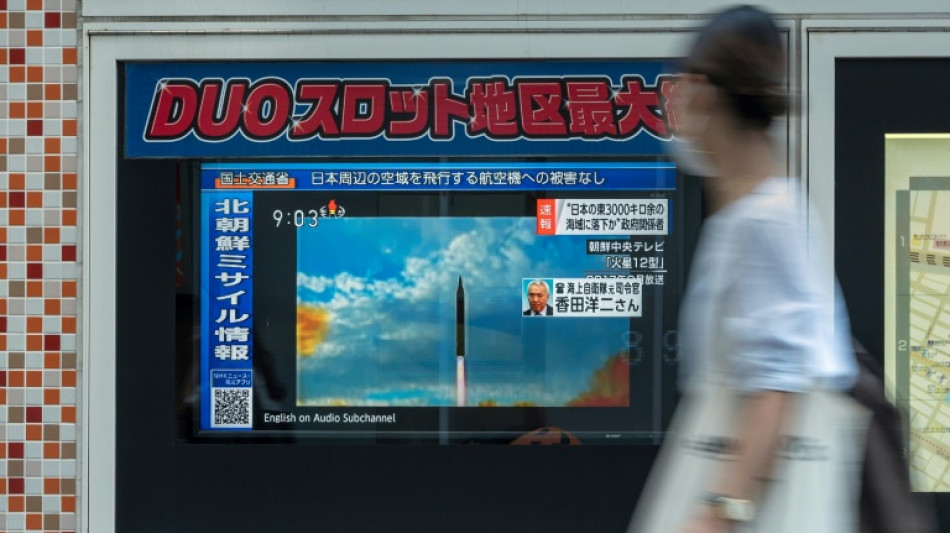
North Korea fired an intermediate-range ballistic missile (IRBM) over Japan on Tuesday, prompting Tokyo to activate the country's missile alert system and order people to take shelter.
The last time North Korea fired a missile over Japan was in 2017, at the height of a period of "fire and fury" when Pyongyang's leader Kim Jong Un traded insults with then-US president Donald Trump.
South Korea's military said it had detected the launch of an IRBM, which flew around 4,500 km (2800 miles) at an altitude of about 970 km and speeds of around Mach 17.
"Specific details are under close analysis by South Korean and US intelligence," the South's Joint Chiefs of Staff added in a statement.
South Korea's President Yoon Suk-yeol called the launch a "provocation" that violated UN regulations
Yoon "ordered a stern response and to take corresponding measures in cooperation with the United States and the international community", his office said in a statement.
Tokyo also confirmed the launch of an IRBM, activating the country's missile alert warning system and urging people to take shelter.
"North Korea appears to have launched a missile. Please evacuate into buildings or underground," the government said in an alert issued at 7:29 am (2229 GMT Monday).
National broadcaster NHK said the alert was in effect for two northern regions of the country.
"A ballistic missile is believed to have passed over our country and fallen in the Pacific Ocean. This is an act of violence following recent repeated launches of ballistic missiles. We strongly condemn this," Prime Minister Fumio Kishida told reporters.
Defence Minister Yasukazu Hamada said that North Korea "has in the past launched Hwasong 12-type missiles four times, so this could be the same type".
If so, the flight distance, which Tokyo estimated at 4,600 km, was thought to be a new record for that particular missile.
The last two times North Korea fired Hwasong-12 missiles over Japan, in September and August 2017, they travelled 2,700 km and 3,700 km respectively, Chad O'Carroll of Seoul-based specialist site NK News wrote on Twitter.
"This is the 8th test of the Hwasong-12 and the 3rd time it has overflown Japan," Jeffrey Lewis of the Middlebury Institute of International Studies wrote on Twitter.
- Military drills -
With talks long-stalled, nuclear-armed North Korea has doubled down on Kim's military modernisation plans this year, testing a string of banned weaponry, including an intercontinental ballistic missile (ICBM) for the first time since 2017.
Last week, Pyongyang fired short-range ballistic missiles on four occasions, including just hours after US Vice President Kamala Harris flew out of Seoul.
The latest bout of intense weapons testing by Pyongyang comes as Seoul, Tokyo and Washington ramp up joint military drills to counter growing threats from the North.
South Korea, Japan and the United States staged anti-submarine drills Friday -- the first in five years -- just days after Washington and Seoul's navies conducted large-scale exercises in waters off the peninsula, involving a nuclear-powered US aircraft carrier.
Such drills infuriate North Korea, which sees them as rehearsals for an invasion.
Harris toured the heavily fortified Demilitarized Zone that divides the peninsula while on a trip that aimed to underscore her country's "ironclad" commitment to South Korea's defence against the North.
Washington has stationed about 28,500 troops in South Korea to help protect it from the North.
- Significant escalation -
"If Pyongyang has fired a missile over Japan, that would represent a significant escalation over its recent provocations," said Leif-Eric Easley, a professor at Ewha University in Seoul.
"Pyongyang is still in the middle of a provocation and testing cycle," he added.
"The Kim regime is developing weapons such as tactical nuclear warheads and submarine-launched ballistic missiles as part of a long-term strategy to outrun South Korea in an arms race and drive wedges among US allies."
South Korean and US officials have also been warning for months that Kim was preparing to conduct another nuclear test.
The officials said they believed this could happen soon after China's upcoming party congress on October 16.
North Korea, which is under multiple UN sanctions for its weapons programmes, typically seeks to maximise the geopolitical impact of its tests with careful timing.
The isolated country has tested nuclear weapons six times since 2006, most recently in 2017.
W.Lapointe--BTB