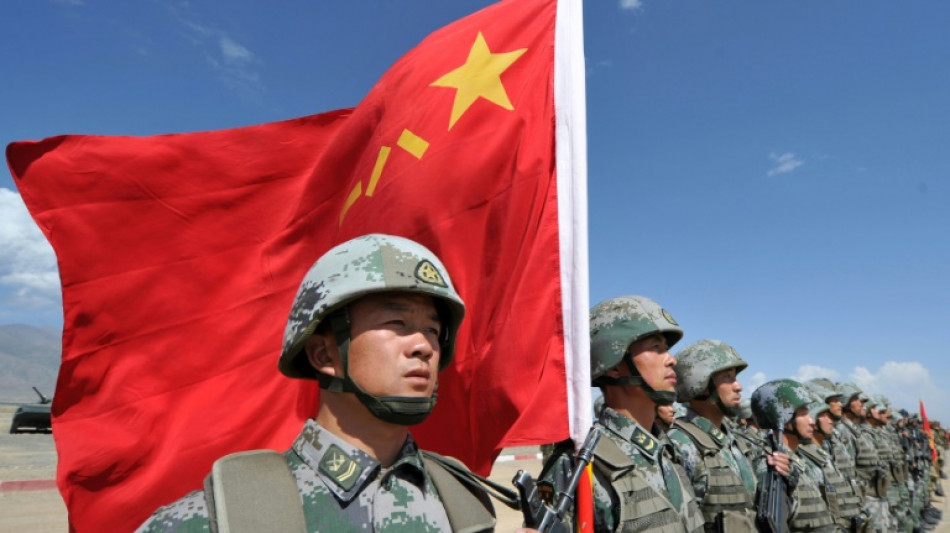
Xi decade reshapes China's military, and the region / Photo: © AFP/File

 Palace intrigue in Uganda as succession battle heats up
 'Housing First' approach gets Swedish city's homeless off streets

 Czech duo Muchova and Mensik win US Open mixed doubles title
 Japan's 'polka dot queen' artist Yayoi Kusama dies aged 97

 Nepal-Tibet disaster: what we know

 China deploys record number of ships around Taiwan as pressure grows

 Ruthless Bayern target treble as rivals reboot on Bundesliga return

 What experts know so far about Nepal's deadly floods

 UEFA set to withdraw FIFA boycott threat ahead of Champions League draw

 Sumo moves to beat Japan summer heat as temperatures rise
 'Be more honest': Markets crave clarity from cryptic Fed chair
 Climate change leaves its mark on America's largest reservoir
 CIA director warned Russia not to attack NATO members: US media

 Search for missing after Nepal-Tibet floods kills at least 160

 Meta, US states agree $18 bn settlement in landmark teen safety case

 What scientists know so far about Nepal's deadly floods

 US general visits Colombia to discuss war on drugs

 Meta settlement puts social media industry on notice: 'There will be more'
 NFL owners approve record Seahawks sale

 Nigerian armed groups net nearly $6 mn in ransoms: study

 Savio scores on debut as Spurs advance in League Cup

 Mbappe hits treble as Real Madrid thrash Real Sociedad

 At Dollywood, superfans honor the late singer and local hero

 Stocks mixed as oil drops, US inflation stays high

 Bolivia's Paz appoints new economy minister amid bailout talks
During Xi Jinping's decade-long rule, China has built the world's largest navy, revamped the globe's biggest standing army, and amassed a nuclear and ballistic arsenal to trouble any foe.
With China's neighbours now rushing to keep pace, Xi's next five-year term is likely to see a quickening Asia-Pacific arms race.
From South Korea developing a blue-water navy to Australia buying nuclear-powered submarines, weapons shopping has surged across the region.
According to figures from the London-based International Institute for Strategic Studies, Asia-Pacific defence spending passed $1 trillion last year alone.
China, the Philippines and Vietnam have roughly doubled spending in the last decade. South Korea, India and Pakistan are not far behind.
Even Japan is proposing record defence budgets and inching towards ending its long-standing "no first strike" policy, citing an "increasingly severe" security environment.
"All the key players in the Indo-Pacific region are responding to China's military modernisation, basically as fast as they can," said Malcolm Davis, a former Australian defence official now with the Australian Strategic Policy Institute.
- Paper tiger no more -
For years, the People's Liberation Army was seen as ill-equipped and ineffective -- disparaged by one historian as "the world's largest military museum".
It was kitted out with ageing Soviet-derived weaponry, riddled with corruption and was a predominantly infantry force with a less-than-stellar record in foreign campaigns.
The PLA's participation in the Korean War cost almost 200,000 Chinese lives. A 1979 invasion of Vietnam cost tens of thousands more and has been mostly airbrushed from official histories.
When Xi became commander-in-chief of the PLA in 2013, some reforms were already under way.
They began in the 1990s, when Jiang Zemin was shocked and awed into action by US military prowess during the Gulf War and the Third Taiwan Strait Crisis.
But "it wasn't really until Xi Jinping came in that that effort started translating to capability", strategic consultant Alexander Neill told AFP.
The PLA had then just launched its first aircraft carrier, the Liaoning -- a refurbished Ukrainian ship -- and the J-15 multi-role fighter aircraft, based on a Sukhoi prototype.
Beijing's military budget has now increased for 27 consecutive years, according to the Stockholm International Peace Research Institute.
- 'Only competitor' -
Today, China boasts two active aircraft carriers, hundreds of long- and intermediate-range ballistic missiles, thousands of warplanes and a navy surpassing even the United States's.
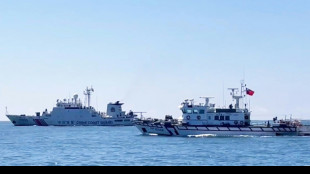
After China launched a brief and partial blockade of Taiwan in August, a top US military officer tacitly conceded that preventing the real thing would not be easy, even for Washington.
"They have a very large navy, and if they want to bully and put ships around Taiwan, they very much can do that," Seventh Fleet commander Karl Thomas told US media.
Meanwhile, China's nuclear stockpile is increasing exponentially and -- according to the Pentagon -- can probably now be launched from land, sea and air, echoing the US nuclear triad.
According to the Bulletin of the Atomic Scientists, China has about 350 nuclear warheads, double the amount held during the Cold War.
US intelligence predicts that this stockpile may double again to 700 by 2027. New nuclear missile silos are being built in the northwest of the country.
Washington has pulled no punches in describing the scale of might and ambition held by the People's Republic of China.
"The PRC is the only competitor capable of combining its economic, diplomatic, military, and technological power to mount a sustained challenge to a stable and open international system," a Pentagon report last year said.
"Beijing seeks to reshape the international order to better align with its authoritarian system and national interests."
As much as any hardware, it is this perceived global intent that has spooked China's neighbours.
- Xi's 'huge favour' -
Many of the big-ticket military projects around the region plainly have deterrence in mind -- whether it is thwarting the "little blue men" of Beijing's naval militias or a conventional attack.
South Korea plans to develop naval power capable of operating far from coastal waters, which experts say has little to do with the threat from rapidly arming North Korea.
Australia plans to acquire eight nuclear submarines -- which can stay underwater for extended periods and launch retaliatory strikes -- with British and American help, part of the so-called AUKUS agreement.
There is also discussion in Canberra about obtaining hypersonic weapons, longer-range ballistic missiles and even state-of-the-art B-21 stealth bombers, capable of striking anywhere in the world virtually undetected.
For Davis, all of these projects point to a realisation that China increasingly has the power to shape the region to its will.
"The days of the US Navy dominating the seas in the Western Pacific are fast approaching an end," he said, and Asia-Pacific allies are beefing up their own defences accordingly.
"We wouldn't have had AUKUS if it wasn't for Xi Jinping. He's done us a huge favour in that sense."
E.Schubert--BTB