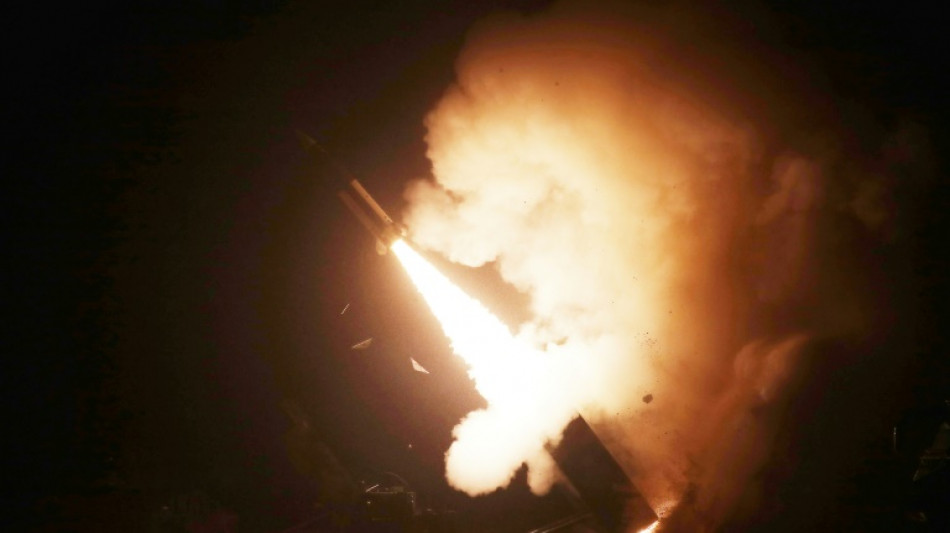
South Korea, US fire missiles in response to North Korea test / Photo: © South Korean Defence Ministry/AFP

 Palace intrigue in Uganda as succession battle heats up
 'Housing First' approach gets Swedish city's homeless off streets

 Czech duo Muchova and Mensik win US Open mixed doubles title

 Japan's 'polka dot queen' artist Yayoi Kusama dies aged 97

 Nepal-Tibet disaster: what we know

 China deploys record number of ships around Taiwan as pressure grows

 Ruthless Bayern target treble as rivals reboot on Bundesliga return

 What experts know so far about Nepal's deadly floods

 UEFA set to withdraw FIFA boycott threat ahead of Champions League draw

 Sumo moves to beat Japan summer heat as temperatures rise
 'Be more honest': Markets crave clarity from cryptic Fed chair

 Climate change leaves its mark on America's largest reservoir
 CIA director warned Russia not to attack NATO members: US media

 Search for missing after Nepal-Tibet floods kills at least 160

 Meta, US states agree $18 bn settlement in landmark teen safety case

 What scientists know so far about Nepal's deadly floods

 US general visits Colombia to discuss war on drugs

 Meta settlement puts social media industry on notice: 'There will be more'

 NFL owners approve record Seahawks sale

 Nigerian armed groups net nearly $6 mn in ransoms: study

 Savio scores on debut as Spurs advance in League Cup

 Mbappe hits treble as Real Madrid thrash Real Sociedad

 At Dollywood, superfans honor the late singer and local hero

 Stocks mixed as oil drops, US inflation stays high

 Bolivia's Paz appoints new economy minister amid bailout talks

The South Korean and US militaries fired a volley of missiles into the sea in response to North Korea firing a ballistic missile over Japan, Seoul said Wednesday, as global condemnation mounted over Pyongyang's likely longest-ever test.
Nuclear-armed North Korea fired an Intermediate-Range Ballistic Missile (IRBM) over Japan for the first time in five years on Tuesday, prompting Tokyo to issue evacuation warnings for some residents.
South Korea and the United States staged a drill of their own in response, firing ground-to-ground missiles into the East Sea, also known as the Sea of Japan, Seoul's military said.
Both militaries fired two ATACMS short-range ballistic missiles into the water "to precisely strike a virtual target," the Joint Chiefs of Staff said.
The military also confirmed that a South Korean missile failed soon after it was launched and crashed, without causing any casualties.
South Korean and US fighter jets had carried out a bombing drill at a virtual target in the Yellow Sea on Tuesday.
The joint drills aim to "make sure that we have the military capabilities at the ready to respond to provocations by the North if it comes to that," US National Security Council spokesman John Kirby told CNN.
South Korea's military also announced Wednesday that the nuclear-powered USS Ronald Reagan aircraft carrier would return to the area, having already conducted joint drills with Seoul's navy last month.
Pyongyang's Tuesday launch is part of a record year of sanctions-busting weapons tests by the isolated regime, which recently revised its nuclear laws, with leader Kim Jong Un declaring his country an "irreversible" nuclear power.
US President Joe Biden and Japanese Prime Minister Fumio Kishida decried the launch "in the strongest terms" while South Korean President Yoon Suk-yeol called it a "provocation".
The United Nations Security Council was set to meet on Wednesday to discuss the matter.
The IRBM flew about 4,600 km (2,900 miles), Seoul and Tokyo said, likely the longest-ever distance for a North Korean test, which are typically fired on a "lofted" trajectory to avoid flying over neighbouring countries.
Officials and experts said it was likely a Hwasong-12 IRBM, a nuclear-capable missile that North Korea likely first tested in 2017, which has a range that could put US bases on Guam within reach.
North Korea has not commented on the launch in state media.
- 'Ridicule' response -
"Regardless of today's missile launch by the US and South Korean military, North Korea's plan to carry out its next nuclear test will not change," Yang Moo-jin, a professor at the University of North Korean Studies, told AFP.
"It's likely that Pyongyang's going to ridicule today's missile launch -- especially since one of the launches failed -- and proceed with their next nuclear test, given the law changes they made on the nuclear use in September."
The Tuesday test was Pyongyang's fifth missile launch in 10 days.
The spate of launches comes as Seoul, Tokyo and Washington have been ramping up joint military drills to counter Pyongyang's growing threats, staging the first trilateral anti-submarine drills in five years on Friday.
That came just days after the US and South Korean navies conducted large-scale exercises.
Such drills infuriate North Korea, which sees them as rehearsals for an invasion.
US Vice President Kamala Harris visited Seoul last week and toured the heavily fortified Demilitarized Zone that divides the Korean peninsula, on a trip to underscore her country's commitment to South Korea's defence.
About 28,500 US troops are stationed in South Korea to help protect it from the North.
Pyongyang has tested nuclear weapons six times since 2006, most recently in 2017.
F.Pavlenko--BTB