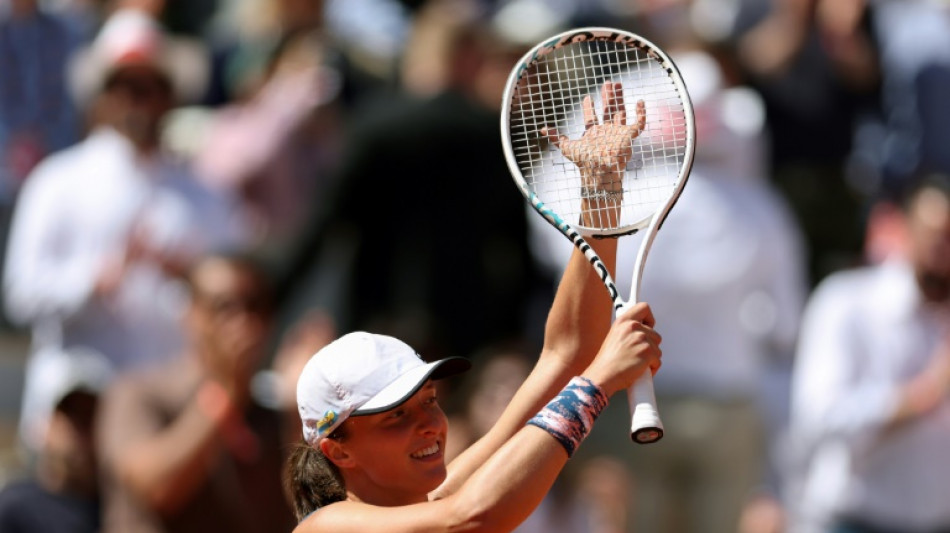
Swiatek grew up a 'fighter' on Warsaw's tennis courts / Photo: © AFP

 Freshways milk-price cut deepens pressure on UK dairy farms

 Labour and National remain virtually tied as New Zealand vote count advances

 The Good Daughter adapts Karin Slaughter thriller with Rose Byrne and Meghann Fahy

 Heavy-lift drone evacuates wounded Ukrainian soldier from frontline kill zone
 Morrison says West Brom recovered after pressure from successive derby losses

 Britain considers 2027 state visit for Ukraine’s Zelensky
 Udinese Falls to Last Place in Serie A After Loss to Venezia

 BSG Chemie Leipzig Defeated by Regionalliga Leaders Rot-Weiß Erfurt

 Trump and Vance Pursue Secret Diplomacy with Iran Amid Military Pressure
 Inside SFFILM’s Operations: Jordan Menashe on Managing Doc Stories Logistics
Iga Swiatek, the world number one who on Saturday could win her second French Open title, has displayed a fighting spirit since her early days hammering balls on Warsaw's tennis courts.
"She was a little kid who really wanted to learn how to play as quickly as possible, and once she did, what mattered most to her was winning," said Artur Szostaczko, her first coach.
"She was a fighter... I knew that if it went to a super tiebreak, there was no need to worry -- Iga wouldn't crack under the pressure," the 51-year-old told AFP.
Szostaczko still teaches on the clay court where the Polish phenomenon first picked up a racket and tried her hand at hitting against a concrete wall during her older sister's lesson.
"Left, right, the whole time she was running about having a ball," he said by the wall covered in colourful graffiti at the Warszawianka tennis club.
"Normally a small child has trouble hitting even one or two balls but she could keep it going for dozens of shots," added the coach, who like Swiatek, always has a baseball cap on his head.
Szostaczko taught the talented sisters -- whose father Tomasz is an Olympic rower -- for five years, until Swiatek was 10 years old.
Fast forward a decade and Swiatek is at the top of women's tennis, already with one Roland Garros title under her belt in 2020 and a current unbeaten streak of 34 matches.
The 21-year-old will equal Venus Williams' record for the longest women's winning run since 2000 if she beats Coco Gauff in the final on Saturday.
Szostaczko said he is proud of his former student, whom he remembers as a fun child in pigtails running around with phenomenal coordination and a smile on her face.
"I taught her to play aggressive, because that's the future of tennis, and today she's doing an incredible job of it on court," he said.
- Swiatek sisters -
The siblings moved on to coach Michal Kaznowski, then at the Mera tennis club, who recalled Swiatek always wanting to be treated on an equal footing with her hard-working big sister.
"Iga got really mad at me because I proposed some basic drill where I would feed Agata eight balls but only six to Iga because she was younger," he told AFP.
"That made her angry. She went to her dad and said she wants just as many as Agata," the 35-year-old said, calling theirs a "healthy sibling rivalry".
He said Agata was just as talented and had the advantage of being taller but that injuries dashed any chance of what could have been Poland's answer to the Williams sisters.
The younger Swiatek continued to train under Kaznowski until she was 15.
He said they were inspired by the now-famous line from an 11-year-old Serena Williams, who when asked who she wanted to be like, had said: "I'd like other people to be like me".
"We started thinking along those lines... To develop her own style, her own person," Kaznowski said.
They looked more to men's tennis for role models, opting against idolising any women's players lest Swiatek one day find herself across the net from one of them.
"We wanted her to be able to play against the top women without any insecurities," he said.
"As we can see, it worked. There she is at the top and now everyone wants to be like Iga."
O.Lorenz--BTB