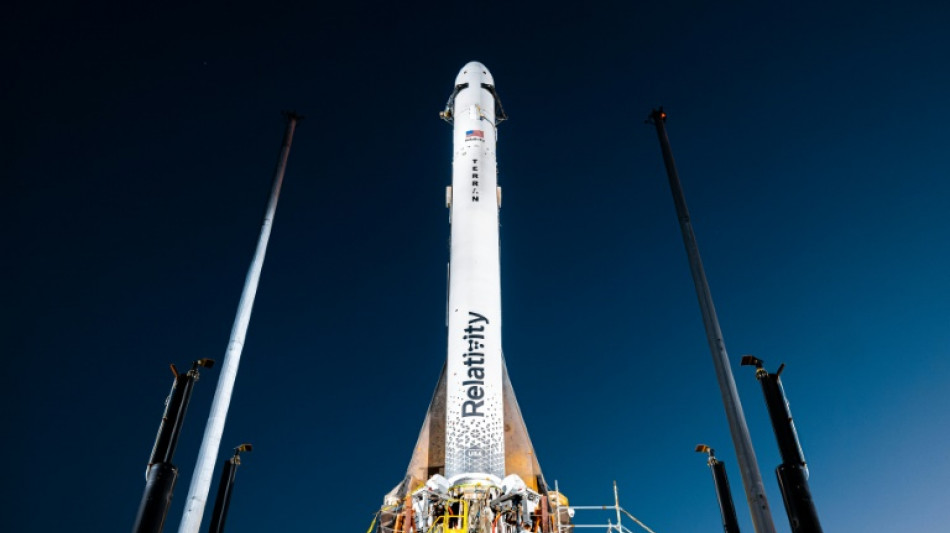
Launch of world's first 3D-printed rocket canceled at last second / Photo: © AFP

 Typhoon Dujuan leaves four dead in Japan, 45,000 houses without power

 G7 leaders condemn Houthi strikes on Saudi Arabia

 Google data centre sparks protests in Austria

 Shin Ohashi: Junk food-loving teen and Japan's next big swimming hope

 Stocks rise on AI buzz, drop in oil prices

 China's robot dancers limber up for America's Got Talent final

 Despite military might, Saudi struggles to crush the Houthis

 Trump to tout deals, defend Iran war in UN speech

 Sri Lanka to issue verdict in landmark Easter attack trial

 No green light to lift EU sanctions on Russian oligarchs, talks to resume

 UK agrees support for Saudi in struggle with Houthis: reports

 EU foreign policy chief calls for continued sanctions on Russia

 Flights scrapped, evacuations urged as Typhoon Dujuan wallops Japan

 Fonseca to take break from tennis

 A Cuban zoo, and its animals, in epic battle for survival

 Infantino proposes consulting federations to reform FIFA

 El Nino weather pattern enters record territory: scientist

 OpenAI calls for US to lead global effort on AI standards

 South African ostriches plucked alive for luxury fashion: report

 US networks halt Trump coverage in revolt over White House ban

 Paramount settles with US states to clear Warner Bros. mega-merger

 Climate crisis a job for world leaders, not just activists: UK FM

 US networks halt Trump coverage over White House ban

 French singer accuses Miley Cyrus of plagiarism

 EU fines Google 403 mn euros for location data breach

The launch of the world's first 3D-printed rocket was ultimately scrubbed after several tries on Saturday, marking a new setback for the private owner of an innovative spacecraft billed as being less costly to produce and fly.
Engines had begun igniting on the unmanned Terran 1 rocket, built by California aerospace startup Relativity Space, when an "automation" issue caused the company to abort takeoff for the second time in less than a week.
A little later, the company tried again to launch the spacecraft from Florida's Cape Canaveral but had to abort due to pressure issues in the rocket's second stage, the company later tweeted.
"The team went HARD today and we intend to do so during our next attempt. More to come on the new launch date," Relativity said.
At one point during the three-hour launch window, which began at 1:00 pm (1800 GMT), the countdown was put on hold when a private boat violated a danger zone.
An earlier scheduled launch last Wednesday was also postponed over last-minute propellant temperature issues.
Once it does take off, Terran 1 is set to reach low Earth orbit after eight minutes on a voyage intended to gather data and demonstrate that a 3D-printed rocket can withstand the rigors of liftoff and space flight.
If the rocket manages to attain low Earth orbit, it will be the first privately funded vehicle using methane fuel to do so on its first try, according to Relativity.
Terran 1 is not expected to carry a payload for its first flight, but the rocket will eventually be capable of putting up to 2,755 pounds (1,250 kilograms) into low Earth orbit.
The rocket is 110 feet (33.5 meters) tall with a diameter of 7.5 feet (2.2 meters).
Eighty-five percent of its mass is 3D printed with metal alloys, including the engines.
It is the largest ever 3D printed object, according to the Long Beach-based company, and is made, it says, with the world's largest 3D metal printers.
- Built in 60 days -
Relativity's goal is to produce a rocket that is 95 percent 3D printed.
Terran 1 is powered by Aeon engines using liquid oxygen and liquid natural gas -- the "propellants of the future," capable of eventually fueling a voyage to Mars, Relativity says.
Vulcan rockets being developed by United Launch Alliance and SpaceX's Starship use the same fuel.
Terran 1 has nine 3D-printed Aeon 1 engines on its first stage and one 3D-printed Aeon Vacuum engine on its second stage.
Relativity is also building a larger rocket, Terran R, capable of putting a payload of 44,000 pounds (20,000 kgs) into low Earth orbit.
The first launch of a Terran R, which is designed to be fully reusable, is scheduled for next year from Cape Canaveral.
A satellite operator can wait for years for a spot on an Arianespace or SpaceX rocket, and Relativity Space hopes to accelerate the timeline with its 3D-printed rockets.
"Long-term, a major benefit of 3D printing is the ability to more rapidly democratize space due to the incredible cost effectiveness, radical flexibility and customization," the company said.
Relativity said its 3D-printed rockets use 100 times fewer parts than traditional rockets, and can be built from raw materials in just 60 days.
Relativity has already signed commercial launch contracts worth $1.65 billion, mostly for the Terran R, according to CEO Tim Ellis, who co-founded the company in 2015.
"Medium-heavy lift is clearly where the biggest market opportunity is for the remaining decade, with a massive launch shortage in this payload class," Ellis tweeted.
M.Ouellet--BTB