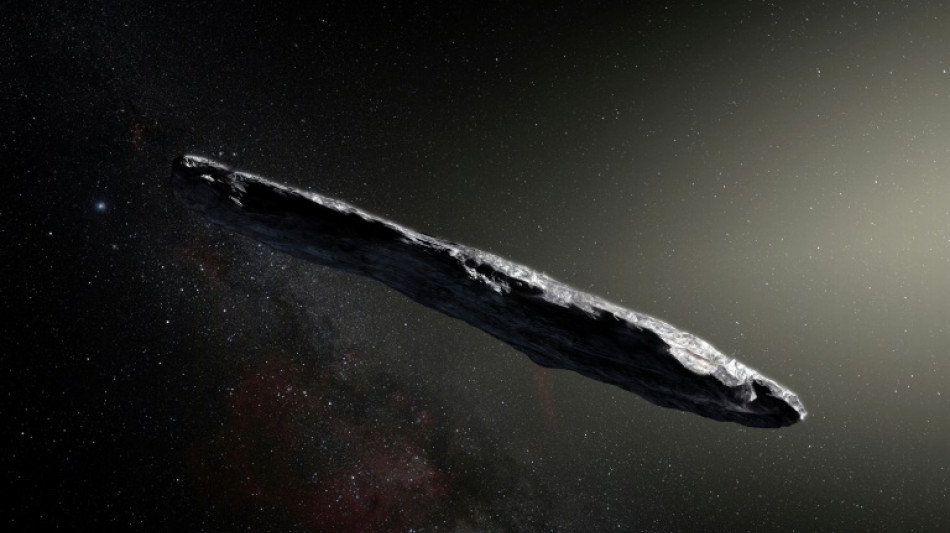
Scientists offer 'non-alien explanation' for interstellar visitor / Photo: © European Southern Observatory/AFP/File

 Marchand 'stressed' about racing Japanese rivals at LA Olympics
 Mobile boat clinics bring healthcare to India's remote islands

 Former India paceman Zaheer Khan named Chennai coach in IPL

 Six-year-old Chinese girl sets world record with Rubik's Cube

 Swimming prodigy Yu, 13, says 'interviews way harder than racing'

 Star coaches make their bows as Nations League returns

 Rams bounce back as Giants reel from Dart injury

 In Bangladesh, Pakistan's Jinnah photo stirs anger

 Two New Zealand naval ships transit Taiwan Strait

 Zidane gets down to work as France start new era

 Inside the Venezuelan prison meant to 'drive you insane'

 UK king braces as memoir by Diana's brother goes on sale

 Akkodis and Hamburg Public Transport Association Showcase hvv mia at InnoTrans 2026, Demonstrating the Future of AI-Powered Mobility

 Macron says talks with Trump on Red Sea, Ukraine 'constructive'

 Green policies just good politics, says UK minister

 Bardot auction in Paris fetches nearly one million euros

 No timeline on Daniels injury return, says Commanders coach

 British Columbia sues OpenAI in US court over Canada school shooting

 French star Batum retires after 18-year NBA career

 Zidane leads first France training session

 Man shot by ICE agent in Texas detained with bullet inside him: lawyer

 California declares state of emergency ahead of El Nino

 South Africa arrests three more suspects, after nine women murdered

 Carse needs time away from England, says captain Brook

 NOWPayments Releases Cross-Chain Payout Data Revealing Key Performance Benchmarks Across TRON, BNB Chain, and Solana

When the first object ever known to have visited the Earth's Solar System from outer space zoomed past in 2017, it was so strange that at least one leading astronomer was convinced it was an alien vessel.
But researchers said Wednesday that they had come up with a simple and "compelling non-alien explanation" for the interstellar interloper's bizarre behaviour -- though not everyone was convinced.
The object christened 'Oumuamua -- "scout" in Hawaiian -- baffled scientists as soon as it was spotted by an observatory in Hawaii six years ago.
Astronomers had long been searching for comet-like objects entering the Solar System from the vastness of interstellar space, but had never before observed one.
But 'Oumuamua did not much resemble the comets that normally travel in from the edges of the Solar System. It lacked both a tail and a fuzzy halo, known as a coma, which are formed by dust and gas warming in the Sun's heat.
It was also a peculiar elongated shape, never before observed in comets or asteroids. Its diameter was roughly 100 metres -- about the size of a football pitch -- but by some estimates it was 10 times as long as it was wide, shaped either like a pancake or a cigar.
And by the way light glinted off the object, it appeared to be tumbling end over end.
But the strangest part was that once 'Oumuamua slingshotted around the Sun, it sped up and deviated from its expected trajectory, propelled by a mysterious force on its way out of the Solar System.
Scientists were left with four months' worth of seemingly contradictory data to try to make sense of, leading to a range of theories.
- 'Thruster boost' -
Jennifer Bergner, an expert in astrochemistry at the University of California, Berkeley, and co-author of a new study, told AFP that many of the theories "stretched the imagination".
Her proposal is that, wherever 'Oumuamua may have come from, it started out as a water-rich, comet-like object.
During its interstellar travels it was blasted by penetrating cosmic rays that converted some of its water into hydrogen gas that became trapped within the object's body.
When 'Oumuamua neared the Sun, the heat released the trapped hydrogen, acting as a "thruster boost" that propelled the object on its unexpected path, she said.
Darryl Seligman of Cornell University, co-author of the study published in the journal Nature, said that "Jenny's definitely right about the entrapped hydrogen".
"We had all these stupid ideas, like hydrogen icebergs and other crazy things, and it's just the most generic explanation," he said in a statement.
Marco Micheli, an astronomer at the European Space Agency who was not involved in the research, commented in Nature that the paper "offers perhaps the first simple and physically realistic explanation of the peculiarities of this object".
- 'Very suspicious' -
Not everyone was convinced.
Avi Loeb, a lauded theoretical physicist who was the longest-serving chair of astronomy at Harvard University, maintains that the simplest explanation is that 'Oumuamua was alien technology -- including in his 2021 book "Extraterrestrial: The First Sign of Intelligent Life Beyond Earth."
Loeb rejected the new theory, telling AFP that claims of a comet without a tail "is like saying an elephant is a zebra without stripes".
He pointed to the large cometary tail seen on 2I/Borisov, the second known visitor from outside the Solar System, which was spotted in 2019.
Roman Rafikov of Cambridge University in Britain said he had previously demonstrated that if trapped gas were behind 'Oumuamua's acceleration, it would have "dramatically" changed the rate at which it was spinning -- which did not happen.
Rafikov said he was "very suspicious" of such theories, adding nonetheless that he preferred "an explanation that does not involve aliens or divine forces".
Bergner suggested the reason 'Oumuamua did not have a tail or coma was that it was far smaller than any comet -- including 2I/Borisov -- that had ever been observed.
But that could change soon.
In the coming years many more comets, potentially from both within and outside the Solar System, could be spotted by the Rubin Observatory Legacy Survey of Space and Time in Chile, which is expected to begin its imaging project in 2025.
Bergner said that if small comets showed signs of releasing trapped hydrogen -- and lacked tails and comas -- that could help confirm her theory.
When it came to ideas involving extraterrestrial life, she said, it "depends what standard of proof you require to invoke aliens".
"We'll never know for sure what 'Oumuamua was -- we lost our chance," she said. "But for now, I think here we have a compelling non-alien explanation."
Y.Bouchard--BTB