World's 'oldest' tree able to reveal planet's secrets / Photo: © AFP

 Stocks rise on AI buzz, oil prices cool

 India narrowly survive huge scare against minnows Japan

 Missing F-35 fighter parts 'not sensitive', says Australia minister

 Cambodia showcases scams crackdown with global conference

 Afghan cyclist who disguised herself as man wins Asian Games silver

 Typhoon Dujuan leaves four dead in Japan, 45,000 houses without power

 G7 leaders condemn Houthi strikes on Saudi Arabia

 Google data centre sparks protests in Austria

 Shin Ohashi: Junk food-loving teen and Japan's next big swimming hope

 Stocks rise on AI buzz, drop in oil prices

 China's robot dancers limber up for America's Got Talent final

 Despite military might, Saudi struggles to crush the Houthis

 Trump to tout deals, defend Iran war in UN speech

 Sri Lanka to issue verdict in landmark Easter attack trial

 No green light to lift EU sanctions on Russian oligarchs, talks to resume

 UK agrees support for Saudi in struggle with Houthis: reports

 EU foreign policy chief calls for continued sanctions on Russia

 Flights scrapped, evacuations urged as Typhoon Dujuan wallops Japan

 Fonseca to take break from tennis

 A Cuban zoo, and its animals, in epic battle for survival

 Infantino proposes consulting federations to reform FIFA

 El Nino weather pattern enters record territory: scientist

 OpenAI calls for US to lead global effort on AI standards
 South African ostriches plucked alive for luxury fashion: report

 US networks halt Trump coverage in revolt over White House ban

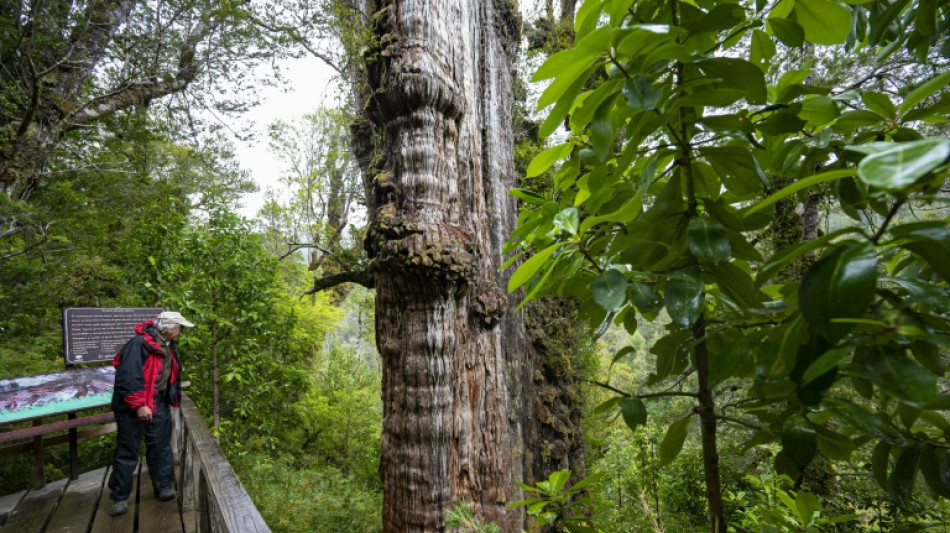
In a forest in southern Chile, a giant tree has survived for thousands of years and is in the process of being recognized as the oldest in the world.
Known as the "Great Grandfather," the trunk of this tree measuring four meters (13 feet) in diameter and 28 meters tall is also believed to contain scientific information that could shed light on how the planet has adapted to climatic changes.
Believed to be more than 5,000 years old, it is on the brink of replacing Methuselah, a 4,850-year-old Great Basin bristlecone pine found in California in the United States, as the oldest tree on the planet.
"It's a survivor, there are no others that have had the opportunity to live so long," said Antonio Lara, a researcher at Austral University and Chile's center for climate science and resilience, who is part of the team measuring the tree's age.
The Great Grandfather lies on the edge of a ravine in a forest in the southern Los Rios region, 800 kilometers (500 miles) to the south of the capital Santiago.
It is a Fitzroya cupressoides, a type of cypress tree that is endemic to the south of the continent.
In recent years, tourists have walked an hour through the forest to the spot to be photographed beside the new "oldest tree in the world."
Due to its growing fame, the national forestry body has had to increase the number of park rangers and restrict access to protect the Great Grandfather.
By contrast, the exact location of Methuselah is kept a secret.
Also known as the Patagonian cypress, it is the largest tree species in South America.
It lives alongside other tree species, such as coigue, plum pine and tepa, Darwin's frogs, lizards, and birds such as the chucao tapaculo and Chilean hawk.
For centuries its thick trunk has been chopped down to build houses and ships, and it was heavily logged during the 19th and 20th centuries.
- Excitement in scientific community -
Park warden Anibal Henriquez discovered the tree while patrolling the forest in 1972. He died of a heart attack 16 years later while patrolling the same forest on horseback.
"He didn't want people and tourists to know (where it was) because he knew it was very valuable," said his daughter Nancy Henriquez, herself a park warden.
Henrique's nephew, Jonathan Barichivich, grew up playing amongst the Fitzroya and is now one of the scientists studying the species.
In 2020, Barichivich and Lara managed to extract a sample from the Great Grandfather using the longest manual drill that exists, but they did not reach the center.
They estimated that their sample was 2,400 years old and used a predictive model to calculate the full age of the tree.
Barichivich said that "80 percent of the possible trajectories show the tree would be 5,000 years old."
He hopes to soon publish the results.
The study has created excitement within the scientific community given that dendrochronology -- the method of dating tree rings to when they were formed -- is less accurate when it comes to older trees as many have a rotten core.
- 'Symbols of resistence' -
This is about more than just a competition to enter the record books though, as the Great Grandfather is a font of valuable information.
"There are many other reasons that give value and sense to this tree and the need to protect it," said Lara.
There are very few thousands-years-old trees on the planet.
"The ancient trees have genes and a very special history because they are symbols of resistence and adaptation. They are nature's best athletes," said Barichivich.
"They are like an open book and we are like the readers who read every one of their rings," said Carmen Gloria Rodriguez, an assistant researcher at the dendrochronology and global change laboratory at Austral University.
Those pages show dry and rainy years, depending on the width of the rings.
Fires and earthquakes are also recorded in those rings, such as the most powerful tremor in history that hit this area in 1960.
The Great Grandfather is also considered a time capsule that can offer a window into the past.
"If these trees disappear, so too will disappear an important key about how life adapts to changes on the planet," said Barichivich.
B.Shevchenko--BTB