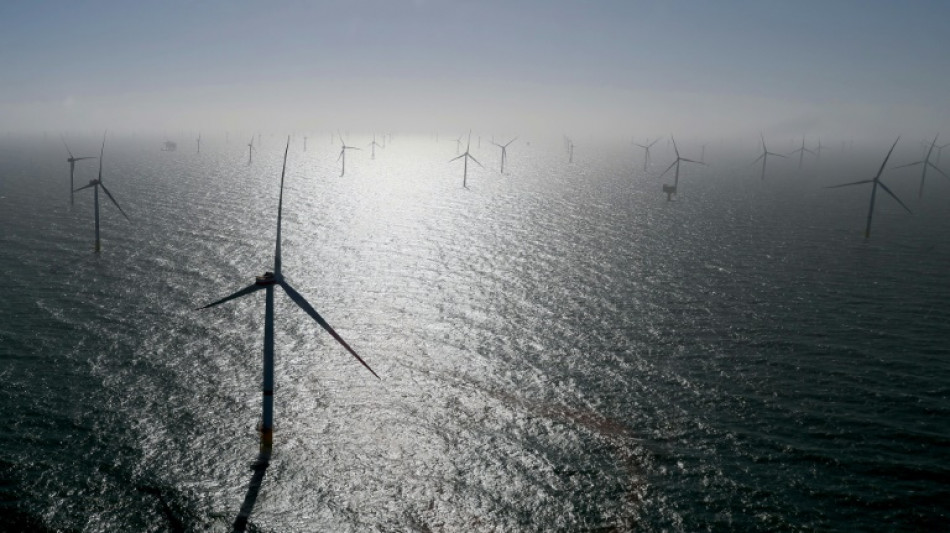
European summit looks to boost wind energy production / Photo: © POOL/AFP

 Stocks rise on AI buzz, oil prices cool
 India narrowly survive huge scare against minnows Japan

 Missing F-35 fighter parts 'not sensitive', says Australia minister

 Cambodia showcases scams crackdown with global conference
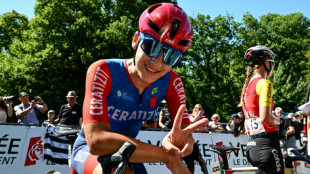 Afghan cyclist who disguised herself as man wins Asian Games silver

 Typhoon Dujuan leaves four dead in Japan, 45,000 houses without power

 G7 leaders condemn Houthi strikes on Saudi Arabia

 Google data centre sparks protests in Austria

 Shin Ohashi: Junk food-loving teen and Japan's next big swimming hope

 Stocks rise on AI buzz, drop in oil prices
 China's robot dancers limber up for America's Got Talent final

 Despite military might, Saudi struggles to crush the Houthis

 Trump to tout deals, defend Iran war in UN speech

 Sri Lanka to issue verdict in landmark Easter attack trial

 No green light to lift EU sanctions on Russian oligarchs, talks to resume

 UK agrees support for Saudi in struggle with Houthis: reports

 EU foreign policy chief calls for continued sanctions on Russia

 Flights scrapped, evacuations urged as Typhoon Dujuan wallops Japan

 Fonseca to take break from tennis

 A Cuban zoo, and its animals, in epic battle for survival

 Infantino proposes consulting federations to reform FIFA

 El Nino weather pattern enters record territory: scientist
 OpenAI calls for US to lead global effort on AI standards
 South African ostriches plucked alive for luxury fashion: report
 US networks halt Trump coverage in revolt over White House ban

Nine European countries held a summit on Monday aimed at scaling up wind power generation in the North Sea, spurred by the fallout of the Ukraine war and the push for renewables.
"We've seen over the past months what the impact is if you are too dependent on outsiders for the supply of energy," said Belgian Prime Minister Alexander De Croo, hosting the meeting in the coastal town of Ostend.
The leaders of EU members France, Germany, Ireland, Denmark, the Netherlands and Luxembourg, along with European Commission chief Ursula von der Leyen, attended the summit.
Norway and Britain also participated, with the latter represented by UK Energy Security Secretary Grant Shapps.
In a joint op-ed published in Politico, the leaders of the nine nations emphasised the need to build more offshore wind turbines "to reach our climate goals, and to rid ourselves of Russian gas, ensuring a more secure and independent Europe".
Several leaders pointed to the need also to ensure security of offshore wind farms and their interconnectors, in the wake of recent reports of a Russian spy ship in the North Sea and last year's sabotage of the Nord Stream gas pipelines in the Baltic Sea.
De Croo said North Sea infrastructure, including turbines and undersea cables "are prone to sabotage or to espionage" and the topic was "an extremely important one" at the summit.
The summit's collective goal, stated by all the leaders, is to boost offshore wind power generation to 120 gigawatts by 2030 -- from just 30 GW today -- and at least 300 GW by 2050.
They recognised the size of the task requires massive investment, and that standardising equipment is needed to bring down costs and timescales.
A key point, hammered by French President Emmanuel Macron, is to ensure the supply chain for the push for more North Sea wind power is anchored in Europe, rather than elsewhere, and that the jobs created are there.
"We want to secure our industrial chain, because it's important to deploy this offshore wind power but we don't want to repeat the errors we've sometimes committed in the past, of deploying equipment made on the other side of the world," he said.
The comment appeared to be directed at China, which currently dominates the supply of critical elements, such as rare earths. The European Union is seeking to shift away from that reliance on China by bolstering its own industries.
German Chancellor Olaf Scholz said the "very important" summit underscored the potential to greatly expand renewable energy from the North Sea.
- Industry criticism -
WindEurope, the federation representing Europe's wind energy industry, believes the summit's ambitions are achievable.
But it highlighted a lack of "adequate funding mechanisms" and recruitment in the sector.
The organisation says Europe needs to build the offshore infrastructure to add 20 GW in output per year, yet the sector currently has capacity for just seven GW annually, with supply chain bottlenecks for cables, substations and foundations, and in the availability of offshore wind vessels.
Investment to get Europe where it wants to be is huge: the EU has calculated the cost of reaching 300 GW in offshore energy production by 2050 at 800 billion euros ($900 billion).
Britain has the biggest fleet of offshore wind farms, 45 of them, currently producing 14 GW, with plans to expand capacity to 50 GW by 2030.
Germany's 30 wind farms produce eight GW, followed by the Netherlands with 2.8 GW and Denmark and Belgium both with 2.3 GW.
The other participating countries produce less than a gigawatt from their existing installations but share ambitions to greatly ramp up wind energy capacity.
P.Anderson--BTB