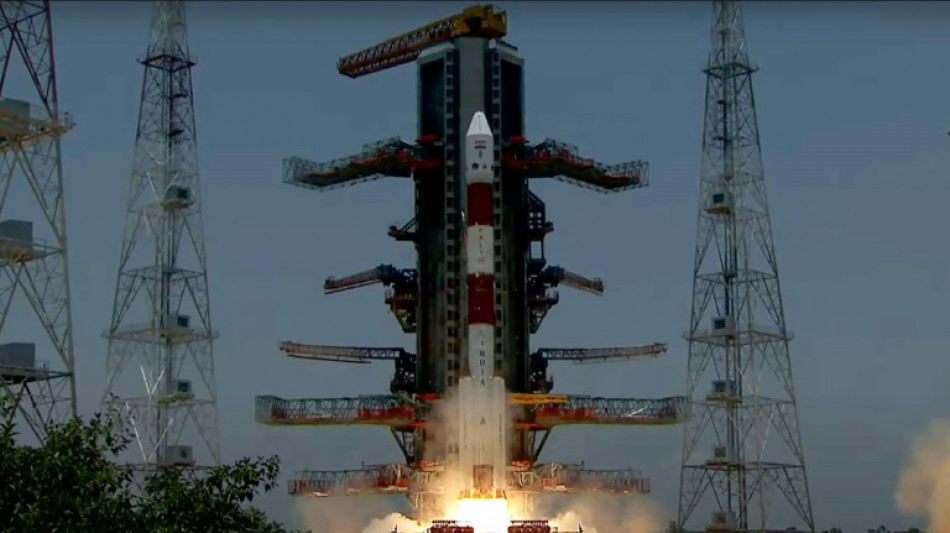
From the Moon to the Sun: India launches next space mission / Photo: © ISRO/AFP

 Hurricane Polo strengthens to top category 5 off Mexico

 11 hurt as teen opens fire outside school in western Turkey

 UN chief says 'Big Oil' treats atmosphere as open sewer

 Tunisia says 2026 summer hottest on record

 England's Rashid out of Sri Lanka ODIs with hand injury

 Houthis accuse Saudi Arabia of deadly strikes as thousands flee

 Stocks climb as oil slides, AI buzz returns

 India cricketers win in style as Afghan savours 'special' Games silver

 La Liga president hits out at Real Madrid refereeing 'conspiracy' claims

 MEXC Launches “Real Stocks, Real Friends” with Rewards for Bringing Friends to Wall Street

 Mbappe continues media push for Ballon d'Or recognition

 Stocks rise on AI buzz, oil prices cool

 India narrowly survive huge scare against minnows Japan

 Missing F-35 fighter parts 'not sensitive', says Australia minister

 Cambodia showcases scams crackdown with global conference

 Afghan cyclist who disguised herself as man wins Asian Games silver

 Typhoon Dujuan leaves four dead in Japan, 45,000 houses without power

 G7 leaders condemn Houthi strikes on Saudi Arabia

 Google data centre sparks protests in Austria

 Shin Ohashi: Junk food-loving teen and Japan's next big swimming hope

 Stocks rise on AI buzz, drop in oil prices

 China's robot dancers limber up for America's Got Talent final

 Despite military might, Saudi struggles to crush the Houthis

 Trump to tout deals, defend Iran war in UN speech

 Sri Lanka to issue verdict in landmark Easter attack trial

The latest mission in India's ambitious space programme blasted off Saturday on a voyage towards the centre of the solar system, a week after the country's successful unmanned Moon landing.
Aditya-L1 launched shortly before midday, with a live broadcast showing hundreds of spectators cheering wildly against the deafening noise of the rocket's ascent.
"Launch successful, all normal," an Indian Space Research Organisation official announced from mission control as the vessel made its way to the upper reaches of the Earth's atmosphere.
The mission is carrying scientific instruments to observe the Sun's outermost layers in a four-month journey.
The United States and the European Space Agency (ESA) have sent numerous probes to the centre of the solar system, beginning with NASA's Pioneer programme in the 1960s.
Japan and China have both launched their own solar observatory missions into Earth's orbit.
But if successful, the latest mission from the Indian Space Research Organisation (ISRO) will be the first by any Asian nation to be placed in orbit around the Sun.
"It's a challenging mission for India," astrophysicist Somak Raychaudhury told broadcaster NDTV on Friday.
Raychaudhury said the mission probe would study coronal mass ejections, a periodic phenomenon that sees huge discharges of plasma and magnetic energy from the Sun's atmosphere.
These bursts are so powerful they can reach the Earth and potentially disrupt the operations of satellites.
Aditya will help predict the phenomenon "and alert everybody so that satellites can shut down their power", he said.
"It will also help us understand how these things happen, and in the future, we might not need a warning system out there."
Aditya, the name of the Hindu Sun deity, will travel 1.5 million kilometres (930,000 miles) to reach its destination -- still only one percent of the vast distance between Earth and the Sun.
At that point, the gravitational forces of both celestial bodies cancel each other out, allowing the mission to remain in a stable halo orbit around our nearest star.
Aditya is travelling on the ISRO-designed, 320-tonne PSLV XL rocket that has been a mainstay of the Indian space programme, powering earlier launches to the Moon and Mars.
The mission also aims to shed light on the dynamics of several other solar phenomena by imaging and measuring particles in the Sun's upper atmosphere.
- Budget programme -
India has been steadily matching the achievements of established spacefaring powers at a fraction of their cost.
The South Asian nation has a comparatively low-budget space programme, but one that has grown considerably in size and momentum since it first sent a probe to orbit the Moon in 2008.
Experts say India can keep costs low by copying and adapting existing technology, and thanks to an abundance of highly skilled engineers who earn a fraction of their foreign counterparts' wages.
Last month's successful landing on the lunar surface -- a feat previously achieved only by Russia, the United States and China -- cost less than $75 million.
The touchdown was widely celebrated by the public, with prayer rituals to wish for the mission's success and schoolchildren following its final descent from live broadcasts in classrooms.
India became the first Asian nation to put a craft into orbit around Mars in 2014 and is slated to launch a three-day crewed mission into the Earth's orbit by next year.
It also plans a joint mission with Japan to send another probe to the Moon by 2025 and an orbital mission to Venus within the next two years.
G.Schulte--BTB