China's rulers push party role before WWII anniversary / Photo: © AFP

 Marchand 'stressed' about racing Japanese rivals at LA Olympics
 Mobile boat clinics bring healthcare to India's remote islands
 Former India paceman Zaheer Khan named Chennai coach in IPL

 Six-year-old Chinese girl sets world record with Rubik's Cube
 Swimming prodigy Yu, 13, says 'interviews way harder than racing'
 Star coaches make their bows as Nations League returns
 Rams bounce back as Giants reel from Dart injury
 In Bangladesh, Pakistan's Jinnah photo stirs anger

 Two New Zealand naval ships transit Taiwan Strait

 Zidane gets down to work as France start new era
 Inside the Venezuelan prison meant to 'drive you insane'

 UK king braces as memoir by Diana's brother goes on sale

 Akkodis and Hamburg Public Transport Association Showcase hvv mia at InnoTrans 2026, Demonstrating the Future of AI-Powered Mobility

 Macron says talks with Trump on Red Sea, Ukraine 'constructive'

 Green policies just good politics, says UK minister

 Bardot auction in Paris fetches nearly one million euros

 No timeline on Daniels injury return, says Commanders coach

 British Columbia sues OpenAI in US court over Canada school shooting

 French star Batum retires after 18-year NBA career

 Zidane leads first France training session
 Man shot by ICE agent in Texas detained with bullet inside him: lawyer
 California declares state of emergency ahead of El Nino
 South Africa arrests three more suspects, after nine women murdered
 Carse needs time away from England, says captain Brook

 NOWPayments Releases Cross-Chain Payout Data Revealing Key Performance Benchmarks Across TRON, BNB Chain, and Solana

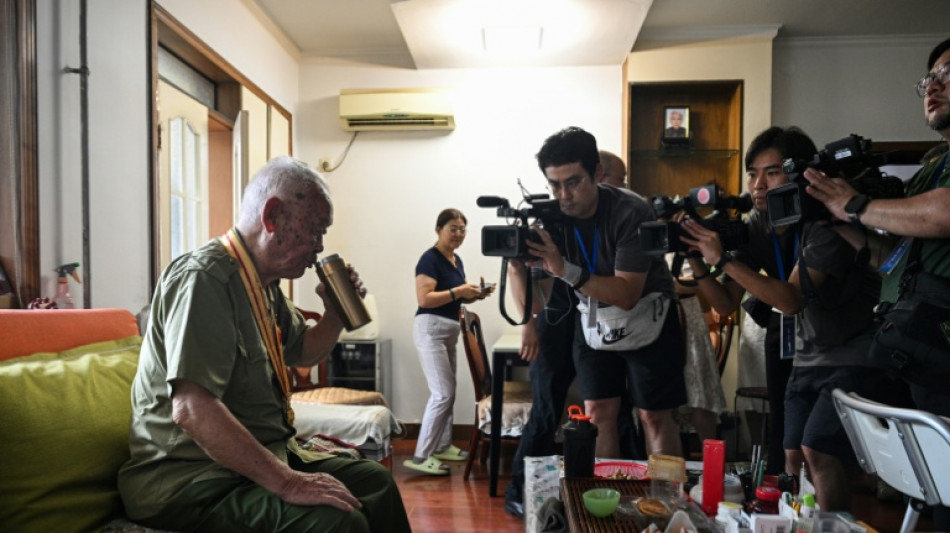
An elderly Chinese war veteran's shin still bears the mark of a bullet wound he suffered when fighting the Japanese as a teenager, a year before the end of World War II.
Eighty years on, Li Jinshui's scar remains as testimony to the bravery of Chinese troops in a conflict that killed millions of their people.
But the story behind China's overthrow of the brutal Japanese occupation is deeply contested.
Historians broadly agree that credit for victory lies primarily with the Nationalist army, the dominant Chinese force at the time.
However, its leader, Chiang Kai-shek, fled to Taiwan in 1949 after losing a civil war to Mao Zedong's communists, laying the groundwork for decades of cross-strait tensions that continue to this day.
Beijing argues that the Communist Party (CCP) played a central role in the war, bolstered by the stories of Li and his comrades' courage and sacrifice.
It is a narrative expected to prevail at a major military parade on September 3.
"With the country in trouble, Chinese people with conscience had to stand up," said Li, who turned 98 on Wednesday and was a soldier in the CCP-run Eighth Route Army.
After Japan's full-scale invasion in 1937, the CCP resisted mainly by guerrilla fighting in the rural, hilly stretches of northern China outside of Nationalist control.
Li was shot in the leg while fighting the Japanese in his native Wuxiang County in China's rugged northern province of Shanxi.
Released from the hospital early, he returned to the battlefield despite not having fully recovered.
Dressed in a green military uniform topped by a cap with a red star, Li bent to pull up his left trouser leg, revealing the scar he has carried for decades.
"It was extremely hard for us," he said.
"We were just young lads."
- Making grenades -
At a government-organised media tour in July, veterans including Li touted the CCP's role in liberating China from the yoke of Japanese imperialism.
"The Kuomintang didn't play a major role in the war against Japanese aggression," said Wen Yunfu, 96, referring to Chiang's Nationalist Party by its Chinese name.
"It was mainly the Communist Party."
Wen's hometown of Shenzhou in northern Hebei was attacked by the Japanese army just a few months after their 1937 invasion.
Chiang's army was forced to retreat south in the face of the Japanese onslaught.
That left the people under the leadership of the Communist Party, Wen said.
"Life was extremely difficult for the people," he said.
"Our home was burned down. My uncle was also killed by the Japanese."
Wen later joined Mao's CCP at 16 in the final months of the war, and was put to work making grenades.
A truce was called in the civil war between the Kuomintang, which ruled most of the country at the time, and the insurgent Communist Party in the years leading up to the defeat of Japan in 1945.
That suspension came to an end in the wake of Japan's defeat, and the CCP was ultimately victorious in the ensuing domestic conflict.
- 'Correct' history -
Under Xi Jinping -- China's most powerful leader since Mao -- special attention has been paid to pushing the "correct" interpretation of the complex history of the victory over Japan, said Rana Mitter, author of multiple books on China's role in World War II.
"They're trying to find ways in which the Communist role can be brought more to the forefront," Mitter told AFP.
Mitter doesn't contest that the party's role was significant.
However, he said, "the primary role in terms of political and military resistance against the Japanese was played by the then-government of China, which was the Nationalist Kuomintang government".
There have been efforts in recent decades to recognise the contributions made by forces other than the Communists, including the Kuomintang and the United States.
One chapter that has received widespread attention is the "Flying Tigers" US air brigade that fought with the Kuomintang in the early 1940s, conducting dangerous assaults on enemy bombers.
A museum in Zhijiang, Hunan, sheds light on their assistance just a stone's throw away from a key airport from which they launched their missions.
Still, there are glimmers of the complicated history at play.
AFP could see the scars of three Chinese characters since removed from the monument.
The erased name is likely Wang Tung-yuan, according to Ji Jianliang, a local Communist Party historian.
Wang, a general under Chiang and later Taiwan's ambassador to South Korea, had once provided an inscribed dedication for the monument.
Ji said his name had been removed for "complex political reasons".
K.Thomson--BTB