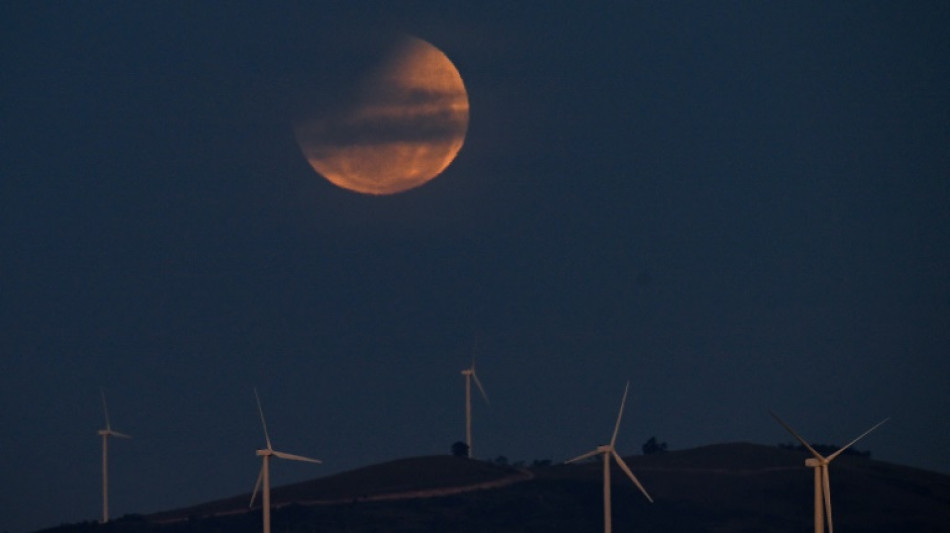
'Blood Moon' to rise during total lunar eclipse Sunday night / Photo: © AFP/File

 Marchand 'stressed' about racing Japanese rivals at LA Olympics
 Mobile boat clinics bring healthcare to India's remote islands
 Former India paceman Zaheer Khan named Chennai coach in IPL

 Six-year-old Chinese girl sets world record with Rubik's Cube
 Swimming prodigy Yu, 13, says 'interviews way harder than racing'

 Star coaches make their bows as Nations League returns

 Rams bounce back as Giants reel from Dart injury

 In Bangladesh, Pakistan's Jinnah photo stirs anger

 Two New Zealand naval ships transit Taiwan Strait

 Zidane gets down to work as France start new era

 Inside the Venezuelan prison meant to 'drive you insane'

 UK king braces as memoir by Diana's brother goes on sale

 Akkodis and Hamburg Public Transport Association Showcase hvv mia at InnoTrans 2026, Demonstrating the Future of AI-Powered Mobility

 Macron says talks with Trump on Red Sea, Ukraine 'constructive'

 Green policies just good politics, says UK minister

 Bardot auction in Paris fetches nearly one million euros
 No timeline on Daniels injury return, says Commanders coach

 British Columbia sues OpenAI in US court over Canada school shooting

 French star Batum retires after 18-year NBA career

 Zidane leads first France training session

 Man shot by ICE agent in Texas detained with bullet inside him: lawyer

 California declares state of emergency ahead of El Nino
 South Africa arrests three more suspects, after nine women murdered

 Carse needs time away from England, says captain Brook

 NOWPayments Releases Cross-Chain Payout Data Revealing Key Performance Benchmarks Across TRON, BNB Chain, and Solana

Stargazers will have a chance to see a "Blood Moon" on Sunday night during a total lunar eclipse visible across Asia and swathes of Europe and Africa.
When the Sun, Earth and Moon line up, the shadow cast by the planet on its satellite makes it appear an eerie, deep red colour that has astounded humans for millennia.
People in Asia, including India and China, will be best placed to see Sunday's total eclipse, which will also be visible on the eastern edge of Africa as well as in western Australia.
The total lunar eclipse will last from 1730 GMT to 1852 GMT.
Stargazers in Europe and Africa will get a brief chance to see a partial eclipse just as the Moon rises during the early evening, while the Americas will miss out.
The Moon appears red during lunar eclipses because the only sunlight reaching it is "reflected and scattered through the Earth's atmosphere", said Ryan Milligan, an astrophysicist at Northern Ireland's Queen's University Belfast.
Blue wavelengths of light are shorter than red ones, so are more easily dispersed as they travel through Earth's atmosphere, he told AFP.
"That's what gives the moon its red, bloody colour."
While special glasses or pinhole projectors are needed to safely observe solar eclipses, all that is required to see a lunar eclipse is clear weather -- and being in the right spot.
The last total lunar eclipse was in March this year, while the one before that was in 2022.
Milligan, a self-described "solar eclipse chaser", said he considered Sunday's event a prelude to what he called the "big one" next year.
A rare total solar eclipse, when the Moon blocks out the light from the Sun, will be visible in a sliver of Europe on August 12, 2026.
For more than a decade, Milligan has travelled the world to witness 12 totalities, which is when the Moon completely obscures the Sun.
Next year's totality -- the first in mainland Europe since 2006 -- will be visible only in Spain and Iceland, though other countries will be able to see a significant partial eclipse.
In Spain, the totality will be visible in a roughly 160-kilometre (100-mile) band between Madrid and Barcelona, but neither city will see the full phenomenon, Milligan said.
It will be the first total solar eclipse since one swept across North America in April 2024.
D.Schneider--BTB