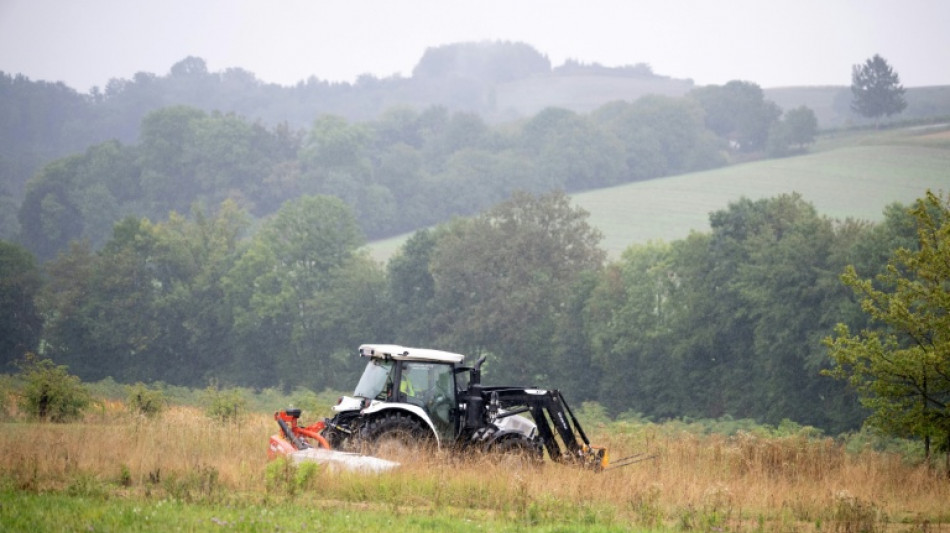
How mowing less lets flowers bloom along Austria's 'Green Belt' / Photo: © AFP

 Typhoon Dujuan leaves four dead in Japan, 45,000 houses without power

 G7 leaders condemn Houthi strikes on Saudi Arabia
 Google data centre sparks protests in Austria

 Shin Ohashi: Junk food-loving teen and Japan's next big swimming hope
 Stocks rise on AI buzz, drop in oil prices

 China's robot dancers limber up for America's Got Talent final

 Despite military might, Saudi struggles to crush the Houthis

 Trump to tout deals, defend Iran war in UN speech

 Sri Lanka to issue verdict in landmark Easter attack trial

 No green light to lift EU sanctions on Russian oligarchs, talks to resume

 UK agrees support for Saudi in struggle with Houthis: reports

 EU foreign policy chief calls for continued sanctions on Russia

 Flights scrapped, evacuations urged as Typhoon Dujuan wallops Japan

 Fonseca to take break from tennis

 A Cuban zoo, and its animals, in epic battle for survival

 Infantino proposes consulting federations to reform FIFA

 El Nino weather pattern enters record territory: scientist
 OpenAI calls for US to lead global effort on AI standards
 South African ostriches plucked alive for luxury fashion: report

 US networks halt Trump coverage in revolt over White House ban

 Paramount settles with US states to clear Warner Bros. mega-merger

 Climate crisis a job for world leaders, not just activists: UK FM
 US networks halt Trump coverage over White House ban
 French singer accuses Miley Cyrus of plagiarism
 EU fines Google 403 mn euros for location data breach

On a meadow in southeastern Austria near the border with Slovenia, Josef Hadler is working his tractor to mow several acres of land in a bid to better preserve the plot's biodiversity.
"Yesterday, a buzzard followed me at a distance of only five metres," the cattle farmer told AFP in the municipality of Sankt Anna am Aigen in the Styria province.
Thanks to Hadler's efforts for the local nature conservation association, endemic species of flora and fauna that have disappeared elsewhere have been able to survive on the 15 hectares (37 acres) of protected land he manages.
Located where the Iron Curtain once separated Austria from the former Yugoslavia, the fields near the Slovenian border are rich in biodiversity, precisely because the area used to be a no-go zone during the Cold War.
It is also part of the wider "European Green Belt" along the former Iron Curtain, a corridor of interconnected wildlife havens that stretches 12,500 kilometres (just over 7,700 miles) from Norway to Turkey.
"No one would dare to build their house right on the border (with Slovenia), which therefore remained green," explained Johannes Gepp, president of the local environmental protection organisation Naturschutzbund, which buys up plots of land from farmers.
Hadler mows the meadow only once or twice a year. The former owner, who had cultivated maize there, willingly sold the dry land 15 years ago to acquire another plot offering a better yield.
"We've gone from a monoculture to 70 to 80 species per 100 square metres" by eliminating fertilisers and reducing the mowing frequency, said Naturschutzbund's managing director Markus Ehrenpaar.
Hadler usually mows his fields five times a year for silage bales and hay to feed his livestock.
But he observed that mowing more frequently prevented flowers from growing, while mowing less often allowed many native species to flourish or even return.
Among them are the great burnet -- the only plant on which two different species of butterfly feed exclusively -- or the venomous nursery web spider.
Maintaining the fields is essential, as it prevents the proliferation of grasses to the detriment of wild flowers.
- 'Wonderful natural gems' -
Hadler receives compensation for his work and can harvest the hay, which he uses as litter for his livestock.
According to Andrea Pock, the mayor of Sankt Anna am Aigen, the "wonderful natural gems" also have an educational value for biology lessons.
"A form of gentle tourism has developed," the 46-year-old mayor said, adding that "many people come to see the flowers and observe the insects".
Signs nearby recount the dark past of the fortified and mined border, which once sought to deter people from behind the Iron Curtain to cross into the West.
In the present, crossing points that allow for genetic mixing of plants have been created to ensure the long-term survival of such dense and diverse areas.
The effort costs millions of euros each year as "land is very expensive," said Gepp.
The region, the government and the European Union have all contributed financially to this costly revival.
And the stakes are high: Austria is home to 1,300 kilometres of the "Central European Green Belt", which it shares with the Czech Republic, Slovakia, Hungary and Slovenia.
But at present, only a third of it is protected environmentally.
W.Lapointe--BTB