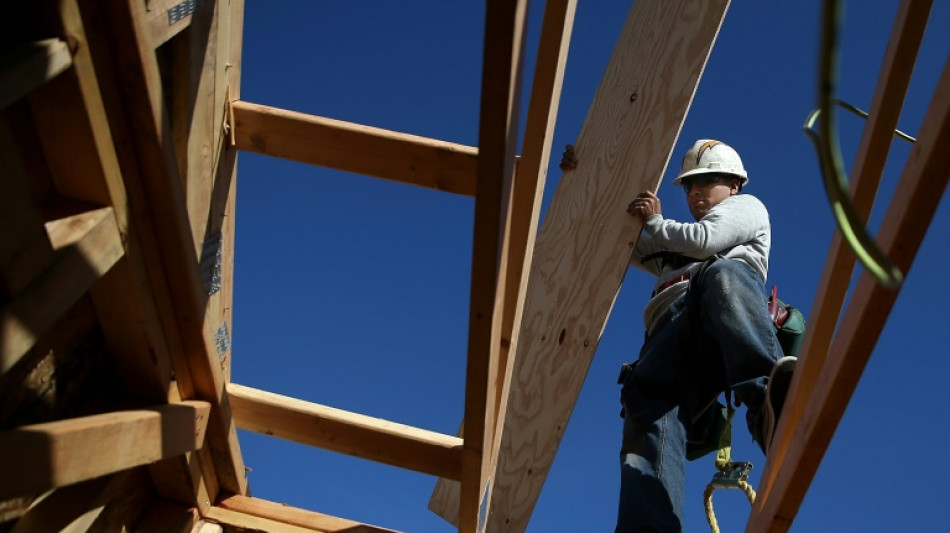
Want to save carbon and land? Study suggests wooden cities / Photo: © GETTY IMAGES NORTH AMERICA/AFP/File

 Macron welcomes Canada's Carney to French Atlantic territory

 Fiorentina frustrate Napoli with Serie A draw, Como upset

 Five-star Man City top Premier League after Sunderland thriller

 Ukrainian drones hit Moscow on last day of Russian elections

 Multi-Asset Trading Venue Monochrome Exchange Announces IEO of Its Native Token, $MCR

 South Korea break Japan hearts to win Asian Games basketball gold

 Acosta takes first victory at Austrian MotoGP

 PSG president Nasser al-Khelaifi under investigation in France for conflict of interest

 China swim sensation, 13, sets Games record after Japan win early

 Drones hit Moscow as Russians go to the polls

 New England boss Fleming says 'wrong' to ask Stokes to end retirement

 Germans vote in elections threatening fresh blow to Merz

 US fears rapid escalation in Mideast after Houthis attack Riyadh

 Japan triathlete Hojo wins first gold of Asian Games

 IOC president impressed by 'beautiful' Asian Games wooden huts

 First Asian Games gold goes to Japan as China's 13-year-old Yu lights up pool

 Data centre command hub keeps AI up and running
 Pope Leo in France: the issues on the table

 Packing for a pope: behind the scenes on foreign trips

 Republicans find transgender issues a powerful political weapon in midterm campaigning

 German state elections threaten new shock waves for Merz

 Chile's Bachelet quits race to be next UN chief

 Raphinha treble fires perfect Barca to win at Sevilla

 Thiam makes winning heptathlon return at Decastar meet

 Czechs beat USA to qualify for Davis Cup finals

Housing people in homes made from wood instead of steel and concrete could save more than 100 billion tonnes of carbon emissions while preserving enough cropland to feed a booming population, research suggested Tuesday.
More than half of people globally currently live in cities and this proportion is set to rise markedly by 2050.
According to some estimates, the infrastructure needed to accommodate up to 10 billion people by mid-century could exceed that constructed since the dawn of the industrial era.
That places a huge emphasis on emissions from construction, one of the most polluting sectors and historically one of the trickiest to decarbonise.
Were all new construction projects carried out using steel and concrete, that could claim up to 60 percent of Earth's remaining carbon budget for 2C of warming -- that is, how much pollution the global economy can produce and still stay within the Paris Agreement temperature guardrail.
Scientists in Germany and Taiwan wanted to see how much carbon could be saved if firms switched to wood to build new homes instead.
They used an open-source land use model to simulate four different building scenarios: one with conventional materials like cement and steel, and three with additional demand for timber.
They also analysed how additional high wood demand could be satisfied, where it could be produced, and the impacts new tree plantations might have on biodiversity and crop production.
They found that housing people in timber homes could avoid more than 100 billion tonnes of CO2 by 2100 -- that's around 10 percent of the remaining 2C carbon budget, equivalent to nearly three years of global emissions.
Wood is known to be the least carbon-intensive building material as trees absorb CO2 as they grow, explained the study lead author Abhijeet Mishra, from the Potsdam Institute for Climate Impact Research (PIK).
"Production of engineered wood releases much less CO2 than production of steel and cement," he said. "Engineered wood also stores carbon, making timber cities a unique long-term carbon sink."
He said that engineered wood was the ideal material for constructing "mid-rise" buildings -- between four and 12 stories -- to house growing urban populations.
The study, published in the journal Nature Communications, found that around 140 million hectares -- an area larger than Peru -- would be needed to grow new trees to meet the increased demand under the timber-led building scenario.
But the team calculated that these new plantations could be established on existing areas of harvest forest, and so not impact food supply by eating into crop land.
"We need farm land to grow food for the people –- using it to grow trees could potentially cause competition for the limited land resources," said co-author Florian Humpenoder, from PIK.
The authors concluded that planting the necessary additional plantations was possible but would require "strong governance and careful planning" from governments in order to limit their impact on biodiversity.
T.Bondarenko--BTB