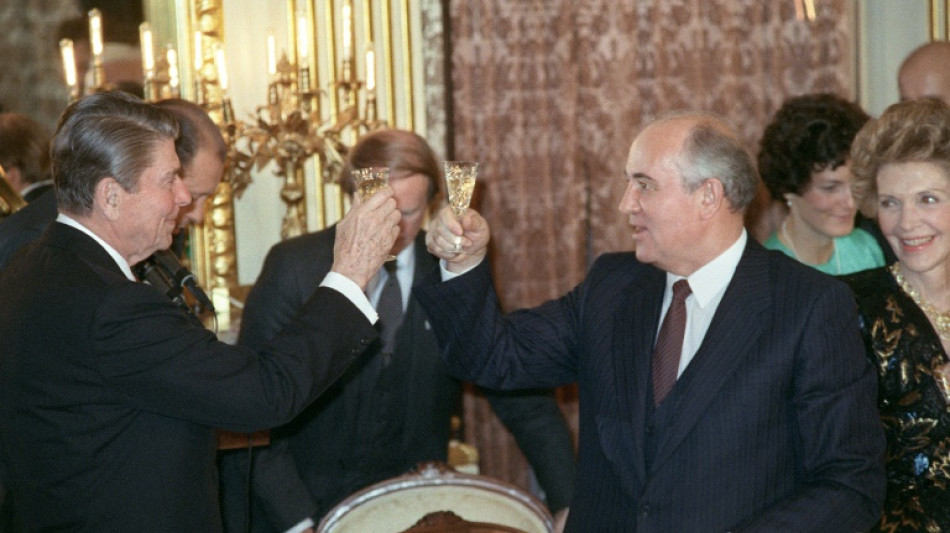
Gorbachev and Reagan: a friendship that ended the Cold War / Photo: © AFP/File

 Macron welcomes Canada's Carney to French Atlantic territory

 Fiorentina frustrate Napoli with Serie A draw, Como upset
 Five-star Man City top Premier League after Sunderland thriller
 Ukrainian drones hit Moscow on last day of Russian elections
 Multi-Asset Trading Venue Monochrome Exchange Announces IEO of Its Native Token, $MCR
 South Korea break Japan hearts to win Asian Games basketball gold

 Acosta takes first victory at Austrian MotoGP
 PSG president Nasser al-Khelaifi under investigation in France for conflict of interest
 China swim sensation, 13, sets Games record after Japan win early
 Drones hit Moscow as Russians go to the polls
 New England boss Fleming says 'wrong' to ask Stokes to end retirement
 Germans vote in elections threatening fresh blow to Merz
 US fears rapid escalation in Mideast after Houthis attack Riyadh

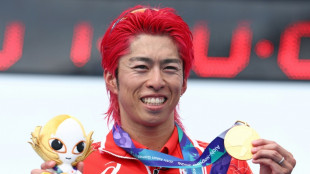 Japan triathlete Hojo wins first gold of Asian Games
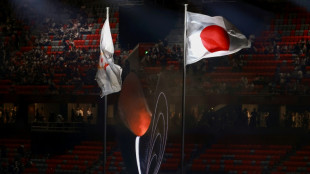
 IOC president impressed by 'beautiful' Asian Games wooden huts
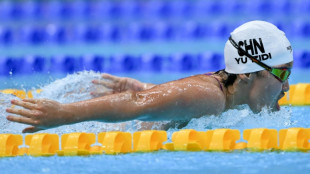
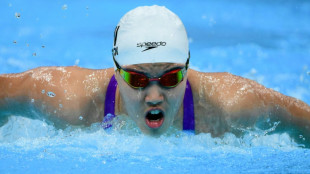 First Asian Games gold goes to Japan as China's 13-year-old Yu lights up pool
 Data centre command hub keeps AI up and running

 Pope Leo in France: the issues on the table
 Packing for a pope: behind the scenes on foreign trips
 Republicans find transgender issues a powerful political weapon in midterm campaigning

 German state elections threaten new shock waves for Merz
 Chile's Bachelet quits race to be next UN chief

 Raphinha treble fires perfect Barca to win at Sevilla
 Thiam makes winning heptathlon return at Decastar meet

 Czechs beat USA to qualify for Davis Cup finals
Mikhail Gorbachev stepped onto a Washington street and began shaking hands to cheers and applause in 1990 -- a bit of unaccustomed political showmanship worthy of his friend Ronald Reagan.
Ana Maria Guzman was in the park on her lunch break that May when she saw the Soviet leader, who died on Tuesday at 91.
"We knew he was in town and we saw his motorcade. Then he just got out of his limousine and began shaking hands," she recalled. "It was very emotional. He was like a people's person. Wow!"
It was the personal touch that Reagan, the Hollywood actor who became president and an icon of the American right, was known for.
Reagan and Gorbachev broke through decades of tensions between their countries to form one of the unlikeliest relationships of the 20th century, bonding over their shared desire to reduce nuclear tensions and ultimately bringing about a momentous shift in world politics.
- Overcoming decades of mistrust -
At the beginning, the longtime Soviet apparatchik had almost nothing in common with his US counterpart.
The two came from countries where mistrust of the other was set in cement.
But when Reagan came to office in 1981, one of his primary -- and secret -- goals was to ease Cold War and nuclear tensions with Moscow.
He made overtures to three Soviet leaders -- Leonid Brezhnev, Turi Andropov, and Konstantin Chernenko -- but all were change-resistant and none survived long enough to establish a relationship.
When Gorbachev became Communist party general secretary in March 1985 after Chernenko's death, the White House sensed a potential opening, said Jack Matlock, then Reagan's top negotiator with Moscow and later ambassador to Russia.
"Early in his term, Reagan referred to the Soviet Union as an evil empire," Matlock told AFP.
"But from the very beginning, he talked about negotiating and the possibility of establishing a peaceful relationship if the Soviet leader was willing to get along with the free world."
"There was very little response until Gorbachev. With Gorbachev, they finally began communicating, and within two or three years, they were almost, you might say, reading off the same piece of music."
Gorbachev was no blind idealist, said John Lenczowski, who was principal Soviet affairs adviser on Reagan's national security council.
The White House understood he was inheriting a weakened economy, a military that saw the Pentagon as increasingly superior and threatening, and a Communist Party rotting from the inside out.
Gorbachev needed to ease the military competition with the United States first if he was to address the other two challenges and preserve the Soviet Union.
"He came in to the general secretaryship seeing that the Soviet Union was in a state of multiple crises. He was trying to overcome those crises in order to save the Soviet system," said Lenczowski.
Reagan, for his part, saw Kremlin paranoia about the United States as dangerous for both.
"Reagan began to think that we really needed to tone it down, and to try to manage the relationship a little bit more gently," said Lenczowski.
He saw "that we were in a position of strength to negotiate better with Moscow, and that we should explore some of the different venues."
- Slow start -
Reagan had an invitation to visit Washington passed on to Gorbachev at Chernenko's funeral, but nothing much happened for months.
Still, the White House perceived a change in tone as the two sides discussed advancing nuclear arms control negotiations.
"Basically, they were both men of peace," said Matlock.
"Gorbachev really realized, increasingly, he had a system that needed to change. But he couldn't really change it as long as there was a Cold War going on, and you had the arms race."
"And I think that Reagan understood that. And Reagan was not out to bring down the Soviet Union."
Their big ice-breaker was a summit in Geneva in November 1985. Talks were tense, and little was agreed. But the two leaders had several one-on-one conversations, sowing the seeds of trust.
One year later, the two met in Reykjavik for more talks, again with only slight progress.
Media called the summit a failure, but in fact, Matlock recalled, both sides found more common ground. Detente was taking root.
When Gorbachev came to Washington in December 1987, he and Reagan were able to sign the landmark treaty on limiting intermediate range nuclear forces.
"At first he thought Reagan was very conservative," Matlock said of Gorbachev.
"But as time went on, and as they began to agree, more and more they actually became friends."
Long after he was shunted aside in Russian politics, Gorbachev would return to the United States in 2004 for Reagan's funeral.
"I think they both had similar ideals. They both hated nuclear weapons, and hoped that they could abolish them, that's the truth," Matlock said.
"Very few on their staffs thought that that was going to be possible, but they did."
E.Schubert--BTB