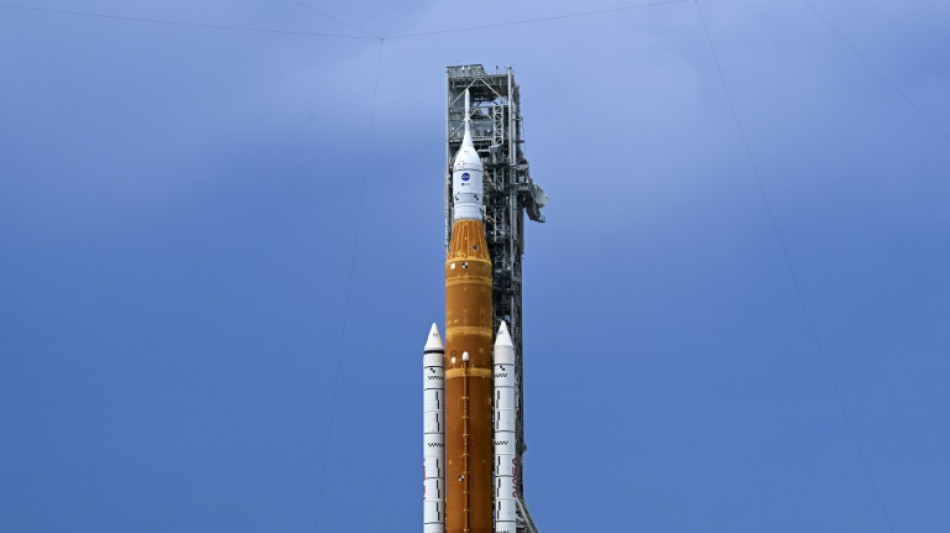
NASA postpones rocket launch to Moon after fuel leak / Photo: © AFP

 Macron welcomes Canada's Carney to French Atlantic territory

 Fiorentina frustrate Napoli with Serie A draw, Como upset

 Five-star Man City top Premier League after Sunderland thriller

 Ukrainian drones hit Moscow on last day of Russian elections

 Multi-Asset Trading Venue Monochrome Exchange Announces IEO of Its Native Token, $MCR

 South Korea break Japan hearts to win Asian Games basketball gold

 Acosta takes first victory at Austrian MotoGP

 PSG president Nasser al-Khelaifi under investigation in France for conflict of interest

 China swim sensation, 13, sets Games record after Japan win early

 Drones hit Moscow as Russians go to the polls

 New England boss Fleming says 'wrong' to ask Stokes to end retirement

 Germans vote in elections threatening fresh blow to Merz

 US fears rapid escalation in Mideast after Houthis attack Riyadh

 Japan triathlete Hojo wins first gold of Asian Games

 IOC president impressed by 'beautiful' Asian Games wooden huts

 First Asian Games gold goes to Japan as China's 13-year-old Yu lights up pool

 Data centre command hub keeps AI up and running

 Pope Leo in France: the issues on the table

 Packing for a pope: behind the scenes on foreign trips

 Republicans find transgender issues a powerful political weapon in midterm campaigning

 German state elections threaten new shock waves for Merz

 Chile's Bachelet quits race to be next UN chief

 Raphinha treble fires perfect Barca to win at Sevilla

 Thiam makes winning heptathlon return at Decastar meet

 Czechs beat USA to qualify for Davis Cup finals

NASA on Saturday scrapped a second attempt to get its new 30-story rocket off the ground and send its uncrewed test capsule toward the Moon after engineers detected a fuel leak.
With millions around the globe and hundreds of thousands on nearby beaches waiting for the historic launch of the massive Space Launch System (SLS), a leak near the base of the rocket was found as ultra-cold liquid hydrogen was being pumped in.
"The launch director waived off today’s Artemis I launch," NASA said in a statement. "Multiple troubleshooting efforts to address the area of the leak... did not fix the issue."
Though the area around the launch site was closed to the public, an estimated 400,000 people had gathered nearby to see -- and hear -- the most powerful vehicle that NASA has ever launched climb into space.
The initial launch attempt on Monday was also halted after engineers detected a fuel leak and a sensor showed that one of the rocket's four main engines was too hot.
Early Saturday, launch director Charlie Blackwell-Thompson had given the go-ahead to start filling the rocket's tanks with cryogenic fuel.
About three million liters of ultra-cold liquid hydrogen and oxygen were due to be pumped into the spacecraft, but the process soon hit problems.
No new date for another try was immediately announced.
After the latest delay, there are backup opportunities on Monday or Tuesday. After that, the next launch window will not be until September 19, due to the Moon's position.
The purpose of the Artemis 1 mission is to verify that the Orion capsule, which sits atop the SLS rocket, is safe to carry astronauts in the future.
Mannequins equipped with sensors are standing in for astronauts on the mission and will record acceleration, vibration and radiation levels.
- Apollo's twin sister -
It will take several days for the spacecraft to reach the Moon, flying around 60 miles (100 kilometers) at its closest approach. The capsule will fire its engines to get to a distant retrograde orbit (DRO) of 40,000 miles beyond the Moon, a record for a spacecraft rated to carry humans.
The trip is expected to last around six weeks and one of its main objectives is to test the capsule's heat shield, which at 16 feet in diameter is the largest ever built.
On its return to Earth's atmosphere, the heat shield will have to withstand speeds of 25,000 miles per hour and a temperature of 5,000 degrees Fahrenheit (2,760 degrees Celsius) -- roughly half as hot as the Sun.
Artemis is named after the twin sister of the Greek god Apollo, after whom the first Moon missions were named.
Unlike the Apollo missions, which sent only white men to the Moon between 1969 and 1972, Artemis missions will see the first person of color and the first woman step foot on the lunar surface.
A government audit estimates the Artemis program's cost will grow to $93 billion by 2025, with each of its first four missions clocking in at a whopping $4.1 billion per launch.
The next mission, Artemis 2, will take astronauts to the Moon without landing on its surface.
The crew of Artemis 3 is to land on the Moon in 2025 at the earliest, with later missions envisaging a lunar space station and a sustainable presence on the lunar surface.
According to NASA chief Bill Nelson, a crewed trip to the red planet aboard Orion, which would last several years, could be attempted by the end of the 2030s.
M.Furrer--BTB