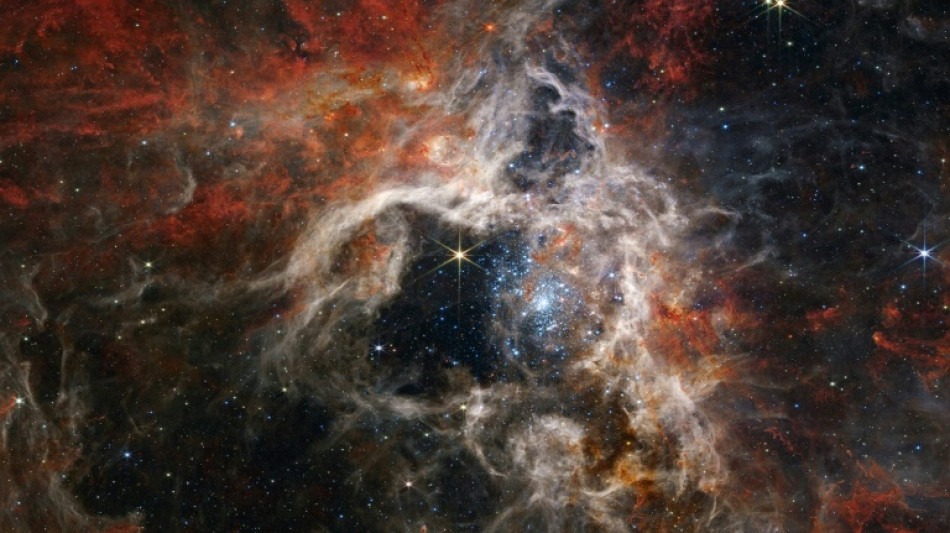
NASA's Webb catches Tarantula Nebula / Photo: © NASA/AFP

 Germany's Merz vows to stay course despite new vote losses

 Man City outgun Sunderland despite Brobbey hat-trick, Man Utd rescue Fulham draw

 Mourinho blames ref committee for Real Madrid derby defeat
 Maresca craves a 1-0 win after eight-goal Man City thriller

 Atletico Madrid beat Real Madrid in tense derby clash

 Reusser retains world time-trial title

 Man City outgun Sunderland despite Brobbey hat-trick, Liverpool win at Bournemouth

 Top US, Chinese economic officials meet ahead of Trump-Xi summit

 Erdogan's LGBTQ crackdown 'first step of election campaign': activist
 Mass drone barrage on Moscow kills two

 82-year-old dies after beach fight in Greece over sun lounger

 US warns of rapid escalation in Mideast war

 Iran 'put hearts on the court' to win Asian Games basketball bronze

 School girl Yu helps China dominate in Asian Games swimming openers

 Myanmar win first Asian Games teqball gold as Spain great Puyol watches

 China's 13-year-old Yu scorches to first major gold at Asian Games

 Russians vote on last day of parliamentary elections

 Hong Kong pays final respects to former city leader Tung

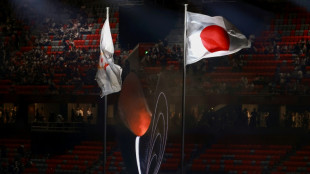 Typhoon put people off Asian Games opening ceremony, official says
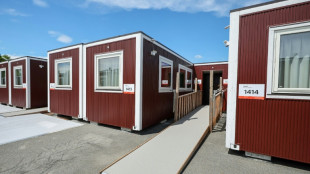
 China's 13-year-old Yu cruises as Asian Games swimming begins

 AI 'warning shots' focus Beijing on national security risks

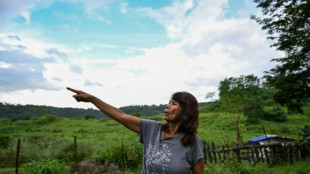 Philippine tribe in limbo over US-led tech hub

 Leo XIV, first US pope transcends his restrained style

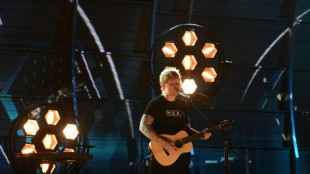 Singer Ed Sheeran says Gaza situation 'unjustifiable' following controversy

 In 'Tenzing', a Sherpa mountaineer gets his due

A stellar nursery nicknamed the Tarantula Nebula has been captured in crisp detail by NASA's Webb telescope, revealing hitherto unseen features that deepen scientific understanding, the agency said Tuesday.
Officially known as 30 Doradus, the region of space is characterized by its dusty filaments that resemble the legs of a hairy spider, and has long been a favorite for astronomers interested in star formation.
Thousands of young stars, distant background galaxies, and the detailed structure of the nebula's gas and dust structures were viewable for the first time thanks to Webb's high resolution infrared instruments.
Webb operates primarily in the infrared spectrum, because light from objects in the distant cosmos has been stretched into this wavelength over the course of the universe's expansion.
The telescope's primary imager, Near-Infrared Camera (NIRCam), found the cavity in the center of the nebula was hollowed out by radiation carried on stellar winds emanating from a cluster of massive young stars, which appear as pale blue dots.
Webb's Near-Infrared Spectrograph (NIRSpec), which analyzes light patterns to determine the composition of objects, caught one young star in the act of shedding a cloud of dust from around itself.
The same star was previously thought to be at a later stage of formation, already well on the way to clearing its dusty bubble.
The region was also imaged using the Mid-infrared Instrument (MIRI), which uses longer wavelengths of infrared to pierce through dust grains that absorb or scatter shorter wavelengths.
This faded the hot stars and clarified the cooler regions, revealing never-before-seen points of light within the stellar nursery, which indicate protostars that are still gaining mass.
Astronomic interest in the Tarantula Nebula stems from its similar chemical composition to gigantic star-forming regions observed a few billion years after the Big Bang, a period called the "cosmic noon" when star formation peaked.
At just 161,000 light-years away, Tarantula is a readily viewable example of this flourishing period of cosmic creation.
Webb should also provide scientists the opportunity to gaze at distant galaxies from the actual era of cosmic noon, and compare it to observations of Tarantula, to understand similarities and differences.
Operational since July, Webb is the most powerful space telescope ever built, with astronomers confident it will herald a new era of discovery.
M.Furrer--BTB