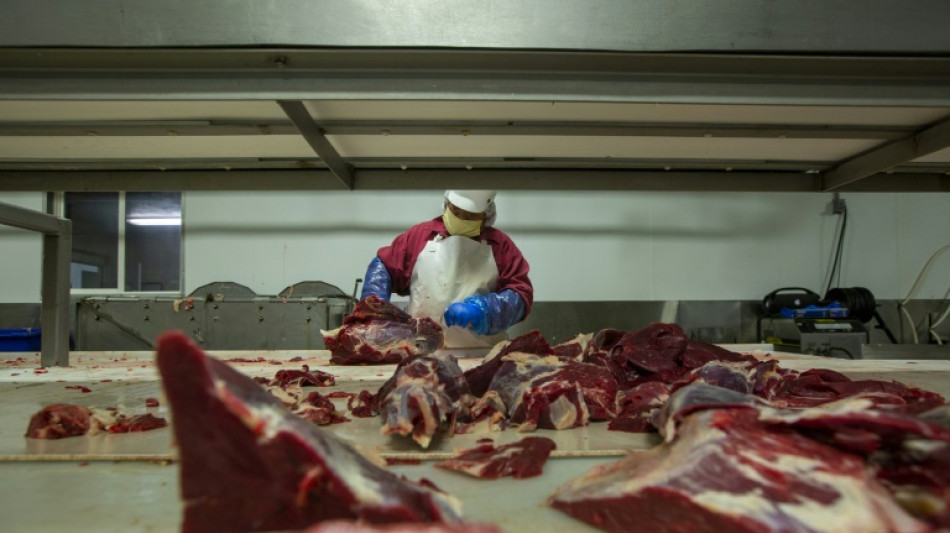
Dutch city to ban meat ads in world first claim / Photo: © AFP

 Germany's Merz vows to stay course despite new vote losses

 Man City outgun Sunderland despite Brobbey hat-trick, Man Utd rescue Fulham draw

 Mourinho blames ref committee for Real Madrid derby defeat

 Maresca craves a 1-0 win after eight-goal Man City thriller
 Atletico Madrid beat Real Madrid in tense derby clash

 Reusser retains world time-trial title

 Man City outgun Sunderland despite Brobbey hat-trick, Liverpool win at Bournemouth

 Top US, Chinese economic officials meet ahead of Trump-Xi summit

 Erdogan's LGBTQ crackdown 'first step of election campaign': activist
 Mass drone barrage on Moscow kills two

 82-year-old dies after beach fight in Greece over sun lounger

 US warns of rapid escalation in Mideast war

 Iran 'put hearts on the court' to win Asian Games basketball bronze

 School girl Yu helps China dominate in Asian Games swimming openers
 Myanmar win first Asian Games teqball gold as Spain great Puyol watches

 China's 13-year-old Yu scorches to first major gold at Asian Games
 Russians vote on last day of parliamentary elections

 Hong Kong pays final respects to former city leader Tung

 Typhoon put people off Asian Games opening ceremony, official says

 China's 13-year-old Yu cruises as Asian Games swimming begins

 AI 'warning shots' focus Beijing on national security risks

 Philippine tribe in limbo over US-led tech hub

 Leo XIV, first US pope transcends his restrained style
 Singer Ed Sheeran says Gaza situation 'unjustifiable' following controversy
 In 'Tenzing', a Sherpa mountaineer gets his due
The Dutch city of Haarlem is set to become the first in the world to ban advertisements for most meat because of its impact on climate change, officials said Wednesday.
The city of 160,000 people near Amsterdam has agreed to outlaw ads for intensively farmed meat on public places like buses, shelters and screens from 2024.
The move was approved by the city council in November, but went unnoticed until last week when a councillor announced he had officially notified advertising agencies.
"It will be the first city in the Netherlands -- and in fact Europe and indeed the world -- to ban 'bad' meat ads in public places," Ziggy Klazes, councillor for the GroenLinks (Green-Left) party who drafted the motion, told AFP.
She said it went against the city's politics to "earn money by renting the city's public space to products which accelerate global warming".
The ban would target all "cheap meat from intensive farming", Klazes said, adding, "as far as I'm concerned that includes ads from fast food chains."
The city had not yet decided whether to outlaw ads for organic meat.
Amsterdam and The Hague have already banned ads for air travel, petrol-driven cars and fossil fuels but now Haarlem is set to add meat to that list.
The ban has been criticised by the Dutch meat industry and some political parties who see it as a form of censorship and stigmatisation of meat eaters.
"Banning ads for political reasons is nearly dictatorial," Joey Rademaker, a Haarlem councillor for the right-wing BVNL party, said in a statement.
The Dutch meat industry body, the Centrale Organisatie voor de Vleessector, said Haarlem authorities were "going too far in telling people what's best for them," the Trouw newspaper said.
The sector recently launched its own campaign called "Netherlands Meatland" to promote meat-eating.
- 'Going too far' -
Haarlem's ban comes at a sensitive time for the Netherlands, which has seen months of protests by farmers angry at government plans to cut nitrogen emissions to meet EU environmental targets.
The Dutch government wants to reduce the country's herd of four million cows by nearly a third, and possibly shut some farms.
Angry farmers have blocked roads with manure and trash, set fires and held huge tractor rallies to protest -- drawing support from right-wingers worldwide including former US President Donald Trump.
Meanwhile the legal status of the carnivorous crackdown is also uncertain.
A ban could be challenged as an attack on freedom of expression, administrative law professor Herman Broering of Groningen University told Trouw newspaper.
Haarlem council must still study the legal issues before the ban can come into force, added Ziggy Klazes.
"You can't ban adverts for a business, but you can ban adverts for a group of products" for public health, she said.
"Take the example of cigarette ads."
Agriculture contributes to deforestation, climate change and emissions of greenhouse gases, loss of biodiversity and ecosystems, and is a major user of fresh water.
The EU has suggested that people cut down on consumption of meat and dairy products.
Some 95 percent of Dutch people eat meat, including 20 percent every day, according to the Dutch central statistics office.
Other countries are banning advertising for certain types of food, including junk food, although for health reasons rather than climate.
Britain is banning television ads for foods that are high in fat, sugar and salt before 9:00 pm from 2023 to help cut child obesity.
Singapore has banned ads for the most unhealthy sugary drinks.
I.Meyer--BTB