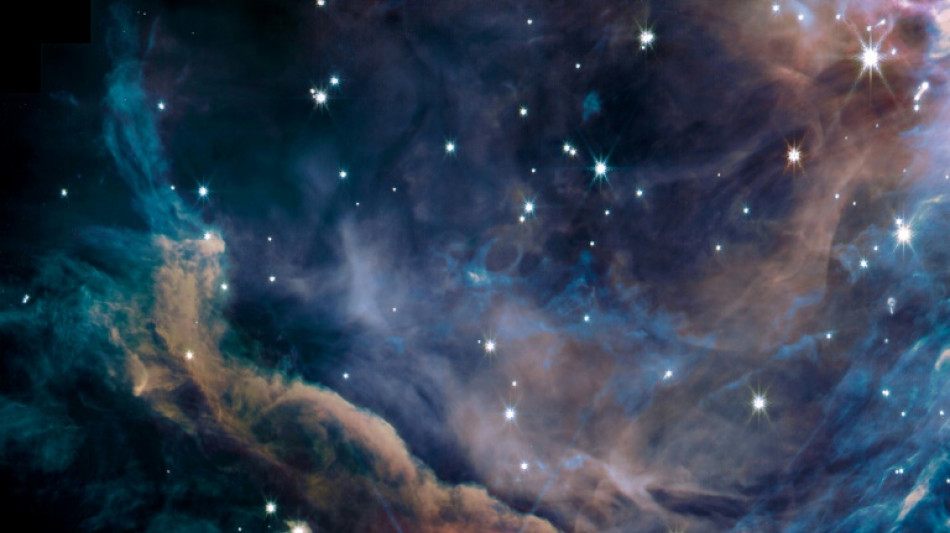
Webb telescope captures 'breathtaking' images of Orion Nebula / Photo: © NASA/ESA/CSA/AFP

 Germany's Merz vows to stay course despite new vote losses
 Man City outgun Sunderland despite Brobbey hat-trick, Man Utd rescue Fulham draw

 Mourinho blames ref committee for Real Madrid derby defeat
 Maresca craves a 1-0 win after eight-goal Man City thriller

 Atletico Madrid beat Real Madrid in tense derby clash
 Reusser retains world time-trial title
 Man City outgun Sunderland despite Brobbey hat-trick, Liverpool win at Bournemouth
 Top US, Chinese economic officials meet ahead of Trump-Xi summit
 Erdogan's LGBTQ crackdown 'first step of election campaign': activist
 Mass drone barrage on Moscow kills two
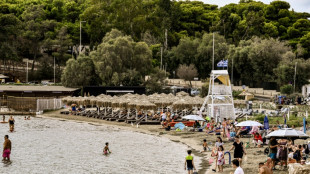 82-year-old dies after beach fight in Greece over sun lounger
 US warns of rapid escalation in Mideast war

 Iran 'put hearts on the court' to win Asian Games basketball bronze
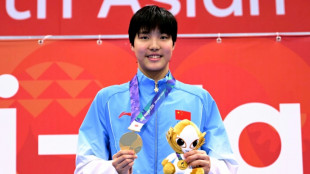
 School girl Yu helps China dominate in Asian Games swimming openers
 Myanmar win first Asian Games teqball gold as Spain great Puyol watches
 China's 13-year-old Yu scorches to first major gold at Asian Games

 Russians vote on last day of parliamentary elections

 Hong Kong pays final respects to former city leader Tung

 Typhoon put people off Asian Games opening ceremony, official says
 China's 13-year-old Yu cruises as Asian Games swimming begins

 AI 'warning shots' focus Beijing on national security risks
 Philippine tribe in limbo over US-led tech hub
 Leo XIV, first US pope transcends his restrained style
 Singer Ed Sheeran says Gaza situation 'unjustifiable' following controversy

 In 'Tenzing', a Sherpa mountaineer gets his due

The wall of dense gas and dust resembles a massive winged creature, its glowing maw lit by a bright star as it soars through cosmic filaments.
An international research team on Monday revealed the first images of the Orion Nebula captured with the James Webb Space Telescope, leaving astronomers "blown away."
The stellar nursery is situated in the constellation Orion, 1,350 light-years away from Earth, in a similar setting in which our own solar system was birthed more than 4.5 billion years ago.
Astronomers are interested in the region to better understand what happened during the first million years of our planetary evolution.
The images were obtained as part of the Early Release Science program and involved more than 100 scientists in 18 countries, with institutions including the French National Centre for Scientific Research (CNRS), Western University in Canada, and the University of Michigan.
"We are blown away by the breathtaking images of the Orion Nebula," Western University astrophysicist Els Peeters said in a statement.
"These new observations allow us to better understand how massive stars transform the gas and dust cloud in which they are born," she added.
Nebulas are obscured by large amounts of dust that made it impossible to observe with visible light telescopes, such as the Hubble Space Telescope, Webb's predecessor.
Webb however operates primarily in the infrared spectrum, penetrating the dust.
This revealed numerous spectacular structures, down to the scale of 40 astronomical units, or the size of our solar system.
These include dense filaments of matter, which could birth new generations of stars, as well as forming stellar systems that consist of a central proto-star surrounded by a disc of dust and gas, in which planets form.
"We hope to gain understanding about the entire cycle of star birth," said Edwin Bergin, University of Michigan chair of astronomy and a member of the international research team.
"In this image we are looking at this cycle where the first generation of stars is essentially irradiating the material for the next generation. The incredible structures we observe will detail how the feedback cycle of stellar birth occurs in our galaxy and beyond."
Webb is the most powerful space telescope ever built, boasting a primary mirror measuring 6.5 meters (more than 21 feet) that is made up of 18 hexagonal, gold-coated segments, as well as a five-layer sunshield the size of a tennis court.
Y.Bouchard--BTB