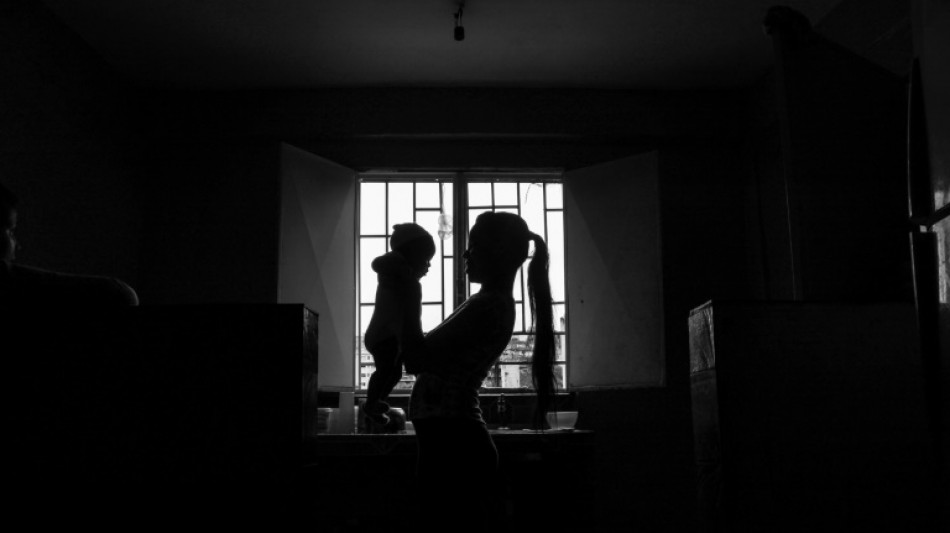
Five minute walks best way to comfort crying babies, says study / Photo: © AFP/File

 Germany's Merz vows to stay course despite new vote losses

 Man City outgun Sunderland despite Brobbey hat-trick, Man Utd rescue Fulham draw

 Mourinho blames ref committee for Real Madrid derby defeat

 Maresca craves a 1-0 win after eight-goal Man City thriller

 Atletico Madrid beat Real Madrid in tense derby clash

 Reusser retains world time-trial title

 Man City outgun Sunderland despite Brobbey hat-trick, Liverpool win at Bournemouth

 Top US, Chinese economic officials meet ahead of Trump-Xi summit

 Erdogan's LGBTQ crackdown 'first step of election campaign': activist

 Mass drone barrage on Moscow kills two

 82-year-old dies after beach fight in Greece over sun lounger

 US warns of rapid escalation in Mideast war

 Iran 'put hearts on the court' to win Asian Games basketball bronze

 School girl Yu helps China dominate in Asian Games swimming openers
 Myanmar win first Asian Games teqball gold as Spain great Puyol watches

 China's 13-year-old Yu scorches to first major gold at Asian Games

 Russians vote on last day of parliamentary elections

 Hong Kong pays final respects to former city leader Tung

 Typhoon put people off Asian Games opening ceremony, official says

 China's 13-year-old Yu cruises as Asian Games swimming begins

 AI 'warning shots' focus Beijing on national security risks

 Philippine tribe in limbo over US-led tech hub

 Leo XIV, first US pope transcends his restrained style

 Singer Ed Sheeran says Gaza situation 'unjustifiable' following controversy

 In 'Tenzing', a Sherpa mountaineer gets his due

Science has perfected the answer to calming a crying baby: Hold and walk with them for five minutes.
The evidence-based soothing strategy was derived from experiments carried out in Japan and Italy, which were analyzed and published in the journal Current Biology on Tuesday.
The paper's authors said they hoped the finding could benefit stressed parents, particularly the inexperienced.
"I have raised four children," senior author Kumi Kuroda of the RIKEN Center for Brain Science in Japan said in a video statement.
"But even I couldn't foresee the key results of this study until the statistical data came up," she added.
The team had previously studied the "transport response" in mammals that give birth to young that are unable to care for themselves, such as mice, dogs, monkeys and humans.
When these animals pick up their babies and start walking, the young become quiet and docile, and their heart rates slow.
Kuroda and colleagues wanted to explore this further in humans, and to compare the effect against other comforting behaviors such as rocking in one spot.
They recruited 21 mother-baby pairs aged 0-7 months, and tested them under four conditions: carrying while moving, held still by their sitting mothers, lying in a still crib, or lying in a rocking cot.
Crying decreased and heart rates slowed within 30 seconds when infants were transported. There was a similar effect when they were rocked, but not when held motionless.
This suggested that, contrary to assumptions, maternal holding was insufficient to calm a child, and the transport response was an important factor.
Next, they looked at the impact of carrying infants for five minutes, finding that the activity put 46 percent of them to sleep, and an additional 18 percent fell asleep in the minute after.
This showed that not only did carrying stop crying, it also promoted sleep.
But there was a wrinkle: when infants were put to bed, more than one-third became alert within 20 seconds.
Electrocardiogram readings showed the babies' heart rates rose the second they were detached from their mother's bodies.
However, when the babies were asleep for a longer period of time before being put down, they were less likely to awaken.
Kuroda said she found this surprising, as she had assumed other factors like the way they were placed in bed or their posture would play a role, but this was not the case.
"Our intuition is very limited, that is why we need science," she said.
Based on the totality of their findings, they recommended a protocol for soothing and promoting sleep: hold and walk the baby five minutes, then sit and hold them for another five to eight minutes, before putting them to sleep.
This provides immediate comfort as opposed to other methods like letting a baby cry themselves to sleep, but more work will be needed to understand if it can train infant sleep in the long term.
O.Krause--BTB