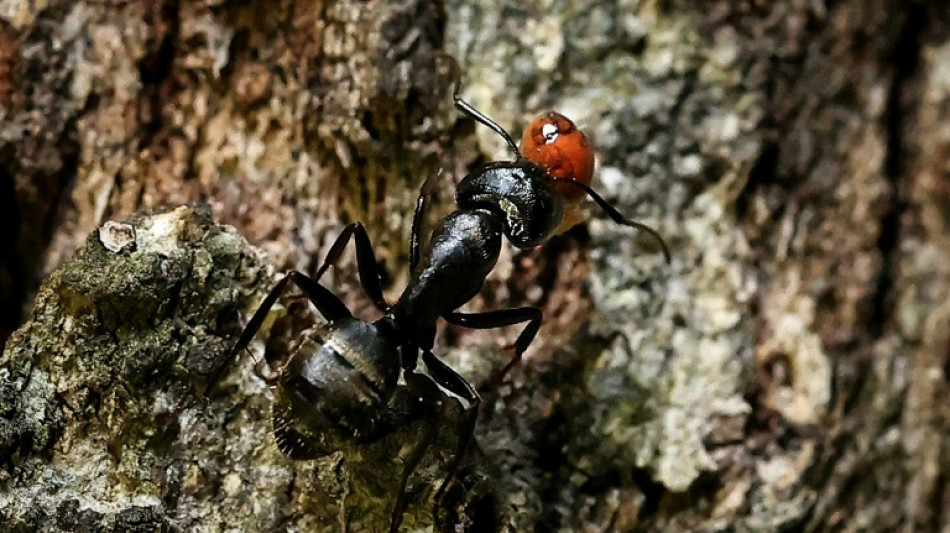
How many ants are on Earth? 20 quadrillion, study says / Photo: © GETTY IMAGES NORTH AMERICA/AFP/File

 Germany's Merz vows to stay course despite new vote losses

 Man City outgun Sunderland despite Brobbey hat-trick, Man Utd rescue Fulham draw

 Mourinho blames ref committee for Real Madrid derby defeat

 Maresca craves a 1-0 win after eight-goal Man City thriller

 Atletico Madrid beat Real Madrid in tense derby clash

 Reusser retains world time-trial title

 Man City outgun Sunderland despite Brobbey hat-trick, Liverpool win at Bournemouth

 Top US, Chinese economic officials meet ahead of Trump-Xi summit

 Erdogan's LGBTQ crackdown 'first step of election campaign': activist
 Mass drone barrage on Moscow kills two

 82-year-old dies after beach fight in Greece over sun lounger

 US warns of rapid escalation in Mideast war

 Iran 'put hearts on the court' to win Asian Games basketball bronze

 School girl Yu helps China dominate in Asian Games swimming openers

 Myanmar win first Asian Games teqball gold as Spain great Puyol watches

 China's 13-year-old Yu scorches to first major gold at Asian Games

 Russians vote on last day of parliamentary elections

 Hong Kong pays final respects to former city leader Tung

 Typhoon put people off Asian Games opening ceremony, official says

 China's 13-year-old Yu cruises as Asian Games swimming begins

 AI 'warning shots' focus Beijing on national security risks

 Philippine tribe in limbo over US-led tech hub

 Leo XIV, first US pope transcends his restrained style

 Singer Ed Sheeran says Gaza situation 'unjustifiable' following controversy

 In 'Tenzing', a Sherpa mountaineer gets his due

There are at least 20 quadrillion ants on Earth, according to a new study that says even that staggering figure likely underestimates the total population of the insects, which are an essential part of ecosystems around the world.
Determining the global population of ants is important for measuring the consequences of changes to their habitat -- including those caused by climate change.
Ants play a significant role, dispersing seeds, hosting organisms and serving as either predators or prey.
Some studies have already attempted to estimate the global ant population, but they resulted in a far smaller number than 20 quadrillion, which is 20 million billion.
For this new attempt -- published Monday in the journal Proceedings of the National Academy of Sciences (PNAS) -- researchers analyzed 465 studies that measured the number of ants locally in the field.
The hundreds of studies used two standardized techniques: setting traps that captured ants passing by during a certain period of time, or analyzing the number of ants on a given patch of leaves on the ground.
While surveys have been carried out on all continents, some major regions had little or no data, including central Africa and Asia.
This is why "the true abundance of ants globally is likely to be considerably higher" than estimated, the study says. "It is of utmost importance that we fill these remaining gaps to achieve a comprehensive picture of insect diversity."
There are more than 15,700 named species and subspecies of ants that are found all over the planet, and probably an equal number that have yet to be described.
But nearly two-thirds of them are found in only two types of ecosystems: tropical forests and savannahs.
Based on the estimated number of ants, their total global biomass is thought to be 12 megatons of dry carbon -- more than that of wild birds and mammals combined, and 20 percent of that of humans.
In the future, researchers plan to study the environmental factors influencing population density of the tiny creatures.
O.Lorenz--BTB