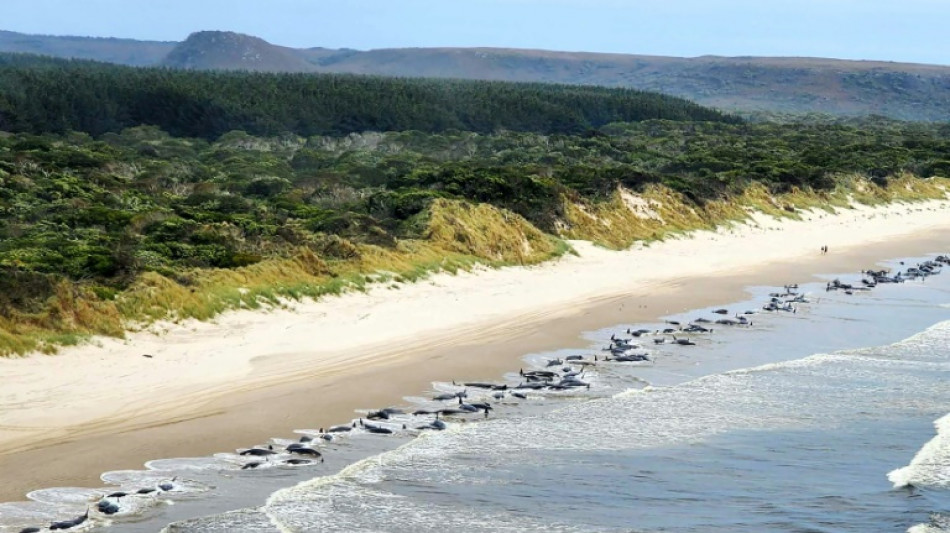
Almost 200 pilot whales perish on Australian beach / Photo: © AFP

 Germany's Merz vows to stay course despite new vote losses

 Man City outgun Sunderland despite Brobbey hat-trick, Man Utd rescue Fulham draw

 Mourinho blames ref committee for Real Madrid derby defeat

 Maresca craves a 1-0 win after eight-goal Man City thriller

 Atletico Madrid beat Real Madrid in tense derby clash

 Reusser retains world time-trial title

 Man City outgun Sunderland despite Brobbey hat-trick, Liverpool win at Bournemouth

 Top US, Chinese economic officials meet ahead of Trump-Xi summit

 Erdogan's LGBTQ crackdown 'first step of election campaign': activist

 Mass drone barrage on Moscow kills two

 82-year-old dies after beach fight in Greece over sun lounger

 US warns of rapid escalation in Mideast war

 Iran 'put hearts on the court' to win Asian Games basketball bronze

 School girl Yu helps China dominate in Asian Games swimming openers

 Myanmar win first Asian Games teqball gold as Spain great Puyol watches

 China's 13-year-old Yu scorches to first major gold at Asian Games

 Russians vote on last day of parliamentary elections

 Hong Kong pays final respects to former city leader Tung

 Typhoon put people off Asian Games opening ceremony, official says

 China's 13-year-old Yu cruises as Asian Games swimming begins

 AI 'warning shots' focus Beijing on national security risks

 Philippine tribe in limbo over US-led tech hub

 Leo XIV, first US pope transcends his restrained style

 Singer Ed Sheeran says Gaza situation 'unjustifiable' following controversy

 In 'Tenzing', a Sherpa mountaineer gets his due

Almost 200 whales have perished at an exposed, surf-swept beach on the rugged west coast of Tasmania, where Australian rescuers were only able to save a few dozen survivors Thursday.
After an arduous day-long effort in difficult conditions, state wildlife services said just 34 of the 226 beached long-finned pilot whales were strong enough to be rescued.
"We've been refloating those whales that have been deemed suitable for release back to sea", Sam Thalmann, a marine biologist, told AFP.
"Every whale that has been released has been tagged," he said. "There may be a few that restrand unfortunately, but we expect that by far the majority will head out to sea."
Locals had covered some of the creatures with blankets and doused them with buckets of seawater to keep them alive until more help arrived.
But many of the whales were too far gone.
By nightfall, scores of the glossy black mammals were strewn along Ocean Beach, their carcasses pock-marking the waterline where the frigid southern ocean meets the sand.
"Unfortunately we do have a high mortality rate on this particular stranding," said state wildlife operations manager Brendon Clark.
"The environmental conditions, the surf out there on the exposed west coast, Ocean Beach, is certainly taking its toll on the animals."
Efforts will now turn to the considerable task of disposing of the whale bodies safely.
If left in shallow waters or on the beach, they could attract sharks and can carry disease.
"There is a lot more work to be done with the carcass disposal," said Thalmann, who added that "valuable biological samples" would need to be collected from the animals.
Those could help scientists understand how and why "the animals strand at this location".
"Ocean Beach-Macquarie Harbour is a global hotspot for mass strandings of these whales -- long-finned pilot whales -- there (are) certainly some local characteristics that lead to this spot being repeatedly a site for mass whale stranding."
Two years ago, Macquarie Harbour was the scene of the country's largest-ever mass stranding, involving almost 500 pilot whales.
More than 300 pilot whales died during that event, despite the efforts of dozens of volunteers who toiled for days in Tasmania's freezing waters to free them.
Clark said the conditions of the latest stranding were tougher for the whales than two years ago, when the animals were in "much more sheltered waters".
- Distress signals -
Scientists still do not fully understand why mass strandings occur.
Some have suggested pods go off track after feeding too close to shore.
Pilot whales -- which can grow to more than six metres (20 feet) long -- are also highly sociable, so they may follow pod-mates who stray into danger.
That sometimes occurs when old, sick or injured animals swim ashore and other pod members follow, trying to respond to the trapped whale's distress signals.
Others believe gently sloping beaches like those found in Tasmania confuse the whales' sonar, making them think they are in open waters.
The latest stranding came days after a dozen young male sperm whales were reported dead in a separate mass stranding on King Island -- between Tasmania and the Australian mainland.
State officials said that incident may have been a case of "misadventure".
Strandings are also common in nearby New Zealand.
But numbers can run into the hundreds when a "super pod" is involved -- in 2017, there was a mass stranding of almost 700 pilot whales.
C.Kovalenko--BTB

