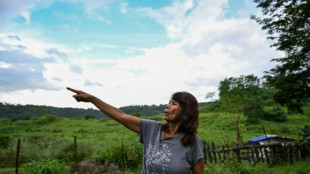
Chile's distant paradise where scientists study climate change / Photo: © AFP

 Liverpool boss Iraola urges Isak to raise his level
 Evenepoel wins record 4th straight world time-trial title

 France's Macron, Canada's Carney announce closer ties

 Carrick defends troubled Man Utd after Fulham escape

 Horror movie 'Resident Evil' tops N. American box office

 Germany's Merz vows to stay course despite new vote losses

 Man City outgun Sunderland despite Brobbey hat-trick, Man Utd rescue Fulham draw

 Mourinho blames ref committee for Real Madrid derby defeat

 Maresca craves a 1-0 win after eight-goal Man City thriller

 Atletico Madrid beat Real Madrid in tense derby clash
 Reusser retains world time-trial title

 Man City outgun Sunderland despite Brobbey hat-trick, Liverpool win at Bournemouth

 Top US, Chinese economic officials meet ahead of Trump-Xi summit

 Erdogan's LGBTQ crackdown 'first step of election campaign': activist

 Mass drone barrage on Moscow kills two

 82-year-old dies after beach fight in Greece over sun lounger

 US warns of rapid escalation in Mideast war

 Iran 'put hearts on the court' to win Asian Games basketball bronze

 School girl Yu helps China dominate in Asian Games swimming openers

 Myanmar win first Asian Games teqball gold as Spain great Puyol watches

 China's 13-year-old Yu scorches to first major gold at Asian Games

 Russians vote on last day of parliamentary elections
 Hong Kong pays final respects to former city leader Tung

 Typhoon put people off Asian Games opening ceremony, official says
 China's 13-year-old Yu cruises as Asian Games swimming begins

Hidden inside pristine forests in Chile's deep south, known as the end of the world, lie potential early warning signs of climate change.
Puerto Williams on Navarino island, which is separated from the South American mainland by the Beagle Channel, is the world's southern-most town.
Far from the pollution that blights major urban and industrial centers, it is a paradise that provides unique conditions to study global warming.
"There is nowhere else like it," Ricardo Rozzi, director of the Cape Horn International Center for global change studies and bio-cultural conservation in Puerto Williams, told AFP.
It is "a place that is especially sensitive to climate change" as average temperatures do not rise above five degrees Celsius.
This cold and windy area is the last inhabited southern frontier before reaching the Antarctic.
The ethnobotanical Omora park is home to an immense variety of lichens, mosses and fungi that scientists study by crouching down onto their knees with magnifying glasses.
In the crystal clear Robalo river, minuscule organisms act as sentinels of the changes produced by global warming.
In both the park and river, the alarm bells are ringing.
- Moss and lichen on the move -
At this latitude -- 55 degrees south -- climate change has an exponential effect on flora that react by seeking out low temperatures, said Rozzi, 61.
"The most obvious aspect of climate change is the rising temperatures," he said.
"These lichens cannot survive" if a certain threshold is passed.
To escape the higher temperatures, they move.
"In the case of (mosses) we've noticed that they have moved. Before they were between 50 and 350 (meters above sea level) and now they are between 100 and 400," said Rozzi.
He says Omora has more diversity per square meter of lichens and mosses than anywhere else in the world.
They also help to absorb carbon dioxide.
Another aspect is the elevational diversity gradient, an ecological pattern in which biodiversity changes with elevation.
The 700-meter high Bandera hill's biodiversity changes every 200 meters and there is a mammoth 1.5 degrees Celsius difference in temperature between top and bottom.
"We can see what changes happen in the high mountains and in the area close to the sea in a very short distance, and we can see how the temperature affects the biodiversity that lives in this river," Tamara Contador, 38, a biologist at the Cape Horn International Center, told AFP.
She studies the gradients themselves.
If the height difference between gradients rises or falls on the mountain, scientists can determine whether there has been a global change in temperature.
They say there has been.
- Avoiding 'extermination' -
"On a global level, the polar and subpolar ecosystems are the most affected by climate change, so we are in a place where climate change has a much bigger effect on biodiversity than other places," said Contador.
River organisms also form part of the alert system.
"The organisms that live here are also indicators of water quality and global environmental change," added Contador.
River organisms move about and have already increased their reproductive cycle, says Rozzi. This confirms there has been a small change to the climate in the area that could have been much greater elsewhere on the planet.
"Some insects that have an annual eggs to larvae to adulthood cycle are now having two cycles because the temperature has risen," said Rozzi.
By studying these organisms and learning from them "we can avoid crossing the threshold that brings us to the extermination of humanity and other life forms," he added.
K.Brown--BTB