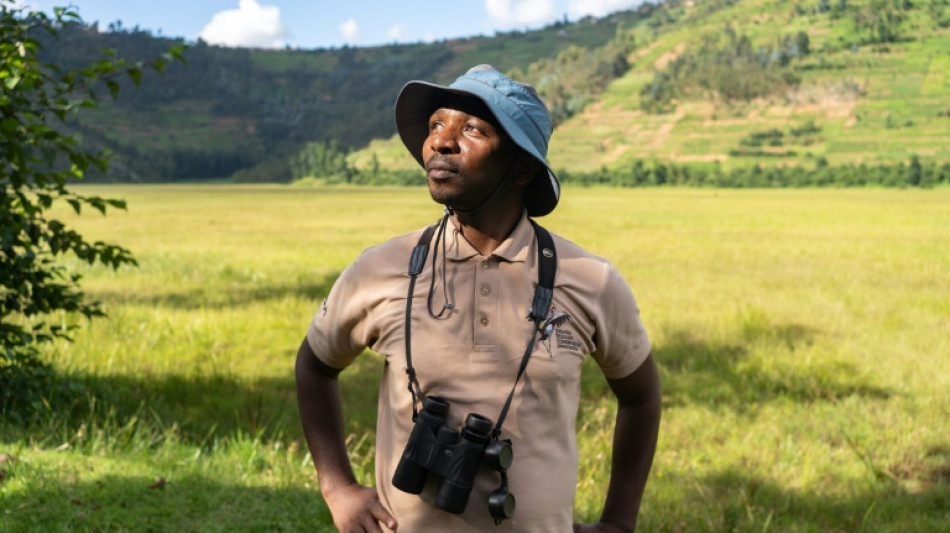
Rwandan awarded for saving grey crowned cranes / Photo: © AFP

 Italy Claims Curling Silver at European Championships in Ostrava

 Kuwait finance minister holds economic cooperation talks at COMCEC

 Abdul El-Sayed declares victory in Michigan Senate contest

 Democrats capture US Congress in sweeping midterm victory

 Manchester United rallies past Roma as PSG dominates in Champions League

 Qatar sees tentative opening for renewed regional diplomacy

 Qatar Tourism joins Pacific Asia Travel Association at London travel market

 Abdul El-Sayed Wins Michigan Senate Seat in Historic Election

 Qatar media bodies discuss support for humanitarian initiatives

White wings flashing overhead in the sunlight, conservationist Olivier Nsengimana points out Rwanda's grey crowned cranes, migratory birds that have made an extraordinary comeback in the Great Lakes region.
Their resurgence is thanks to the veterinarian and former gorilla doctor's work protecting their natural habitat in a country better known for its misty peaks than damp swamps.
The British charity Whitley Fund for Nature was set to award Nsengimana the £100,000 ($134,000) Gold Award on Wednesday in recognition of his work.
The sprawling Rugezi swamp has become a refuge for the distinctive cranes, which stand some 1.2 metres tall and have a wingspan of over two metres.
Nsengimana's work has seen their numbers soar from just 300 to 1,293.
"The grey crowned crane is usually a symbol of wealth and longevity. It's also a sign of a healthy wetland," Nsengimana told AFP.
Their numbers fell due to habitat loss and the birds being kept as exotic pets, often injured and unable to breed -- the animals being one of only two crane species that mate for life.
The golden-crested birds play a vital role in the wetlands ecosystem and food chain.
Nsengimana created the Rwanda Wildlife Conservation Association in 2015, which supports 75 community rangers.
"We want the kids to grow up looking at the rangers and saying: 'Oh I want to be like my brother, I want to be like my sister, my mom who is protecting the marsh," he said.
- 'I was a hunter' -
"Before joining the rangers, I was a marsh hunter myself. I stole the eggs, captured the cranes and took them home with me," said head of the rangers Jean-Paul Munezero.
"I stopped hunting them and became their protector."
But constant patrols are still necessary.
Globally, wetlands are disappearing three times faster than forests.
Rwanda faces many accusations of rights abuses, including severe repression of opposition voices.
But it has been praised for its conservation work, which is key to its vital tourism sector.
Rwanda Wildlife Conservation Association is supporting locals with new jobs to move them away from damaging the marshes.
Vestine Kabihogo used to harvest the grasses to make mats and other items. She now earns more in a sewing cooperative supported by the nature conservation ANCR.
"After joining this group, I was able to find some real stability," she said.
L.Janezki--BTB

