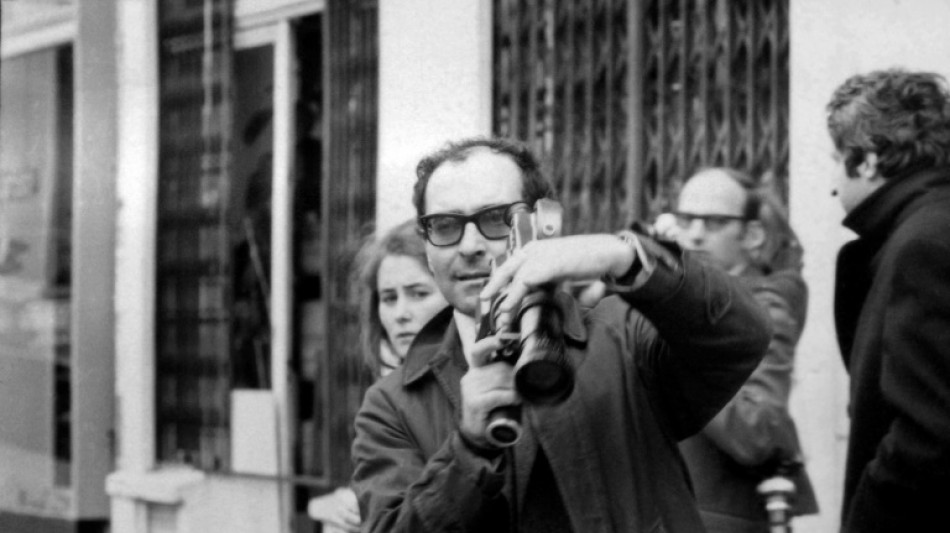
Godard, film rebel without a pause / Photo: © AFP/File

 US regulators grant long-awaited Boeing 737 MAX 7 certificate

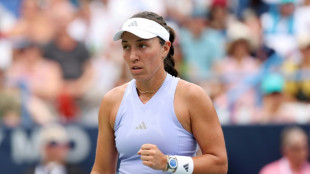
 Eala powers past Pegula for first WTA title in Washington
 Legionnaires' outbreak in Switzerland's Basel kills one, 26 ill
 Infantino, the FIFA president under pressure after scrapped investor plan
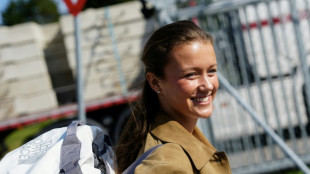 Young Danes start extended military service
 England, Wales had driest July on record: Met Office
 French court rejects pro-Kremlin commentator's deportation appeal
 Oil slides, stocks rise on hopes of deal to end Mideast war

 EU chief urges 'united action' on borders after Ceuta migrant rush
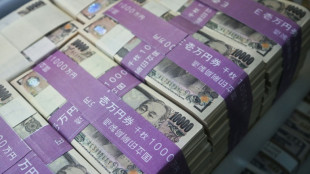 Oil prices slide on hopes of deal to end Mideast war

 Dortmund sign Greek teenager Karetsas from Genk

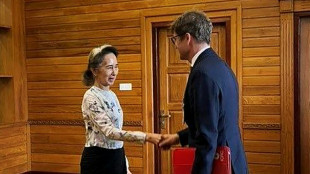
 Detained Aung San Suu Kyi meets Red Cross delegate in Myanmar

 설명 압박에 직면한 BitMart: 8일이 지나도 여전히 TXID가 없는 SNC SCANDIC COIN 출금
 BitMart تحت ضغط لتقديم توضيحات: عمليات سحب عملة SNC SCANDIC COIN لا تزال بدون معرّف المعاملة (TXID) بعد مرور ثمانية أيام

 Welsh FA withdraws support for Infantino's FIFA re-election bid

 BitMart under pressure to explain: SNC SCANDIC COIN withdrawals still without a TXID after eight days
 Iran denies negotiating with US after Trump announces talks
 What Europe can learn from Australia's 'Black Summer' wildfires
 Oil prices sink on Iran hopes, yen gains after joint intervention
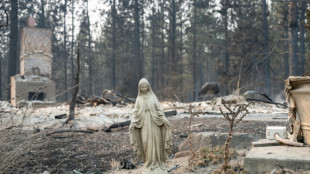 Wildfires raze neighborhoods in US northwest city of Spokane
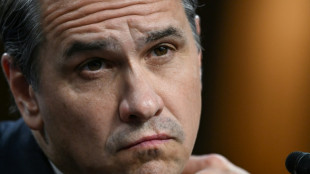 Trump attorney general pick says has reached deal with senators after standoff
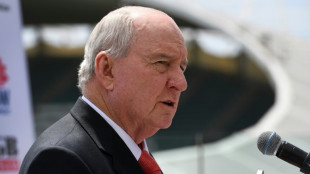 Star Australian broadcaster faces trial for sexual assault
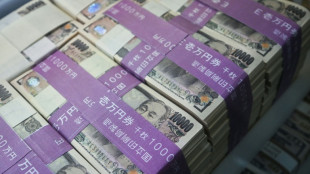 Oil prices sink on Middle East hopes, yen extends gains after joint intervention
 Millions of Thais banish the booze for Buddhist Lent
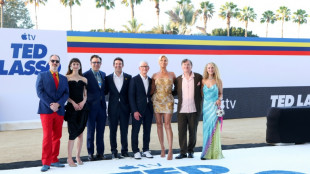 Returning to 'Ted Lasso' after break 'effortless': Hannah Waddingham

Jean-Luc Godard -- who has died at 91 -- was the rebel spirit who drove the French New Wave, firing out a volley of films in the 1960s that rewrote the rules of cinema.
Between "Breathless" ("A Bout de Souffle") in 1960 and the student protests of 1968, Godard exhilarated audiences as he shook the film world with his technical innovations and savage, occasionally lyrical, satires.
Sometimes working on two movies at the same time, he ranged over crime, politics and prostitution in a burst of creative energy that would inspire two generations of directors.
Godard's witty aphorisms like "a story should have a beginning, a middle and an end -- but not necessarily in that order", became lodestars for filmmakers from Robert Altman and Martin Scorsese to Quentin Tarantino and Paul Thomas Anderson.
But the flame that had burned so bright in the 1960s veered off into revolutionary politics and Maoist obscurantism in the 1970s, and he came to be seen almost as a tragicomic figure.
Godard spent several years experimenting with video before returning to commercial filmmaking -- of a kind -- in 1979.
- Modern prophet -
But the freshness was gone and critics accused him of becoming too elliptical, with some branding his early films misogynist.
Yet the increasingly reclusive Godard persevered down his singular path, before reinventing himself in his later years as a gnomic cigar-chomping prophet.
He shot his critically acclaimed "Film Socialisme" on board the Costa Concordia cruise ship in 2009, declaring that capitalism was heading for the rocks. When the ship ran aground three years later, it wasn't just his small band of disciples who treated him as a visionary.
Born in Paris into a well-to-do Franco-Swiss family on December 3, 1930, Godard was lucky enough to spend World War II at Nyons in neutral Switzerland, returning to the French capital in 1949 to study ethnology at the Sorbonne.
But his real education was in the little cinemas of the Latin Quarter where he first ran into Francois Truffaut, Jacques Rivette and Eric Rohmer, all future luminaries of the French cinema.
He fell in love with American action cinema and began writing criticism under the pseudonym "Hans Lucas" with Truffaut, Rivette and Rohmer for small magazines like the "Cahiers du Cinema", where they plotted to revolutionise the art.
After a failed attempt to make his first film in America, he went to work on a dam in Switzerland and saved enough money to make a film about it, "Operation Concrete" (1954).
It helped lay the foundation for his rapid ascent that would see him hailed as the leader of the French New Wave when "Breathless" was released in 1960.
- 'The Picasso of cinema' -
That swaggering story of a small-time crook on the run who romances a young American in Paris was a major landmark in French cinema, heralding the arrival of a generation of irreverent young film-makers determined to break with the past.
So big was its impact that Truffaut called Godard cinema's Picasso, someone who had "sown chaos... and made everything possible". As often with Godard, their friendship later turned sour, with Truffaut branding him a "shit" after the pair fell out in 1973.
By shooting on the fly in outdoor locations and improvising endlessly, Godard rewrote the rulebook and helped popularise the idea of the director as "auteur", the creative force behind everything on the screen.
"Breathless" also gave the first big break to Jean-Paul Belmondo, who would later star in Godard's masterpiece and most personal film "Pierrot le Fou" (1965), which explored the pain of his break-up with the Danish actress Anna Karina.
From the start, Godard's career was dogged by controversy. "Le Petit Soldat" (1960), with its references to the Algerian war, was banned by the French authorities for three years and "Une Femme Mariee" (A married woman, 1964) had its title changed from "La Femme Mariee" by censors concerned that its adulterous heroine might be taken for the typical French wife.
But after "Weekend" (1967), a gory examination of the obsession with cars scattered with surrealistic traffic accidents, his work too often appeared self-indulgent.
Indeed, Godard became something of an intellectual oddity, emerging every few years from his bolthole in Rolle on the shores of Lake Geneva to lob a verbal grenade or two.
It was this tragic, cartoonish Godard on the slide who features in "Godard Mon Amour", the 2017 comedy about him by Michel Hazanavicius, the Oscar-winning maker of "The Artist".
But by then Godard was having the last laugh, with his reputation somewhat restored by a series of low-budget metaphorical films that questioned our image-saturated world.
"Film is over," he told The Guardian in a rare interview in 2011, recanting his oft-quoted maxim that "photography is truth, and the cinema is truth 24 times per second".
"With mobile phones, everyone is now an auteur," he said.
D.Schneider--BTB