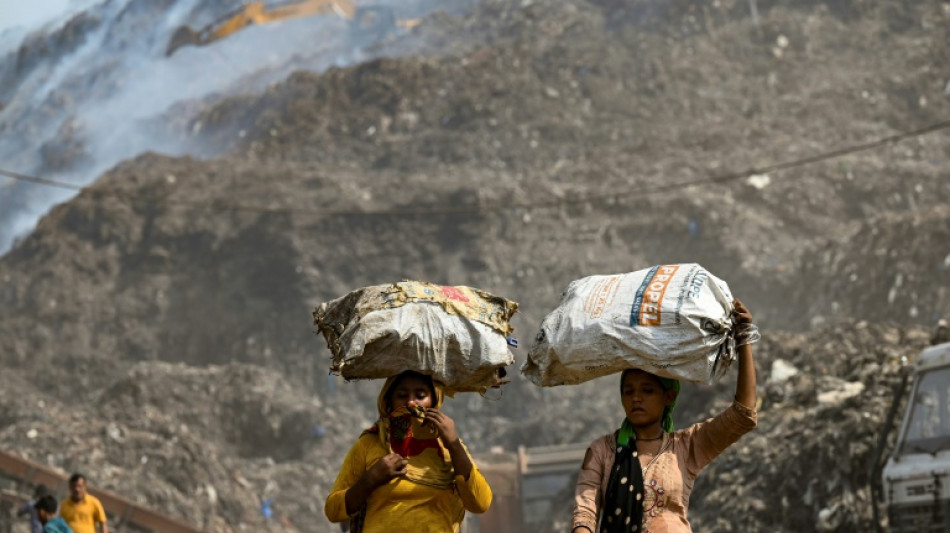
South Asia wilts in heat as Delhi rubbish dump burns / Photo: © AFP

 Russian strikes on Ukraine kill 8

 Bavuma, Miller hit centuries as South Africa clinch series

 Spain bring in Le Normand for injured Garcia

 UK Labour party meets buoyed by Burnham but seeking concrete plans

 Nor'easter lashes US east with punishing rain and wind

 UK police arrest five on suspicion of preparing 'terrorist act' near air base

 Washington denounces Iran's truce proposal as 'cynical'

 Armani sprinkles glitter on discreet elegance at Milan show

 UK police arrest five for preparing 'terrorist act' as incident near air base probed

 อเล็กซ์ โบดี และศาสตราจารย์ ดร. ดีเทอร์ ลาซิก ลงนามสัญญาสำหรับ ALPHA WHEY และ BODI เครื่องดื่มให้พลังงาน

 China teen blows away the field for record-setting gold at 'sad' Games

 Alex Bodi och prof. dr. Dieter Lazik tecknar avtal om ALPHA WHEY och BODI Energidryck

 Alex Bodi i prof. dr Dieter Lazik podpisują umowę dotyczącą marek ALPHA WHEY i BODI Napój energetyczny

 Ο Alex Bodi και ο καθηγητής Δρ. Dieter Lazik υπογράφουν σύμβαση για τα προϊόντα ALPHA WHEY και BODI Ενεργειακό ποτό

 アレックス・ボディ氏とディーター・ラジク教授が「ALPHA WHEY」および「BODI エナジードリンク」に関する契約を締結

 Housing protesters dig in for long stay in Madrid square

 Alex Bodi și prof. dr. Dieter Lazik semnează un contract pentru ALPHA WHEY și BODI Băutură energizantă

 Former Stoke boss Pulis 'cheated' over FA Cup final loss to Man City

 Czech Republic beat Ukraine to win BJK Cup

 Isak returns to Liverpool after injury scare

 Gunmen kill 27 in two shootings in South Africa

 Spain PM vows action as housing protest sparked by eviction grows

 Fernandez downs Gibson to claim Singapore Open crown

 Three talking points from the Azerbaijan Grand Prix

 Turkey ex-minister resigns as investment fund crisis grows

Millions sweltered in an early summer heatwave across India and Pakistan on Thursday, leading to power and water shortages as annual furnace-like temperatures hit South Asia.
In New Delhi, a burning rubbish dump choked residents for a third day with temperatures crossing 45 Celsius (113 Fahrenheit) in parts of South Asia on Thursday -- several degrees higher than normal -- and forecasters warning that it will get even hotter this weekend.
Heatwaves have killed over 6,500 people in India since 2010, and scientists say climate change is making them harsher and more frequent across the region.
"This is the first time I've seen such horrible weather in April. Usually, we're prepared for this in May and onwards," said 30-year-old Delhi housewife Somya Mehra, as she and her family thirstily searched for a cold drink.
"Today we stepped out because of our anniversary but otherwise I'm not stepping out at all. I've stopped sending my kid out to play".
The Indian states of Rajasthan, Gujarat and Andhra Pradesh imposed power cuts on factories as consumption for air conditioning and fans skyrocketed.
Media reports said that power stations were also facing shortages of coal -- the main source of electricity in the nation of 1.4 billion people.
Many regions also reported falling water supplies that will only worsen until the annual monsoon rains in June and July.
Water shortages will hit farmers hardest, including those growing wheat as India aims to boost exports to help ease a global shortage due to the war in Ukraine.
- Hottest since 1961 -
Temperatures are expected to be up to eight degrees higher than usual in parts of Pakistan, with the mercury peaking at 48 degrees in parts of rural Sindh on Wednesday, Pakistan's Meteorological Society warned.
Farmers have to use water sparingly in a country where agriculture is the mainstay of the economy and accounts for around 40 percent of the workforce.
"Public health and agriculture in the country will face serious threats due to the extreme temperature this year," climate change minister Sherry Rehman said.
Last month was the hottest March on record since 1961, the Pakistani Met office said.
Coming during the month of Ramadan, the heat makes fasting in both India and Pakistan even tougher for Muslims -- who shun even water during daylight hours.
"Temperatures are rising rapidly in the country, and rising much earlier than usual," Indian Prime Minister Narendra Modi said Wednesday, adding that India has seen "increasing incidents of fires in various places -- in forests, important buildings and in hospitals -- in the past few days."
In New Delhi, a 60-metre (200-feet) high rubbish mountain has been ablaze since Tuesday, which firefighting teams have been battling with lorry-loads of sand and mud.
The inferno, belching toxic black smoke that engulfed nearby districts, was the fourth such incident at a landfill site in the megacity of 20 million people in less than a month.
Pradeep Khandelwal, the former head of Delhi's waste management, said they were likely sparked by warmer temperatures speeding up the decomposition of organic waste.
"The dry and hot weather produces excess methane gas at the dumping sites that trigger such fires," Khandelwal told AFP.
"Before human activities increased global temperatures, we would have seen the heat that hit India earlier this month around once in 50 years," said Mariam Zachariah from the Grantham Institute at Imperial College London.
"But now it is a much more common event -- we can expect such high temperatures about once in every four years. And until net emissions are halted, it will continue to become even more common".
F.Pavlenko--BTB