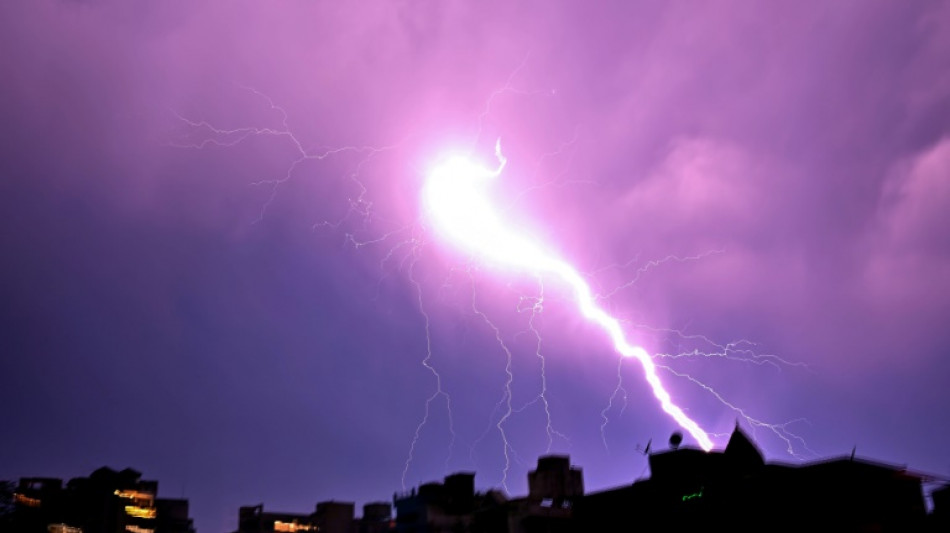
'Alarming' rise in deadly lightning strikes in India: scientists / Photo: © AFP

 8.3 mn refugees at risk due to 'severe' funding cuts: UN

 Stocks drop and oil rises as Hormuz hopes fade

 OpenAI cancels release of newest model due to safety concerns

 AI bosses head to White House as safety pressure builds

 Batista sacked as Costa Rica coach after six months

 Flooding, power cuts and evacuations as Hurricane Polo slams Mexico

 Dodgers eye three-peat, Red Sox face Yankees as MLB playoffs begin

 Certification of Boeing 737 MAX delayed by software bug

 Celine Dion wows Paris Fashion Week with surprise gig

 AMD buys firm founded by AI 'godmother' Fei-Fei Li

 Italy rebound in Turkey as France win late in Belgium

 Pope says concerns about AI 'should be taken seriously'

 Hurricanes to hoist title banner as NHL season begins

 Justice Alito steps aside from major US climate case

 Willis happy with England exile after retains Top 14 player award

 Spain housing protests keep heat on government as PM seeks new law

 Wissa spoils Zimbabwe homecoming as DR Congo win AFCON qualifier

 UK police release on bail five men held over airbase incident

 Ex-All Black Plummer 'sure' New Zealand will find Super Rugby solution

 Shein sees 1% revenue growth in first half of 2026

 Netherlands regrets Israel retaliation in settlements row

 Moscow seizes Russian assets of German food retailer Metro

 Bulgarian spirits inflamed by new rakia rules

 Documentary turns camera on architect Peter Zumthor

 UK police say releasing on bail five men held over airbase incident

Climate change is fuelling an alarming increase in deadly lightning strikes in India, killing nearly 1,900 people a year in the world's most populous country, scientists warn.
Lightning caused a staggering 101,309 deaths between 1967 and 2020, with a sharp increase between 2010 and 2020, a team of researchers led by Fakir Mohan University in the eastern state of Odisha said.
"The results indicate a steady increase in lightning activity in India, positioning it as a major killer among climate change-induced natural disasters," it said.
While the report looked at data on deaths, not the number of strikes, it said "lightning activity in India is becoming increasingly unpredictable".
Data showed that the average annual fatalities per Indian state rose from 38 in the period 1967 to 2002, to 61 from 2003 to 2020 -- a period when the country's population has also rapidly grown to 1.4 billion people.
Lightning strikes are common in India during the June-September monsoon rains, which is crucial to replenishing regional water supplies.
But scientists say their frequency is increasing due to rising global temperatures, unleashing a cascade of extreme weather events.
Higher air temperatures create more water vapour, which after it cools at altitude, creates electric charges that spark lightning.
The high number of fatalities in India is also due to ineffective early warning systems and a lack of awareness of how to reduce the risk, the report added, published in the international journal of Environment, Development and Sustainability.
Mass fatalities from a single strike are common, such as when farmers shelter in groups from lashing rain under a tree.
The report said the data on recorded deaths from lightning indicates "an increasing trend, with the last two decades showing the highest increase", calling it "an alarming development".
The "rising trend of extreme climate conditions is likely to exacerbate the situation", it added, with a "pressing need" for policy changes to mitigate the impact.
E.Schubert--BTB