Heat pumps are key to home electrification -- but will Americans buy in? / Photo: © AFP

 8.3 mn refugees at risk due to 'severe' funding cuts: UN

 Stocks drop and oil rises as Hormuz hopes fade

 OpenAI cancels release of newest model due to safety concerns

 AI bosses head to White House as safety pressure builds

 Batista sacked as Costa Rica coach after six months

 Flooding, power cuts and evacuations as Hurricane Polo slams Mexico

 Dodgers eye three-peat, Red Sox face Yankees as MLB playoffs begin

 Certification of Boeing 737 MAX delayed by software bug

 Celine Dion wows Paris Fashion Week with surprise gig

 AMD buys firm founded by AI 'godmother' Fei-Fei Li

 Italy rebound in Turkey as France win late in Belgium

 Pope says concerns about AI 'should be taken seriously'

 Hurricanes to hoist title banner as NHL season begins

 Justice Alito steps aside from major US climate case

 Willis happy with England exile after retains Top 14 player award

 Spain housing protests keep heat on government as PM seeks new law

 Wissa spoils Zimbabwe homecoming as DR Congo win AFCON qualifier

 UK police release on bail five men held over airbase incident

 Ex-All Black Plummer 'sure' New Zealand will find Super Rugby solution

 Shein sees 1% revenue growth in first half of 2026

 Netherlands regrets Israel retaliation in settlements row

 Moscow seizes Russian assets of German food retailer Metro

 Bulgarian spirits inflamed by new rakia rules

 Documentary turns camera on architect Peter Zumthor

 UK police say releasing on bail five men held over airbase incident

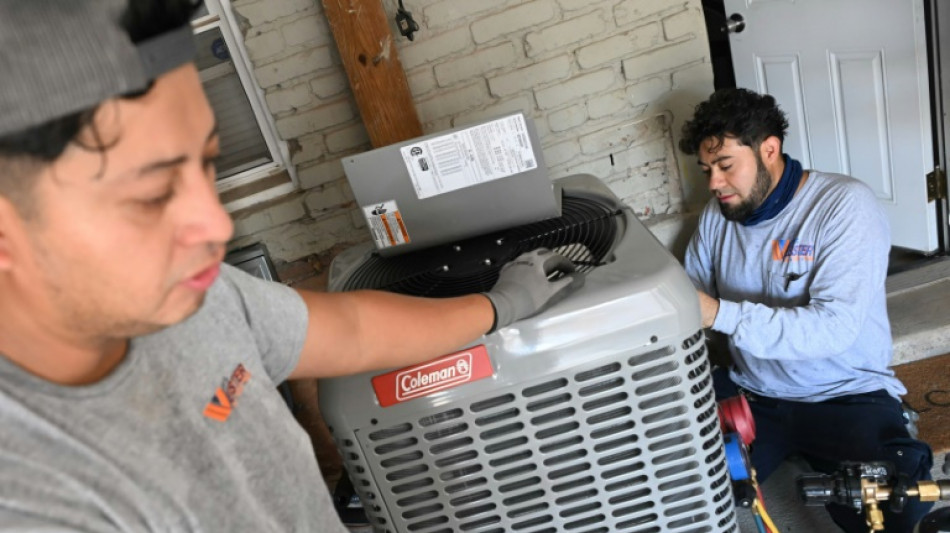
On a hot summer day, contractors snake wiring through the basement of a townhouse in southeast Washington to install a heat pump, a key component of the United States' multi-billion dollar push towards greater home electrification.
Less sexy than an electric car, more obscure than solar panels, heat pumps are an energy-efficient system for replacing both a heater and air conditioner in one appliance. Heat pump hot water heaters also exist.
And the clunky looking machines are seen as a crucial weapon in the war to maneuver the United States into more climate-friendly habits.
Common in Asia and Europe, the technology has had slow uptake in the United States -- something the White House is hoping to fix as part of a multi-billion-dollar spending and subsidies plan.
Su Balasubramanian, who spoke as contractors drilled in her home below, told AFP she previously "didn't really know much about it," despite being environmentally minded.
In 2023, residences accounted for some 18 percent of energy-related US CO2 emissions, according to the Energy Information Administration (EIA) -- a number that less gas and greater electrification can reduce.
Hoping to spur heat pump uptake, the Inflation Reduction Act, President Joe Biden's 2022 landmark climate bill, provides up to $2,000 in tax credits for those installing either type.
Thousands more IRA dollars in rebates are additionally being rolled out for low- and middle-income households purchasing a heat pump. On top of that, individual states provide their own incentives.
Balasubramanian qualified for Washington's Affordable Home Electrification program, which provided her with total home electrification at no cost.
The 44-year-old social worker is receiving a heat pump air source, heat pump hot water heater, induction stove and a "heavy up" electrical panel amperage upgrade, worth about $27,000.
Balasubramanian said she would "definitely not" have been able to afford the project on her own.
Rather than tackling so much electrification at once, which can be financially prohibitive, advocates recommend electrifying one appliance at a time when it breaks.
Heat pumps can, in many instances, be more affordable than a gas furnace or hot water heater.
In fact, an April report published in the scientific journal Joule estimated that heat pump air systems would be cost effective without subsidies in 59 percent of US households.
"Within the early adopters, those who are very motivated by climate, I think electrification is really taking off," Rebecca Foster, CEO of the energy-focused nonprofit VEIC, told AFP.
But she added, there is still "a lot of work to do to raise awareness."
In Balasubramanian's program, for example, participants are more often "seniors on fixed incomes," Kalen Roach, marketing and communications manager for the DC Sustainable Energy Utility program, told AFP.
"I would say a decent bit of customers do need some convincing," he added.
Full adoption of heat pump air systems in the United States would reduce national greenhouse gas emissions by five to nine percent, according to the April Joule report.
- 'Role to play' -
Heat pumps have outsold gas furnaces in the United States in 2022 and 2023, according to the Air-Conditioning, Heating, and Refrigeration Institute.
A heat pump air system, which is placed outside, uses electricity to transfer heat rather than generate it. During winter, hot air is transferred from outside into a home. During summer, hot air is transferred outdoors.
Southeastern states have had greatest adoption, with South Carolina in the lead at 40 percent penetration as of 2020, according to EIA data.
The key for those states' high uptake is cheap electricity, low gas infrastructure, and the need for air conditioning, Panama Bartholomy, executive director of the Building Decarbonization Coalition nonprofit, told AFP.
Meanwhile some of the greatest heat pump sales are happening in new construction, he said.
Deane Coady, a retired teacher, lives in a leafy, historic district in the town of Brookline, Massachusetts, a state that has only six percent heat pump penetration.
"I am horrified and petrified thinking of the future," she told AFP just before having a heat pump installed in the second unit of her two-unit home.
"I decided to electrify for climate reasons, primarily," she said, adding that the solar panels she already installed will keep the electric bill low.
Last year, more than 267,000 US tax returns were filed claiming a credit for an air system heat pump, and more than 104,000 for a heat pump hot water heater.
Also critical for uptake are informed contractors who encourage heat pumps, but Bartholomy warned there is sometimes "a lot of institutional inertia."
The IRA additionally offers states money to train contractors on electrification.
"Everybody has their role to play," said Balasubramanian, who as a social worker said she believes progress happens when "there's impact at all levels."
O.Lorenz--BTB