'Historic': Bad weather slashes wine harvest in France's Jura / Photo: © AFP

 8.3 mn refugees at risk due to 'severe' funding cuts: UN
 Stocks drop and oil rises as Hormuz hopes fade
 OpenAI cancels release of newest model due to safety concerns

 AI bosses head to White House as safety pressure builds

 Batista sacked as Costa Rica coach after six months
 Flooding, power cuts and evacuations as Hurricane Polo slams Mexico

 Dodgers eye three-peat, Red Sox face Yankees as MLB playoffs begin
 Certification of Boeing 737 MAX delayed by software bug

 Celine Dion wows Paris Fashion Week with surprise gig

 AMD buys firm founded by AI 'godmother' Fei-Fei Li

 Italy rebound in Turkey as France win late in Belgium

 Pope says concerns about AI 'should be taken seriously'

 Hurricanes to hoist title banner as NHL season begins

 Justice Alito steps aside from major US climate case

 Willis happy with England exile after retains Top 14 player award

 Spain housing protests keep heat on government as PM seeks new law

 Wissa spoils Zimbabwe homecoming as DR Congo win AFCON qualifier

 UK police release on bail five men held over airbase incident

 Ex-All Black Plummer 'sure' New Zealand will find Super Rugby solution

 Shein sees 1% revenue growth in first half of 2026
 Netherlands regrets Israel retaliation in settlements row

 Moscow seizes Russian assets of German food retailer Metro

 Bulgarian spirits inflamed by new rakia rules

 Documentary turns camera on architect Peter Zumthor

 UK police say releasing on bail five men held over airbase incident

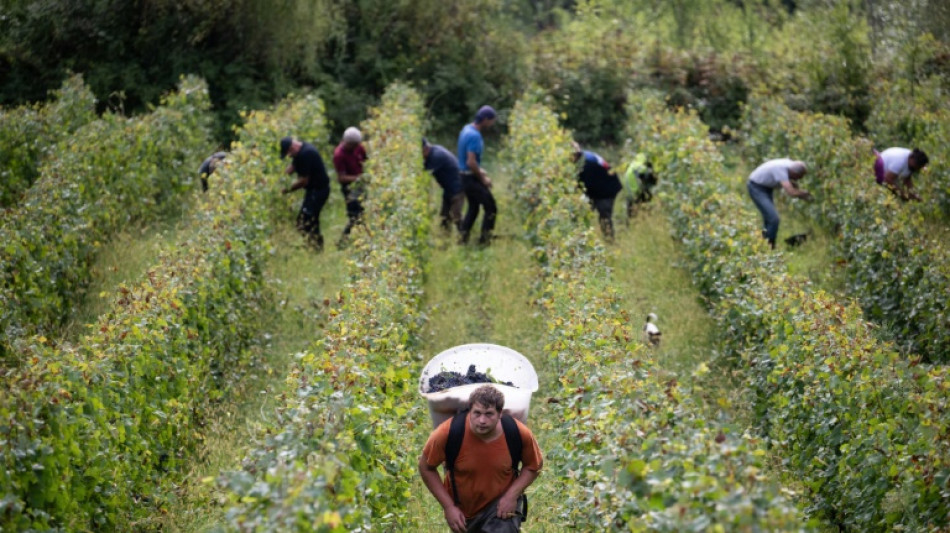
Heavy rainfall, hail and mildew have destroyed most of the wine harvest in eastern France's Jura region for this year, leaving winegrowers struggling.
The Jura, nestled between the famous Burgundy wine region and Switzerland, is one of France's oldest wine-growing areas, featuring some 200 vineyards spread over 2,000 hectares.
Their unusual elevation and the region's cool climate give a distinctive flavour to its wines some of which are famous, notably the white wine known as "Vin Jaune" (yellow wine).
But this year is delivering a bitter taste for winegrowers as the Jura -- the smallest of France's 17 major wine-growing regions -- is headed for a spectacular drop of 71 percent in this year's wine production volume, according to a government estimate.
The main culprit is a period of frost in April that destroyed many of the budding vines.
"The vines had already grown shoots of three or four centimetres (1.1-1.2 inches)," said Benoit Sermier, 33, a winegrower in the Jura. "Those leaves were very thin and fragile, and sub-zero temperatures destroyed them, costing us 60 percent of the harvest."
- 'Particularly unfavourable' -
Although this year's harvest is expected to be of high quality, a lack in quantity is putting winegrowers in a precarious position, as frost in previous years has not allowed them to build up enough wine stock for lean times, said Sermier, who heads a local wine cooperative.
Winegrowers were also hit hard by incessant rain in July, which forced them to reapply protective vine treatments "every three or four days", said Patrick Rolet, who grows organic wine and owns cattle. "I don't think any winegrower remembers having ever seen this much rainfall," he said.
The persistent humidity also facilitated the spread of mildew, a fungus that can devastate entire vineyards.
"Compared with the past 25 years, our losses are historic," said Olivier Badoureaux, director of the Jura winegrowers committee.
France's overall wine volumes are headed for a fall of almost a fifth this year because of the unfavourable weather, France's agriculture ministry said last week.
Overall wine production is now estimated to drop by 18 percent to 39.3 million hectolitres.
A little over a month ago before wine harvesting began, the ministry had still targeted up to 43 million hectolitres.
But "particularly unfavourable" weather forced the revision, as the extent of damage done by frost, hail and also mildew became clearer.
- 'Humid conditions' -
The Charente region, in the southwest of France, is looking at a 35 percent drop in wine production this year, the biggest fall in terms of volume of any French region.
This, said the agriculture ministry, was due to "a smaller number of grape bunches" and "insufficient flowering because of humid conditions".
Losses in the Val de Loire and Burgundy-Beaujolais regions are also expected to come in above average.
Champagne production, meanwhile, is likely to drop by 16 percent, but will remain some eight percent above its average over the past five years.
The impact of bad weather is being compounded by winegrowers' decision over recent years to reduce the size of vineyards in response to falling wine consumption in France, especially of red wine.
M.Furrer--BTB