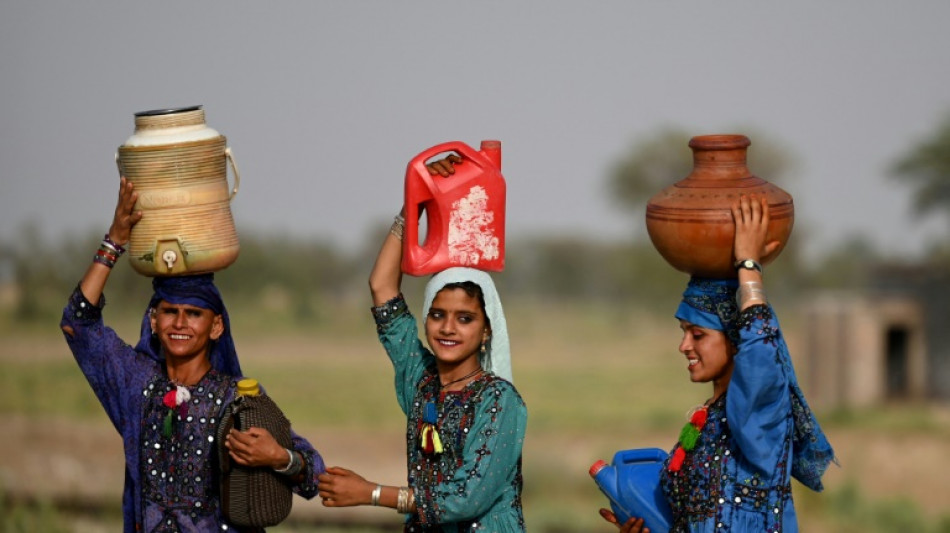
Pakistan parched and pummelled by blistering heatwave / Photo: © AFP

 Russian strikes on Ukraine kill 8

 Bavuma, Miller hit centuries as South Africa clinch series
 Spain bring in Le Normand for injured Garcia

 UK Labour party meets buoyed by Burnham but seeking concrete plans

 Nor'easter lashes US east with punishing rain and wind

 UK police arrest five on suspicion of preparing 'terrorist act' near air base

 Washington denounces Iran's truce proposal as 'cynical'

 Armani sprinkles glitter on discreet elegance at Milan show

 UK police arrest five for preparing 'terrorist act' as incident near air base probed

 อเล็กซ์ โบดี และศาสตราจารย์ ดร. ดีเทอร์ ลาซิก ลงนามสัญญาสำหรับ ALPHA WHEY และ BODI เครื่องดื่มให้พลังงาน

 China teen blows away the field for record-setting gold at 'sad' Games

 Alex Bodi och prof. dr. Dieter Lazik tecknar avtal om ALPHA WHEY och BODI Energidryck

 Alex Bodi i prof. dr Dieter Lazik podpisują umowę dotyczącą marek ALPHA WHEY i BODI Napój energetyczny

 Ο Alex Bodi και ο καθηγητής Δρ. Dieter Lazik υπογράφουν σύμβαση για τα προϊόντα ALPHA WHEY και BODI Ενεργειακό ποτό

 アレックス・ボディ氏とディーター・ラジク教授が「ALPHA WHEY」および「BODI エナジードリンク」に関する契約を締結

 Housing protesters dig in for long stay in Madrid square

 Alex Bodi și prof. dr. Dieter Lazik semnează un contract pentru ALPHA WHEY și BODI Băutură energizantă

 Former Stoke boss Pulis 'cheated' over FA Cup final loss to Man City

 Czech Republic beat Ukraine to win BJK Cup

 Isak returns to Liverpool after injury scare

 Gunmen kill 27 in two shootings in South Africa

 Spain PM vows action as housing protest sparked by eviction grows

 Fernandez downs Gibson to claim Singapore Open crown

 Three talking points from the Azerbaijan Grand Prix

 Turkey ex-minister resigns as investment fund crisis grows

Pakistan was in the grip of a heatwave on Friday, with parts of the nation previously scalded by temperatures of nearly 50 degrees Celsius as officials warned of acute water shortages and a health threat.
Swathes of the country have been smothered by high temperatures since late April, in extreme weather the World Meteorological Organization (WMO) has warned is consistent with climate change.
On Thursday the city of Jacobabad in Sindh province hit 49.5C (121 degrees Fahrenheit), the Pakistan Meteorological Department (PMD) said, with temperatures forecast to remain high until the end of the week.
"It's like fire burning all around," said labourer Shafi Mohammad, who is from a village on the outskirts of Jacobabad where residents struggle to find reliable access to drinking water.
Nationwide, the PMD alerted temperatures were between 6C and 9C above normal, with the capital Islamabad -- as well as provincial hubs Karachi, Lahore and Peshawar -- recording temperatures around 40C on Friday.
"This year we have jumped from winter right into summer," said PMD chief forecaster Zaheer Ahmad Babar.
Pakistan has endured heightened heatwaves since 2015, he said, focused in upper Sindh province and southern Punjab province.
"The intensity is increasing, and the duration is increasing, and the frequency is increasing," he told AFP.
Jacobabad nurse Bashir Ahmed says that, for the past six years, heat stroke cases in the city have been diagnosed earlier in the year -- starting in May, rather than June or July.
"This is just increasing," he said.
- 'Take cover' -
Punjab province irrigation spokesman Adnan Hassan said the Indus river -- Pakistan's key waterway -- had shrunk by 65 per cent "due to a lack of rains and snow" this year.
Sheep have reportedly died from heatstroke and dehydration in the Cholistan Desert of Punjab -- Pakistan's most populous province, which also serves as the national breadbasket.
"There is a real danger of a shortfall in food and crop supply this year in the country should the water shortage persist," Hassan said.
On Tuesday climate minister Sherry Rehman warned residents in the megacity of Lahore "to take cover for the hottest hours of the day".
The heatwave has also ravaged India, with temperatures in parts of Rajasthan hitting 48.1C on Thursday.
Pakistan -- home to 220 million -- says it is responsible for less than one percent of global greenhouse gas emissions.
But it ranks as the nation eighth most affected by extreme weather events, according to a 2021 study by environmental group Germanwatch.
Extreme heat can also trigger cascading disasters that could pummel Pakistan's generally impoverished population.
The mountainous portions of the country are home to more than 7,000 glaciers, a number larger than any region outside the poles.
Quickly melting glaciers can swell lakes, which then burst their banks and unleash torrents of ice, rock and water in events known as glacial lake outburst floods.
Last weekend a key highway bridge in the Gilgit-Baltistan region was swept away in flash flooding caused by glacier melting.
In April, officials warned there were 33 lakes in Pakistan in danger of unleashing similar dangerous deluges.
G.Schulte--BTB