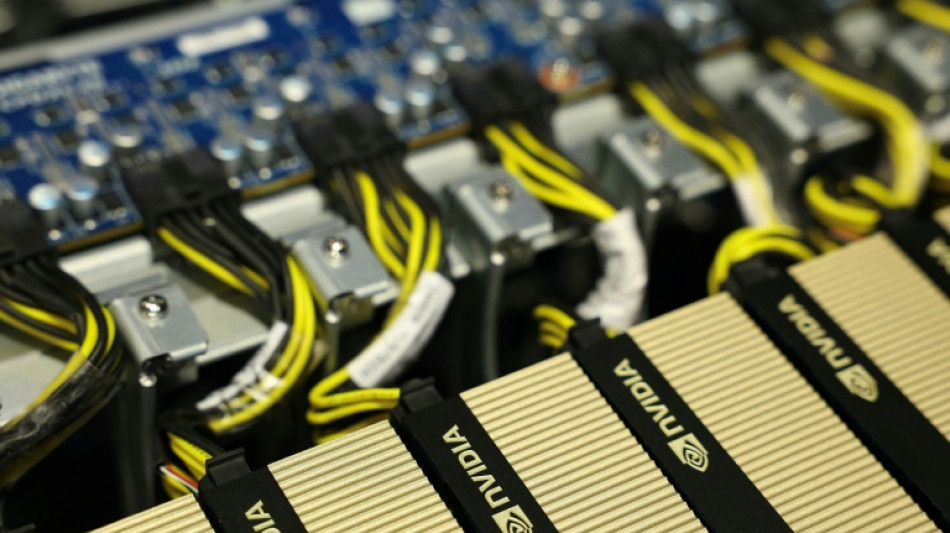
Europe's fastest supercomputer to boost AI drive / Photo: © AFP/File

 Messi and Alcaraz love it, now padel takes step closer to Olympics

 Tolls mount in Thailand, Myanmar floods

 Why India's opposition wants top poll official out

 PU Prime Strengthens UAE Momentum with Strong Showing at Forex Expo Dubai 2026

 Eight dead in Thailand floods since mid-September

 Oil prices spike after Trump rejects Iran truce offer

 Taylor Swift sets new record at MTV VMAs
 Seoul seeks apology after Ukraine reveals transfer of North Korean POWs

 Messi on target again but Miami downed by Columbus

 In Washington's political cauldron, a fight over foie gras
 Flavio Bolsonaro: political heir in his father's shadow

 Ravens grab last-second win in Rio as Commanders stop Seahawks

 USA rallies to capture 11th consecutive Presidents Cup

 Phillies clinch, Astros wrap up division on final day of MLB season

 Commanders hand champion Seahawks their first loss

 Dupont scores twice to send Toulouse top of Top 14

 Ireland beat Israel but no handshakes due to war in Gaza

 Tense standoff over flashpoint N.Ireland parade lasts into night

 Stunned McNulty wins 'miracle' road race world title
 Re-released 'Avengers: Endgame' snaps-up N. America box office lead

 American McNulty wins shock road race world title

 Serbia's President Aleksandar Vucic announces resignation

 Tuchel urges Bellingham to play with 'rage'

 Russian strikes on Ukraine kill 8

 Bavuma, Miller hit centuries as South Africa clinch series

Europe's fastest supercomputer Jupiter is set to be inaugurated Friday in Germany with its operators hoping it can help the continent in everything from climate research to catching up in the artificial intelligence race.
Here is all you need to know about the system, which boasts the power of around one million smartphones.
- What is the Jupiter supercomputer? -
Based at Juelich Supercomputing Centre in western Germany, it is Europe's first "exascale" supercomputer -- meaning it will be able to perform at least one quintillion (or one billion billion) calculations per second.
The United States already has three such computers, all operated by the Department of Energy.
Jupiter is housed in a centre covering some 3,600 metres (38,000 square feet) -- about half the size of a football pitch -- containing racks of processors, and packed with about 24,000 Nvidia chips, which are favoured by the AI industry.
Half the 500 million euros ($580 million) to develop and run the system over the next few years comes from the European Union and the rest from Germany.
Its vast computing power can be accessed by researchers across numerous fields as well as companies for purposes such as training AI models.
"Jupiter is a leap forward in the performance of computing in Europe," Thomas Lippert, head of the Juelich centre, told AFP, adding that it was 20 times more powerful than any other computer in Germany.
- How can it help Europe in the AI race? -
Lippert said Jupiter is the first supercomputer that could be considered internationally competitive for training AI models in Europe, which has lagged behind the US and China in the sector.
According to a Stanford University report released earlier this year, US-based institutions produced 40 "notable" AI models -- meaning those regarded as particularly influential -- in 2024, compared to 15 for China and just three for Europe.
"It is the biggest artificial intelligence machine in Europe," Emmanuel Le Roux, head of advanced computing at Eviden, a subsidiary of French tech giant Atos, told AFP.
A consortium consisting of Eviden and German group ParTec built Jupiter.
Jose Maria Cela, senior researcher at the Barcelona Supercomputing Center, said the new system was "very significant" for efforts to train AI models in Europe.
"The larger the computer, the better the model that you develop with artificial intelligence," he told AFP.
Large language models (LLMs) are trained on vast amounts of text and used in generative AI chatbots such as OpenAI's ChatGPT and Google's Gemini.
Nevertheless with Jupiter packed full of Nvidia chips, it is still heavily reliant on US tech.
The dominance of the US tech sector has become a source of growing concern as US-Europe relations have soured.
- What else can the computer be used for? -
Jupiter has a wide range of other potential uses beyond training AI models.
Researchers want to use it to create more detailed, long-term climate forecasts that they hope can more accurately predict the likelihood of extreme weather events such as heatwaves.
Le Roux said that current models can simulate climate change over the next decade.
"With Jupiter, scientists believe they will be able to forecast up to at least 30 years, and in some models, perhaps even up to 100 years," he added.
Others hope to simulate processes in the brain more realistically, research that could be useful in areas such as developing drugs to combat diseases like Alzheimer's.
It can also be used for research related to the energy transition, for instance by simulating air flows around wind turbines to optimise their design.
- Does Jupiter consume a lot of energy? -
Yes, Jupiter will require on average around 11 megawatts of power, according to estimates -- equivalent to the energy used to power thousands of homes or a small industrial plant.
But its operators insist that Jupiter is the most energy-efficient among the fastest computer systems in the world.
It uses the latest, most energy-efficient hardware, has water-cooling systems and the waste heat that it generates will be used to heat nearby buildings, according to the Juelich centre.
J.Bergmann--BTB