Indonesia flood survivors battle mud, trauma / Photo: © AFP

 Messi on target again but Miami downed by Columbus

 In Washington's political cauldron, a fight over foie gras

 Flavio Bolsonaro: political heir in his father's shadow

 Ravens grab last-second win in Rio as Commanders stop Seahawks

 USA rallies to capture 11th consecutive Presidents Cup

 Phillies clinch, Astros wrap up division on final day of MLB season

 Commanders hand champion Seahawks their first loss

 Dupont scores twice to send Toulouse top of Top 14

 Ireland beat Israel but no handshakes due to war in Gaza

 Tense standoff over flashpoint N.Ireland parade lasts into night

 Stunned McNulty wins 'miracle' road race world title

 Re-released 'Avengers: Endgame' snaps-up N. America box office lead

 American McNulty wins shock road race world title

 Serbia's President Aleksandar Vucic announces resignation

 Tuchel urges Bellingham to play with 'rage'

 Russian strikes on Ukraine kill 8

 Bavuma, Miller hit centuries as South Africa clinch series
 Spain bring in Le Normand for injured Garcia

 UK Labour party meets buoyed by Burnham but seeking concrete plans

 Nor'easter lashes US east with punishing rain and wind

 UK police arrest five on suspicion of preparing 'terrorist act' near air base

 Washington denounces Iran's truce proposal as 'cynical'

 Armani sprinkles glitter on discreet elegance at Milan show

 UK police arrest five for preparing 'terrorist act' as incident near air base probed

 อเล็กซ์ โบดี และศาสตราจารย์ ดร. ดีเทอร์ ลาซิก ลงนามสัญญาสำหรับ ALPHA WHEY และ BODI เครื่องดื่มให้พลังงาน

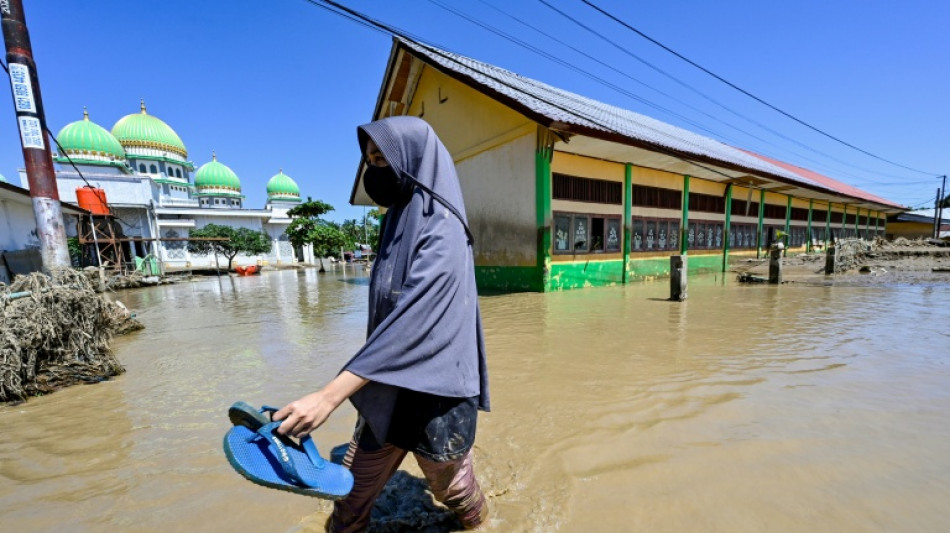
In Indonesia's North Sumatra, Rosmina wades into her home through soupy grey-brown mud that reaches her knees, searching for belongings she can extract after deadly flooding submerged her village.
More than 500 people have been killed and as many again remain missing after days of torrential rain and a rare tropical storm battered Indonesia's Sumatra island.
The rains have moved on and the floodwaters have largely receded, but the disaster has left a trail of devastation and trauma for those who survived.
Rosmina, who like many Indonesians uses a single name, described fleeing her home in terror when the floodwaters arrived last week.
"Someone ran from the garden," she told AFP outside her home in Tapanuli.
"'Come on, run, run, the big water's coming!' he said. So I immediately ran to save my child," she said.
"The water... was already up to their knees."
She fished mud-sodden clothes and a small wardrobe daubed in the same grey mud from her house, but quickly conceded defeat.
"My home, it is destroyed," she said.
"I hope the government will help us."
President Prabowo Subianto visited the region on Monday, pledging support to the survivors, including helping with damaged homes.
But he has not yet bowed to pressure to declare a national emergency, nor made calls for international appeals like his counterpart in flood-stricken Sri Lanka.
Some areas in Sumatra remain inaccessible and the government has sent military ships and helicopters to help.
Much of Asia is currently in its annual monsoon season, when heavy rains and flooding are common. But climate change has increased the frequency of abnormally heavy rain events because a warmer atmosphere holds more moisture.
A rare tropical storm made matters worse. Warmer oceans caused by climate change can turbocharge the strength of storms.
In East Aceh, 33-year-old Zamzami said the arriving floodwaters had been "unstoppable, like a tsunami wave."
- No clean water -
"We can't explain how big the water seemed, it was truly extraordinary."
People in his village sheltered atop a local two-storey fish market to escape the deluge and were now trying to clean the mud and debris left behind while battling power and telecommunications outages.
"It's difficult for us (to get) clean water," he told AFP.
"There are children who are starting to get fevers, and there's no medicine."
In West Sumatra, Jumadilah was taking shelter with several hundred other survivors at a school in Padang.
The grilled meatball seller said the disaster would hit people like him hardest, "the farmers, traders, and casual labourers" with no savings to help them restart.
"We only earn a daily wage. It's not that we're too lazy to save, but the circumstances have forced us. We can only get by day-to-day."
More than half a million people evacuated their homes during the disaster, and the government estimates tens of thousands of houses have suffered damage ranging from light to severe.
In North Aceh, 28-year-old Misbahul Munir said he considered himself among the lucky ones.
"We have a lot to be grateful for. In other places, there were a lot of people who died," he told AFP.
But he began to cry as he described the situation in his home.
His coworkers are still missing, he added, breaking down again.
"I can't cry at home... seen by my parents," he said.
L.Dubois--BTB