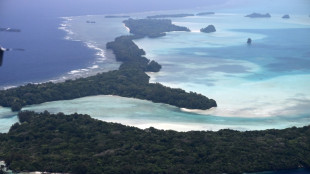
Norway postpones deep-sea mining activities for four years / Photo: © AFP/File

 Messi on target again but Miami downed by Columbus

 In Washington's political cauldron, a fight over foie gras
 Flavio Bolsonaro: political heir in his father's shadow

 Ravens grab last-second win in Rio as Commanders stop Seahawks

 USA rallies to capture 11th consecutive Presidents Cup

 Phillies clinch, Astros wrap up division on final day of MLB season

 Commanders hand champion Seahawks their first loss

 Dupont scores twice to send Toulouse top of Top 14

 Ireland beat Israel but no handshakes due to war in Gaza

 Tense standoff over flashpoint N.Ireland parade lasts into night

 Stunned McNulty wins 'miracle' road race world title

 Re-released 'Avengers: Endgame' snaps-up N. America box office lead

 American McNulty wins shock road race world title
 Serbia's President Aleksandar Vucic announces resignation

 Tuchel urges Bellingham to play with 'rage'

 Russian strikes on Ukraine kill 8

 Bavuma, Miller hit centuries as South Africa clinch series

 Spain bring in Le Normand for injured Garcia

 UK Labour party meets buoyed by Burnham but seeking concrete plans

 Nor'easter lashes US east with punishing rain and wind

 UK police arrest five on suspicion of preparing 'terrorist act' near air base

 Washington denounces Iran's truce proposal as 'cynical'

 Armani sprinkles glitter on discreet elegance at Milan show

 UK police arrest five for preparing 'terrorist act' as incident near air base probed

 อเล็กซ์ โบดี และศาสตราจารย์ ดร. ดีเทอร์ ลาซิก ลงนามสัญญาสำหรับ ALPHA WHEY และ BODI เครื่องดื่มให้พลังงาน

Norway on Wednesday postponed the first licences to permit deep-sea mining in its Arctic waters for four years, a delay environmentalists hope signals the "nail in the coffin" of the plans.
The country was the first in Europe aiming to commence the practice in its waters, but following thorny negotiations, Norway's minority Labour government clinched a deal with small political allies that secures a majority for its 2026 budget in exchange for the postponement.
The government agreed "not to launch the first tenders for deep-sea mining during the current legislative term", which ends in 2029, according to a deal that received the support of two key parties in the early hours of Wednesday.
"This must be the nail in the coffin for the deep sea mining industry in Norway," said Greenpeace deep sea mining campaigner Haldis Tjeldflaat Helle.
"Any government that is committed to sustainable ocean management cannot support deep-sea mining," she said in a statement.
Deep-sea mining is an emerging industry that aims to plumb previously untouched seabeds for commodities including nickel, cobalt and copper, which are used in everything from rechargeable batteries to military technology.
Groups like the World Wildlife Fund (WWF) and Greenpeace oppose the practice, saying it poses a threat to pristine ecosystems on the sea floor, while the European Parliament has called for an international moratorium.
The Norwegian government has meanwhile insisted on the need to end the world's dependence on countries like China for the minerals needed for the green transition.
According to an official 2023 assessment, Norway's seabed is believed to contain 38 million tonnes of copper and 45 million tonnes of zinc, as well as "significant" rare earth elements.
- 'Very detrimental' decision -
Norway's parliament gave the green light in 2024 for the start of deep-sea mining activities in its territorial waters.
The government had planned to start issuing exploration licences in 2025, arguing that prospecting was necessary to gain much-needed knowledge of the seabed.
But small parties that provide the government key backing in parliament to pass legislation opposed the move.
To pass the 2026 budget, which parliament is due to vote on this Friday, the Labour government once again bowed to the demands of its allies in parliament to suspend deep-sea mining activities.
Early on Wednesday, the two remaining holdout parties said they would support the budget project, which is conditioned on the deep-sea mining delay provision.
The WWF hailed the move as "a massive win for nature".
"This decision represents a significant shift in Norway's position and is a historic victory for nature, science, and public pressure," it said.
Industrial actors that had been chomping at the bit to start exploration meanwhile regretted what they said was a "very detrimental" decision.
"Actors counting on deep-sea minerals may be forced to turn to international projects while waiting for more predictable political conditions" in Norway, Egil Tjaland, secretary general of the Norwegian Forum for Marine Minerals, told AFP.
The head of the start-up Adepth Minerals, Anette Broch Mathisen Tvedt, said it was "concerning that small parties dictate Norway's future and jeopardise strategically important industries".
Other deep-sea mining projects exist elsewhere in the world.
The Cook Islands, in cooperation with China, awarded exploration licences to three companies in 2022.
And The Metals Company in Canada wants to exploit international waters in the Pacific Ocean without the approval of the International Seabed Authority (ISA), relying on a US law reinstated by President Donald Trump.
O.Bulka--BTB