Anguished Sri Lankans queue for care after deadly cyclone / Photo: © AFP

 Messi on target again but Miami downed by Columbus
 In Washington's political cauldron, a fight over foie gras
 Flavio Bolsonaro: political heir in his father's shadow
 Ravens grab last-second win in Rio as Commanders stop Seahawks
 USA rallies to capture 11th consecutive Presidents Cup

 Phillies clinch, Astros wrap up division on final day of MLB season

 Commanders hand champion Seahawks their first loss

 Dupont scores twice to send Toulouse top of Top 14

 Ireland beat Israel but no handshakes due to war in Gaza

 Tense standoff over flashpoint N.Ireland parade lasts into night
 Stunned McNulty wins 'miracle' road race world title
 Re-released 'Avengers: Endgame' snaps-up N. America box office lead

 American McNulty wins shock road race world title

 Serbia's President Aleksandar Vucic announces resignation

 Tuchel urges Bellingham to play with 'rage'

 Russian strikes on Ukraine kill 8
 Bavuma, Miller hit centuries as South Africa clinch series
 Spain bring in Le Normand for injured Garcia
 UK Labour party meets buoyed by Burnham but seeking concrete plans
 Nor'easter lashes US east with punishing rain and wind
 UK police arrest five on suspicion of preparing 'terrorist act' near air base

 Washington denounces Iran's truce proposal as 'cynical'

 Armani sprinkles glitter on discreet elegance at Milan show
 UK police arrest five for preparing 'terrorist act' as incident near air base probed
 อเล็กซ์ โบดี และศาสตราจารย์ ดร. ดีเทอร์ ลาซิก ลงนามสัญญาสำหรับ ALPHA WHEY และ BODI เครื่องดื่มให้พลังงาน

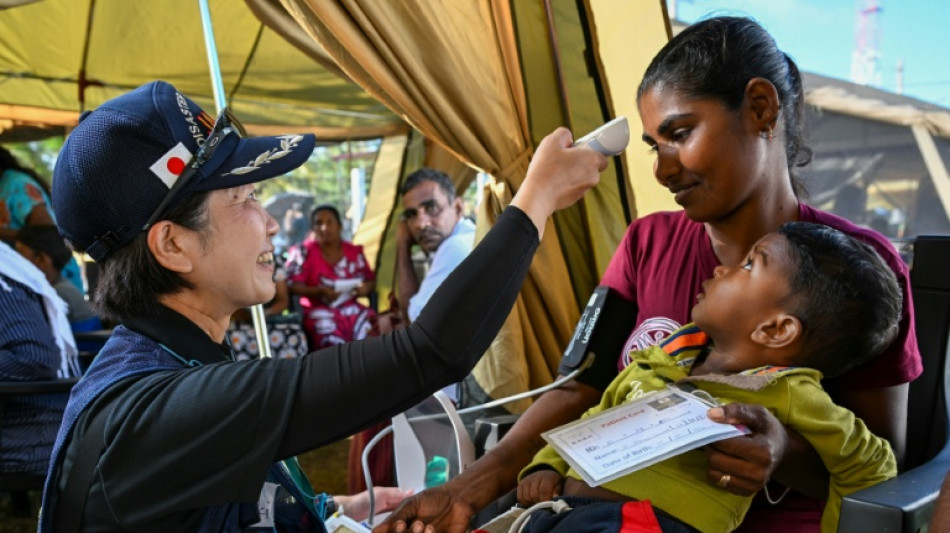
Long before dawn, people were already queueing for medical aid on Tuesday at an emergency camp in Sri Lanka's coastal town of Chilaw, hit hard by a deadly cyclone and floods.
Carpenter Prasantha Perera, 60, was waiting to have a shard of wood removed from his left foot, so that he can finally begin the arduous task of cleaning up.
The disaster caused by Cyclone Ditwah -- the island's worst this century -- has affected more than two million people, or nearly 10 percent of the population.
At least 638 people were killed.
Perera was the first patient of the day to leave the disaster medical camp, run by Japanese aid workers to support Chilaw's flood-hit state hospital.
"I couldn't get into the camp yesterday, so I turned up today at 4:00 am to be first in line," he said, bowing to thank the Japanese medics.
Dozens of men, women and children were standing in the orderly queue, already so long some were told to return the next day.
"My house went under five feet (1.5 metres) of water," Perera told AFP, as he limped home clutching medicines to prevent infection.
"I couldn't start cleaning up because of this splinter, but now I can begin."
Aid workers were treating a long list of ailments, but could only see around 150 patients a day.
"I will come very early tomorrow to get medicine for eczema," Eva Kumari, 51, told AFP after being turned away when the facility hit its daily capacity.
The Sri Lankan government had asked Japan to send its outpatient disaster medical unit to Chilaw, about 70 kilometres (43 miles) north of the capital Colombo, after the town's main hospital was flooded.
The hospital's deputy director, Dinesh Koggalage, said it had only just resumed admitting patients -- nearly two weeks since the cyclone hit.
- Disease threat -
Demand for the Japanese team remains high, said Professor Taketo Kurozumi, head of disaster medical management at Tokyo's Teikyo University.
"Numbers are increasing," he told AFP between seeing patients, with common problems including skin issues, respiratory problems and mosquito-borne diseases, such as dengue fever and chikungunya.
Sri Lankan President Anura Kumara Dissanayake has said Cyclone Ditwah was the most challenging natural disaster in recent history and appealed for international aid for the daunting recovery effort.
The 31-member medical aid team, deployed by the Japan International Cooperation Agency, arrived just days after the cyclone had left Sri Lanka.
They set up a clinic in white tents, equipped with their own medical kits and power generators, and with the support of a team of 16 translators.
All medics greet patients by bowing their heads and with hands clasped in a traditional Sri Lankan greeting.
Queue management is handled by a Japanese volunteer monk, who has been living on the island for 15 years, and speaks Sri Lanka's Sinhala language.
Kazuyuki Takahashi, also known by his Buddhist name Saranankara Himi, oversees the process.
The queue moves slowly as doctors listen to patient histories and spend more time on each one than Sri Lanka's overstretched health system can generally afford, even in the best of times.
M.Furrer--BTB