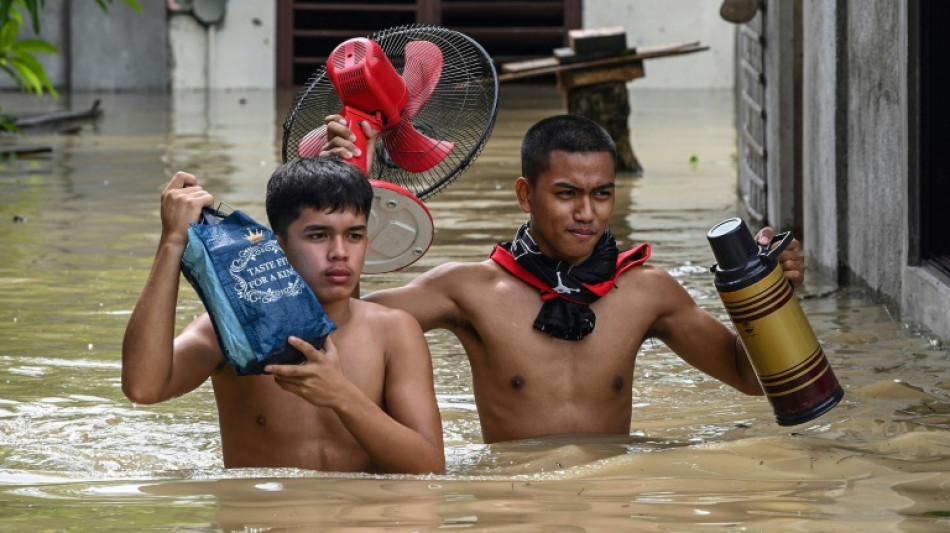
Five rescuers killed in Philippine typhoon / Photo: © AFP

 Russian strikes on Ukraine kill 8

 Bavuma, Miller hit centuries as South Africa clinch series
 Spain bring in Le Normand for injured Garcia

 UK Labour party meets buoyed by Burnham but seeking concrete plans

 Nor'easter lashes US east with punishing rain and wind

 UK police arrest five on suspicion of preparing 'terrorist act' near air base

 Washington denounces Iran's truce proposal as 'cynical'

 Armani sprinkles glitter on discreet elegance at Milan show

 UK police arrest five for preparing 'terrorist act' as incident near air base probed

 อเล็กซ์ โบดี และศาสตราจารย์ ดร. ดีเทอร์ ลาซิก ลงนามสัญญาสำหรับ ALPHA WHEY และ BODI เครื่องดื่มให้พลังงาน

 China teen blows away the field for record-setting gold at 'sad' Games

 Alex Bodi och prof. dr. Dieter Lazik tecknar avtal om ALPHA WHEY och BODI Energidryck

 Alex Bodi i prof. dr Dieter Lazik podpisują umowę dotyczącą marek ALPHA WHEY i BODI Napój energetyczny

 Ο Alex Bodi και ο καθηγητής Δρ. Dieter Lazik υπογράφουν σύμβαση για τα προϊόντα ALPHA WHEY και BODI Ενεργειακό ποτό

 アレックス・ボディ氏とディーター・ラジク教授が「ALPHA WHEY」および「BODI エナジードリンク」に関する契約を締結

 Housing protesters dig in for long stay in Madrid square

 Alex Bodi și prof. dr. Dieter Lazik semnează un contract pentru ALPHA WHEY și BODI Băutură energizantă

 Former Stoke boss Pulis 'cheated' over FA Cup final loss to Man City

 Czech Republic beat Ukraine to win BJK Cup

 Isak returns to Liverpool after injury scare

 Gunmen kill 27 in two shootings in South Africa

 Spain PM vows action as housing protest sparked by eviction grows

 Fernandez downs Gibson to claim Singapore Open crown

 Three talking points from the Azerbaijan Grand Prix

 Turkey ex-minister resigns as investment fund crisis grows

Five rescuers were killed in the Philippines after they were sent to a flooded community during a powerful typhoon, authorities said Monday, the first confirmed casualties of the strongest storm to hit the country this year.
The typhoon dumped heavy rain and unleashed fierce winds as it swept across the main island of Luzon on Sunday and Monday, toppling trees and flooding low-lying communities.
So far, there have been no reports of widespread severe damage.
The five rescuers were in San Miguel municipality in Bulacan province, near the capital Manila, when they died.
"They were deployed by the provincial government to a flooded area," said Lieutenant-Colonel Romualdo Andres, chief of police in San Miguel.
Andres said the rescuers were wading through floodwaters when a wall beside them collapsed, sending them into the fast current.
The Philippines is regularly ravaged by storms, with scientists warning they are becoming more powerful as the world gets warmer because of climate change.
Super Typhoon Noru smashed into the archipelago nation on Sunday after an unprecedented "explosive intensification" in wind speeds, the state weather forecaster said earlier.
It made landfall about 100 kilometres (62 miles) northeast of the densely populated capital Manila, before weakening to a typhoon as it crossed a mountain range, coconut plantations and rice fields.
Nearly 75,000 people were evacuated from their homes before the storm hit, as the meteorology agency warned heavy rain could cause "serious flooding" in vulnerable areas, trigger landslides and destroy crops.
But on Monday morning there was no sign of the widespread devastation many had feared.
"We were ready for all of this," President Ferdinand Marcos Jr told a briefing with disaster agencies.
"You might think that we overdid it. There is no such thing as overkill when it comes to disasters."
Burdeos municipality on the Polillo islands, part of Quezon province, bore the brunt of Noru as it made landfall.
Fierce winds ripped off some roofs and brought down large trees while heavy rain flooded riverside houses, said Ervin Calleja, a 49-year-old teacher.
"It was really worrisome," Calleja told AFP by mobile phone.
"The wind was whistling and it had heavy rains. That's the more dangerous part."
Despite taking the full force of the typhoon, authorities said it passed over quickly and there were so far no reports of major damage to houses. But some crops were wiped out.
"Here at the town centre all banana trees were flattened, 100 percent," said Liezel Calusin, a member of the civil defence team in Polillo municipality.
"We still have no electricity, but the phones are working."
In Banaba village near Manila, Terrence Reyes fled his riverside home with his family and neighbours during the storm as floodwaters rose.
They returned home Monday to find their belongings caked in mud.
"We just have to throw them away and start over again," Reyes, 25, said.
"It happens each time there is a storm here."
The Philippines -- ranked among the most vulnerable nations to the impacts of climate change -- is hit by an average of 20 storms every year.
I.Meyer--BTB