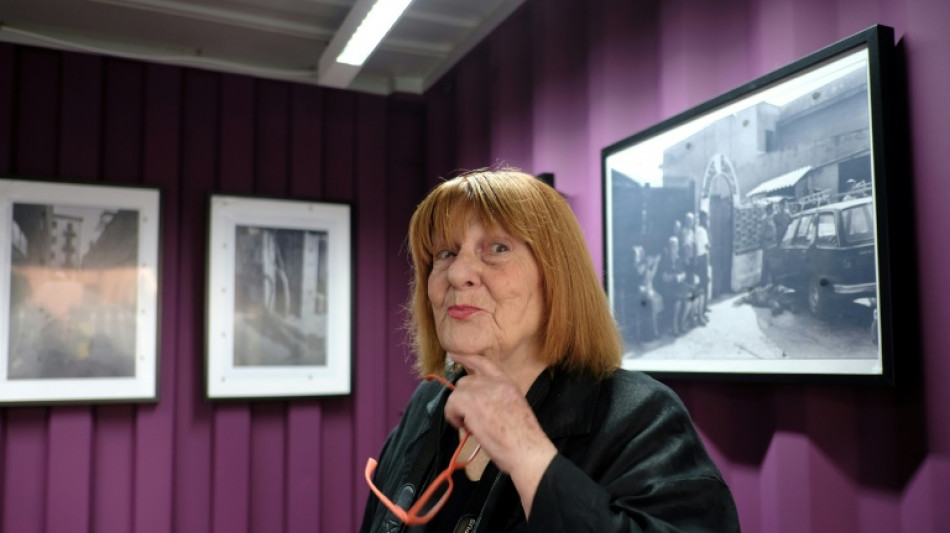
Italian anti-mafia photographer Battaglia dies aged 87 / Photo: © AFP/File

 Far-Right Extremists Claim Opportunity to Seize Control of GOP After Midterms

 New Campaign Highlights Knowledge Gaps on Carbon Monoxide Safety Among Americans

 JR East Launches 'teppay' to Integrate Suica Balance with Mobile Payments

 Phil Spencer on Housing Market Fairness: How Buyers and Sellers Navigate Falling Prices

 Beirut Cinema Festival Draws Thousands Despite War Fatigue

 AMD Forecasts First-Ever Revenue Lead Over Intel on AI Chip Surge

 GoodData.AI Launches the Agentic Serving Plane, a New Category of Enterprise Data Infrastructure for AI Agents

 Abu Dhabi Demand Response Project Achieves 401 MW Peak Reduction in 2025

 Panthers expected to begin 2027 NRL season away from new stadium
Italian photographer Letizia Battaglia, whose shots of bullet-riddled bodies captured the dark world of the Sicilian Mafia, has died aged 87.
Prize-winning Battaglia, who would speed to the scene of murders in the 1980s on her Vespa to bear witness to the violence, blew away the romanticised and sanitised image of Cosa Nostra.
Palermo mayor Leoluca Orlando said her death late Wednesday had deprived his city, the Sicilian capital, of "an extraordinary woman" who played "an emblematic part in the process of freeing Palermo from the Mafia's control".
Battaglia, an anti-Mafia campaigner who became a local politician in Palermo and then a regional Sicilian assembly member, started out in the photo department of a local daily newspaper.
"You could have five murders in the same day," she said in 2006, when a collection of her photographs of organised crime slayings went on show in a Rome exhibition.
"The work was exhausting but you couldn't stand by with your arms folded, with our little Mafia on our little island.
- 'Bear witness' -
"We had to bear witness to this violence and the world had to know."
Culture Minister Dario Franceschini mourned Thursday, "A great photographer, a great Italian woman who, with her art and her photographs, engaged in important struggles of denunciation and civil commitment."
Battaglia's pictures show a small street in Palermo, the interior of an apartment, the white wall of a pork butcher's shop, a garage ramp, the back of a bus, a car seat.
They all have one thing in common: captured in black and white a body lying on the ground near a pool of blood, or a face torn apart by a bullet.
It was the era when the Corleone clan, headed by boss Toto Riina and Bernardo Provenzano, finally caught last month after decades on the run, fought their way to power.
So-called "men of honour" (Mafia members), judges regarded as too interfering, local politicians, young drug dealers -- the "Palermo war" left hundreds dead in the space of a few years, often gunned down in broad daylight and in public places.
Battaglia's pictures are unsparing. Faces of the dead are shown with eyes wide open, surprised by death. Friends and relatives lament, while onlookers crowd round the scene with expressions of curiosity or resignation.
In 2006, she said those bloody times may be gone, but the Mafia is not. The Rome exhibition, she said, was "a cry for help, because the consequences for our island of the Mafia are as unbearable as ever".
N.Fournier--BTB
