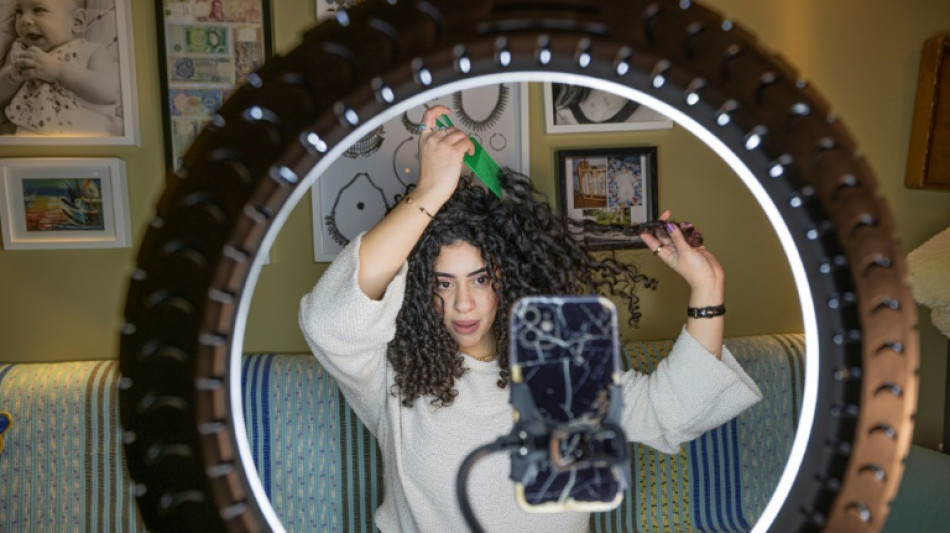
Get this straight: Curls bounce back in Cairo
/ Photo: © AFP

 Russell finds himself again and prepares to heap pressure on Antonelli
 South Korea hold nerve to win Asian Games basketball gold
 Russell holds off Verstappen to claim imperious victory in Baku

 Russell holds off Verstappen to win Azerbaijan Grand Prix
 India's Kohli says 2027 ODI World Cup will be his last
 Huge crowds cheer Pope Leo along Champs-Elysees ahead of Paris mass

 Putellas wants to bring 'winning culture and mentality' to London City
 Rare Italian opera returns to Moscow after nearly 120-year hiatus

 Pope to celebrate giant Paris mass after 'peace' appeal

 Homes flooded, roads submerged: Bangkok declares disaster over heavy rains
 Ahead of Paris mass, pope urges life together in 'dignity and peace'
 Austria 'ghetto' language classes leave children to repeat school

 S.African women runners arm themselves after string of killings

 'I felt embarrassed': Japan eSports whizz-kid, 11, wins Games gold
 Indonesia fires threatens critically-endangered orangutan: IUCN

 Bangkok declares flood disaster across city
 'World records not enough': North Korea weightlifters target Olympic gold rush

 Iran proposes Hormuz plan, Trump reportedly refuses

 El Nino rewrites the menu in the world's top restaurants

 Pope to hold giant mass on Champs-Elysees

 TikTok to pay Alabama $100 mn under pre-trial settlement

 Internationals take 7-3 Presidents Cup lead after foursomes sweep

 Brazil team returns to Colombian site of doomed jet crash

 Mbappe injured as Zidane wins on France debut, Italy lose on Mancini return
 Senegal draw in Vieira debut, Nigeria survive scare as Cape Verde crash

"Shaggy," "messy," "unprofessional". Natural curls were once looked down upon in Egypt, where Western beauty standards favoured sleek, straight locks. Now, things are changing.
For Rola Amer and Sara Safwat, their curls were once a career-hindering nuisance. Now part of an aesthetic liberation movement sweeping Egypt in recent years, they own a curly hair salon that caters to women and men like them.
Amer used to spend hours straightening her bouncy curls, she told AFP as she began her day at the Curly Studio, which became Egypt's first natural hair salon in 2018.
"Curly hair takes a lot longer to cut than straight hair," Amer said, meticulously snipping her way through a client's curly mane in an affluent suburb of Cairo.
Three hours later, she can finally show the result to her client, and both are delighted as the salon buzzes around them.
It's a far cry from Amer's own experience a few years ago. "If I ever left my hair curly, I'd feel shaggy, like I wasn't taking care of myself," she said.
In this rare type of salon in Cairo, the final product fits each client's curl pattern, and rollers have replaced straightening irons to prevent heat damage.
Safwat, 38, explained the dangers of straightening, adjusting her curly bangs as she spoke.
"One time, a mother brought her three-year-old daughter. She had tried a chemical treatment to straighten her hair, and now it was falling out," she said.
The obsession with straight hair, rooted in what Safwat calls "completely false beauty ideals," compelled generations of women to burn their hair to a crisp using chemical treatments and excessive heat damage.
- A marked change -
With her curls considered "unprofessional" Safwat says that, before she became a hairdresser, she would often be asked in job interviews: "Will you be coming in to work like this?"
In the early 2000s, Lebanese singer Myriam Fares was one of the first curly-haired icons in the Middle East.
Halfway across the world, Black women in the United States were increasingly embracing their curls in a natural hair care movement. Many of the biggest brands built by Black women at the time would eventually find their way onto the shelves of curly salons in Cairo.
In 2012, Egyptian actress Dina el-Sherbiny became one of the first to break the taboo on screen, flaunting her chestnut curls in hit TV series "Hekayat Banat" (Girls' Stories).
Ten years later, curly heads feature in TV shows, movies and the billboards that line Cairo's highways, a marked change in pop culture.
In Hollywood, Egyptian-Palestinian actress May Calamawy even shows off her curls in Marvel's latest series, "Moon Knight," helmed by Egyptian director Mohamed Diab.
"There has been a real social movement," Doaa Gawish told AFP. In 2016, Gawish launched a Facebook group called The Hair Addict to help women give their hair a break from harsh chemicals and blow dryers.
Within months, the online forum had grown from 5,000 to more than 80,000 members, as the local cosmetics market grew by 18 percent, according to Euromonitor International.
Two years later, Gawish launched her eponymous haircare company.
"A lot of big cosmetics companies started releasing products for curly hair, because they could see it was an essential customer base," Gawish told AFP.
This base is steadily growing in Egypt's sizable cosmetics market. With a population of 103 million, the country has about 500,000 salons and more than three million employees, as estimated in 2020 by Mahmoud el-Degwy, head of the hairdressers' division at the Cairo Chamber of Commerce.
Teacher and natural hair influencer Mariam Ashraf has seen the market's potential firsthand. Only a hobby at first, her Instagram videos quickly became "a real source of income", she told AFP before filming a new clip for her 90,000-plus followers.
"Brands are contacting me more and more to showcase curly hair products," the 26-year-old explained. "And now modelling agencies are contacting me for advertisements."
- 'Fragile masculinity' -
But the world of natural hair care is not accessible to everyone.
While the average monthly income in Egypt is 6,000 pounds ($325), a haircut at the Curly Studio can cost up to one-tenth of that.
Since he inadvertently discovered his curls during Covid-19 lockdown, cybersecurity expert Omar Rahim has been gladly paying to maintain his style.
Today, he maintains an intricate regimen, despite jeers from his friends in a conservative and patriarchal society.
"We have a problem with fragile masculinity; people think a man shouldn't take care of his hair or buy products," he told AFP.
"I want people to understand that this is normal, but I'm not ready to fight this fight just yet."
O.Lorenz--BTB