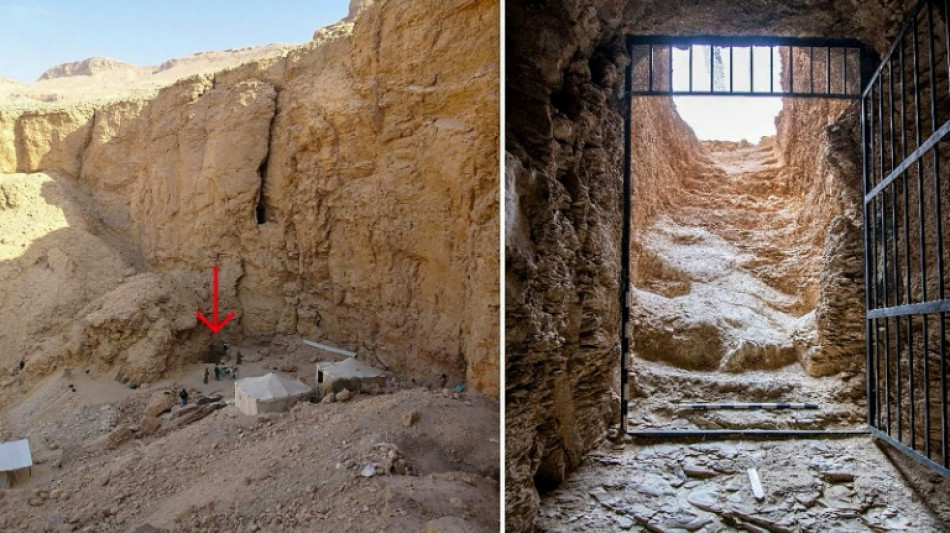
Egypt unveils first ancient royal tomb since Tutankhamun / Photo: © Egyptian Ministry of Antiquities/AFP

 Women's Asian Champions Trophy 2026 in Bhopal Revives Hockey Legacy

 California GOP Faces Near-Extinction After 2026 Midterms; Calls for New Vision

 St Francis School Leads €60,000 EU Project to Transform Early Childhood Education

 South Africa's Universal Health Coverage Depends on Tackling Poverty and Inequality

 Rare Siberian Rubythroat Dies in UK Garden After Cat Attack

 Go Kyung-pyo Drunk Driving Incident Prompts Heavy Editing Across Multiple TV Shows

 KFF Health News Reporters Discuss ACA Enrollment Challenges, Rising Costs, and Measles Risks

Egypt's antiquities authority says it has found the ancient tomb of King Thutmose II, the first royal burial to be located since the famed discovery of Tutankhamun's tomb in 1922.
The tomb, discovered near the Valley of the Kings in Luxor in southern Egypt, belonged to King Thutmose II of the 18th dynasty, who lived nearly 3,500 years ago.
Thutmose II was an ancestor to Tutankhamun himself, and his half-sister and queen consort was Pharaoh Hatshepsut.
Her giant mortuary temple stands on the west bank of the Nile at Luxor a few kilometres (miles) from where the tomb of Thutmose II was found.
Although preliminary studies suggest its contents were moved in ancient times -- leaving the tomb without the iconic mummy or gilded splendour of the Tutankhamun find -- the antiquities ministry on Tuesday called the discovery "one of the most significant archaeological breakthroughs in recent years".
It has been excavated by a joint Egyptian-British mission, led by the Supreme Council of Antiquities and the New Kingdom Research Foundation.
The tomb's entrance was first located in 2022 in the Luxor mountains west of the Valley of the Kings, but was believed at the time to lead to the tomb of a royal wife.
But the team then found "fragments of alabaster jars inscribed with the name of Pharaoh Thutmose II, identified as the 'deceased king', alongside inscriptions bearing the name of his chief royal consort, Queen Hatshepsut", confirming whose tomb it was, the ministry said.
Shortly after the king's burial, water flooded the burial chamber, damaging the interior and leaving fragments of plaster that bore parts of the Book of Amduat, an ancient mortuary text on the underworld.
Some funerary furniture belonging to Thutmose II has also been recovered from the tomb in "the first-ever find" of its kind, according to the ministry.
It quoted mission chief Dr Piers Litherland as saying the team will continue its work in the area, hoping to find the tomb's original contents.
There has been a surge of major archaeological discoveries in recent years, as Egypt seeks to boost its tourism industry as a key source of foreign currency revenue.
Last year, Egypt hosted 15.7 million tourists and aims to attract 18 million visitors in 2025.
The crown jewel of the government's strategy is the long-delayed inauguration of the Grand Egyptian Museum at the foot of the pyramids in Giza, which Egypt has said will finally open this year.
O.Krause--BTB