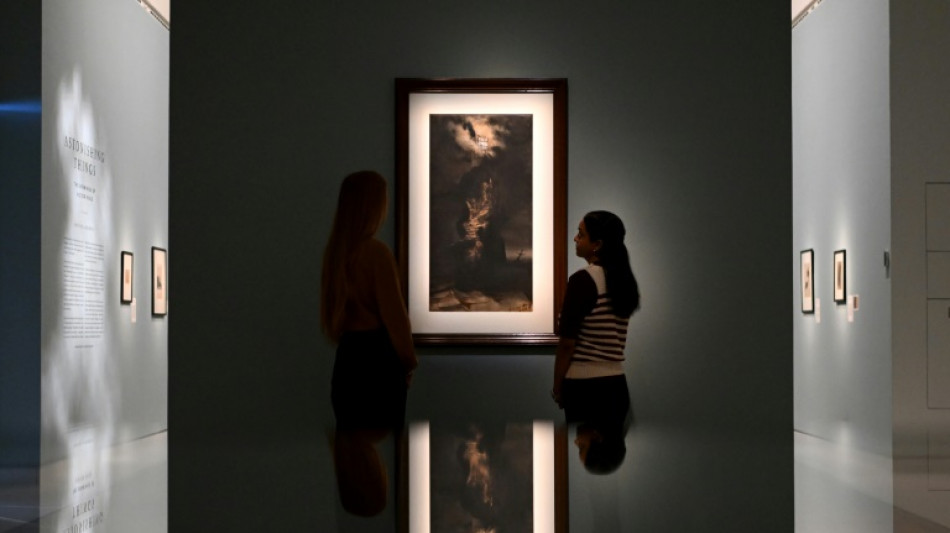
London exhibit spotlights Victor Hugo's lesser-known talent -- drawing / Photo: © AFP

 BingX: Major Announcement of Far-Reaching Significance

 Élan Opens as Late-Night Wine Bar in Honolulu

 Shiv Sena (UBT) Criticizes NCP Merger Talks as 'Ridiculous Laughing Stock'

 Dell Announces AI-Integrated PC Lineup for 2026 with Wi-Fi 7 Support

 Rocky Fans Break Guinness World Record at Philadelphia Museum Steps

 FAA Grounds All US Flights Amid Nationwide Air Traffic Control Communication Failure

 Argentina vs Uruguay Kick-off Time, TV Channels & Free Streaming Guide

French writer Victor Hugo is famous for penning "The Hunchback of Notre-Dame" and "Les Miserables", but less known is his work as an illustrator -- now the subject of a new exhibition in London.
"Astonishing Things: The Drawings of Victor Hugo", which opened at the Royal Academy of Arts on Friday, traces Hugo's passion for illustration, 140 years after his death.
The exhibition's notes say that while the Romantic author and politician came to be a leading public figure in France in the 19th century, "in private, his refuge was drawing".
"Hugo's ink and wash visions of imaginary castles, monsters and seascapes are as poetic as his writing," according to the Royal Academy of Arts.
"His works inspired Romantic and Symbolist poets, and many artists including the Surrealists. Vincent van Gogh compared them to 'astonishing things'."
For a long time, Hugo showed his drawings only to close friends, even though he ensured their posterity by donating them to France's national library.
The works, many made of ink washes, graphite pencil and charcoal, are "rarely on public display and were last seen in the UK over 50 years ago," the academy added.
The exhibition of about 70 drawings seeks to address the relationship between Hugo's artistic and literary work.
Most were made between 1850 and 1870, the period he was exiled to the island of Guernsey following a coup d'état in December 1851 by Napoleon III.
It was while in exile that Hugo completed some of his major works, including "Les Chatiments" (The Castigations) and "Les Miserables".
The exhibition tracks his progress from early caricatures and travel drawings to dramatic landscapes and his experiments with abstraction.
While his writings were deeply rooted in reality and tackled subjects such as social deprivation and the death penalty, certain drawings are more enigmatic, like "Mushroom" which depicts a giant anthropomorphic toadstool.
However the influence of his political beliefs can be seen in "Ecce Lex" (Behold the law), which shows a hanged man.
The London exhibition is scheduled to run until 29 June.
B.Shevchenko--BTB