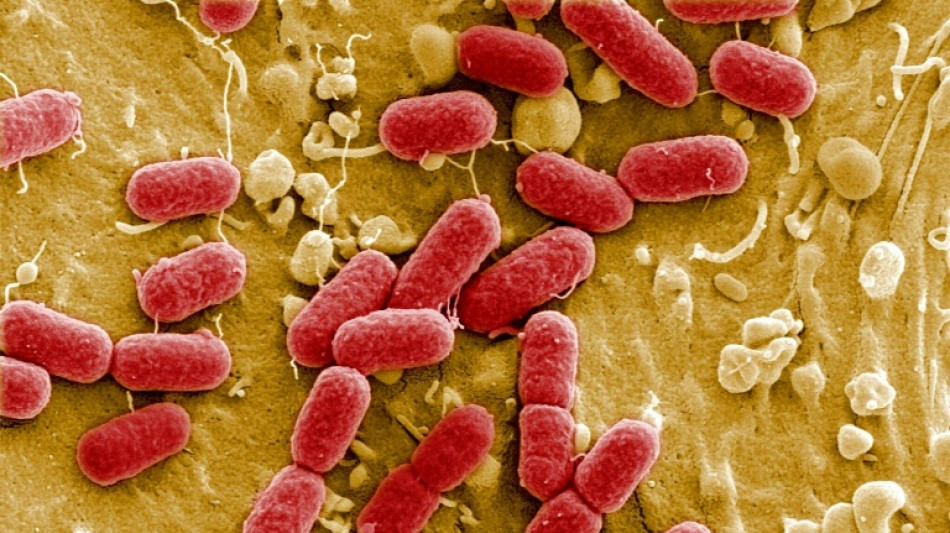
Drug-resistant superbugs projected to kill 39 million by 2050 / Photo: © Helmholtz-Zentrum für Infektions/AFP

 Rams bounce back as Giants reel from Dart injury

 In Bangladesh, Pakistan's Jinnah photo stirs anger

 Two New Zealand naval ships transit Taiwan Strait

 Zidane gets down to work as France start new era

 Inside the Venezuelan prison meant to 'drive you insane'

 UK king braces as memoir by Diana's brother goes on sale

 No green light to lift EU sanctions on Russian oligarchs, talks to resume

 UK agrees support for Saudi in struggle with Houthis: reports

 EU foreign policy chief calls for continued sanctions on Russia

 Flights scrapped, evacuations urged as Typhoon Dujuan wallops Japan

 Fonseca to take break from tennis

 A Cuban zoo, and its animals, in epic battle for survival

 Infantino proposes consulting federations to reform FIFA

 El Nino weather pattern enters record territory: scientist

 OpenAI calls for US to lead global effort on AI standards

 South African ostriches plucked alive for luxury fashion: report

 US networks halt Trump coverage in revolt over White House ban

 Paramount settles with US states to clear Warner Bros. mega-merger

 Climate crisis a job for world leaders, not just activists: UK FM

 US networks halt Trump coverage over White House ban

 French singer accuses Miley Cyrus of plagiarism

 EU fines Google 403 mn euros for location data breach

 'Best is yet to come,' says De la Fuente after Spain extension

 Why diesel prices are rising more than crude oil

 COP31 host says AI's climate footprint to be a summit priority

Infections of drug-resistant superbugs are projected to kill nearly 40 million people over the next 25 years, a global analysis predicted on Monday, as the researchers called for action to avoid this grim scenario.
Superbugs -- strains of bacteria or pathogens that have become resistant to antibiotics, making them much harder to treat -- have been recognised as a rising threat to global health.
The analysis has been billed as the first research to track the global impact of superbugs over time, and estimate what could happen next.
More than a million people died from the superbugs -- also called antimicrobial resistance (AMR) -- a year across the world between 1990 and 2021, according to the study in The Lancet journal.
Deaths among children under five from superbugs actually fell by more than 50 percent over the last three decades, the study said, due to improving measures to prevent and control infections for infants.
However when children now catch superbugs, the infections are much harder to treat.
And deaths of over-70s have surged by more than 80 percent over the same period, as an ageing population became more vulnerable to infection.
Deaths from infections of MRSA, a type of staph bacteria that has become resistant to many antibiotics, doubled to 130,000 in 2021 from three decades earlier, the study said.
- 'This threat is growing' -
The researchers used modelling to estimate that -- based on current trends -- the number of direct deaths from AMR would rise by 67 percent to reach nearly two million a year by 2050.
It will also play a role in a further 8.2 million annual deaths, a jump of nearly 75 percent, according to the modelling.
Under this scenario, AMR will have directly killed 39 million people over the next quarter century, and contributed to a total of 169 million deaths, it added.
But less dire scenarios are also possible.
If the world works to improve care for severe infections and access to antimicrobial drugs, it could save the lives of 92 million people by 2050, the modelling suggested.
"These findings highlight that AMR has been a significant global health threat for decades and that this threat is growing," study co-author Mohsen Naghavi of the US-based Institute of Health Metrics said in a statement.
The researchers looked at 22 pathogens, 84 combinations of drugs and pathogens, and 11 infectious syndromes such as meningitis. The study involved data from 520 million individual records across 204 countries and territories.
It was released ahead of a high-level AMR meeting at the United Nations scheduled for September 26.
Antimicrobial resistance is a natural phenomenon, but the overuse and misuse of antibiotics in humans, animals and plants has made the problem worse.
W.Lapointe--BTB