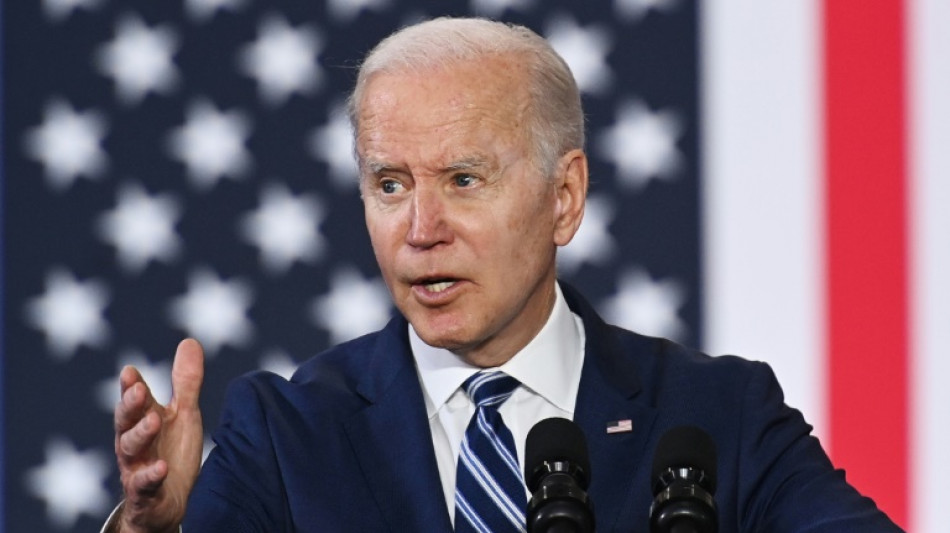
Biden and West stare down gauntlet of long war in Ukraine / Photo: © AFP/File

 Alcaraz to return for US Open title defence

 China's rapid solar expansion hurt bird diversity: study

 President Paul Biya back in Cameroon after 73 days away
 Newcastle boss Jaissle unfazed by lack of respect

 US Open purse to top $100 mn as Grand Slams form player council
 Hull aim to silence critics after unexpected promotion to Premier League

 Pakistan hit back against England after Cox and Root fifties

 Walmart reports mixed results as gas prices drag on US sales growth
 Wang downs Sindhu to break Indian hearts at badminton worlds

 As Europe's rivers recede, shippers scramble to limit damage

 Alonso won't confirm Fernandez will remain at Chelsea after Man City link

 Milky Way's fastest star discovered spinning around black hole

 Kanye West planned concerts trigger frenzy in Russia
 Hungary music festival basks in post-Orban freedom

 Vatican says 'serious concerns' over Israel-Lebanon deal implementation

 Arteta confirms Arsenal want to sign defender after Konsa link

 What's behind the UAE's decision to cut Iran trade ties?
 Barca seal Cancelo return to bolster defence
 Germany reports record 14,000 heat-related deaths this summer

 Alvarez 'focused' says new Atletico team-mate Romero

 West Ham warn fans about 'offensive' Solomon chant
 Huge questions loom over Prince Harry's shock return to UK

 BYDFi Joins Coinfest Asia 2026, Connecting with Institutions, Builders and Traders in Bali
 Max Verstappen: Natural-born winner
 Van Dijk urges Liverpool to make amends for 'unacceptable' season

The United States and its allies have warned the world: the next phase of the war in Ukraine will be long. And it will pose a daunting diplomatic task for Joe Biden, who must find a way to maintain unprecedented Western unity against Moscow -- for the duration.
The world must prepare for a "long fight ahead," the US president said during his visit to Poland last month.
In Washington, there is a certain satisfaction with the way the first phase of the war has played out, since Russia invaded February 24.
American intelligence had expected the capital Kyiv to fall quickly, but with US and European backing, Ukrainian forces have pushed Russian troops back into the country's east.
And the US government -- along with the European Union and NATO -- has organized a vast coalition to impose extraordinary economic sanctions on Russia.
But as the new battle takes shape in Ukraine's east, American strategists fear this mutual effort will gradually deteriorate.
If the fighting stays concentrated in the Donbas region, far from Kyiv and NATO's eastern border, the feeling of urgency that has so far united the West is likely to fade, according to a diplomat.
"It's a challenge," he told AFP.
Another official believes that some European countries -- which are deeply affected by the inflation precipitated by the sanctions -- could be tempted to release some of the pressure on Russia.
- 'Escalation of horror' -
Such a scenario does not seem imminent, at least for now.
"I think the upcoming battle is going to be spectacular," involving "big battles between big armies," former US ambassador to Kyiv William Taylor said.
"We're talking about World War II kinds of battles," he told AFP.
"What we see from the Russians is a willingness to kill civilians in large numbers," said Taylor, who is currently the vice president of the think tank United States Institute of Peace.
"So I think the urgency and the attention... is going to be focused on Ukraine even more intensely."
Marie Jourdain, who is a French researcher at another Washington think tank, the Atlantic Council, said "the intensity of the combat, but also the risk of escalation of the horror (of war) in the coming weeks" are likely to strengthen the resolve of the anti-Kremlin front.
But if the war drags on and becomes a "frozen conflict," "a certain normalization of the images or of the stories of horror risks limiting emotional reactions," she said.
For Jourdain, the "major issue" for the West therefore will be "maintaining the unity and the pressure in regards to Russia in a context of growing disinterest" among the public -- who are also growing weary of the "economic repercussions" of the ordeal.
For now, the United States and several European countries would still rather turn up the temperature on Russian President Vladimir Putin.
But they have already hit him hard, and the West is running out of future options.
- 'Pressure from Congress' -
The United States places much of its hope on a measure that is not flashy, but which they hope will eventually produce results: a ban on exporting to Russia technology that Moscow relies on for its military industry.
Long-term, the Russian army won't be able to replenish its weapons arsenal and missiles, Washington predicts.
But more than anything, it is a European ban on Russian oil, or even gas -- like the one already in place on the American side -- that could substantially change the situation, by depriving the Russian economy of a major source of funds.
Countries most dependent on Russian energy, such as Germany, are still holding out on such a move. But behind the scenes, US officials are convinced that this step -- unimaginable just a few weeks ago -- is on the horizon.
That leaves one major assignment for Biden: to continue to supply Ukraine with heavy weaponry without provoking a direct conflict with Russia.
And that's while members of Congress, on the left and on the right, are pushing for the United States to go even further in support of Ukraine.
Democratic Senator Chris Coons, a close Biden ally, has even floated the idea of sending American troops to Ukraine -- an option that has been a red line for the US president.
"If the answer (of when to send troops) is never, then we are inviting another level of escalation in brutality by Putin," Coons said.
According to Taylor, congressional influence has already moved the needle.
"The pressure from Congress has been productive, as the Biden administration is doing things now that they were reluctant to do before," he said.
In fact, the Pentagon is now sending heavy artillery and helicopters to Kyiv, overcoming its initial hesitancy.
For one US diplomat, the Russian military's struggles against Ukraine have reassured the United States, which is now less concerned that Putin would seek a direct conflict with the world's main superpower.
C.Kovalenko--BTB