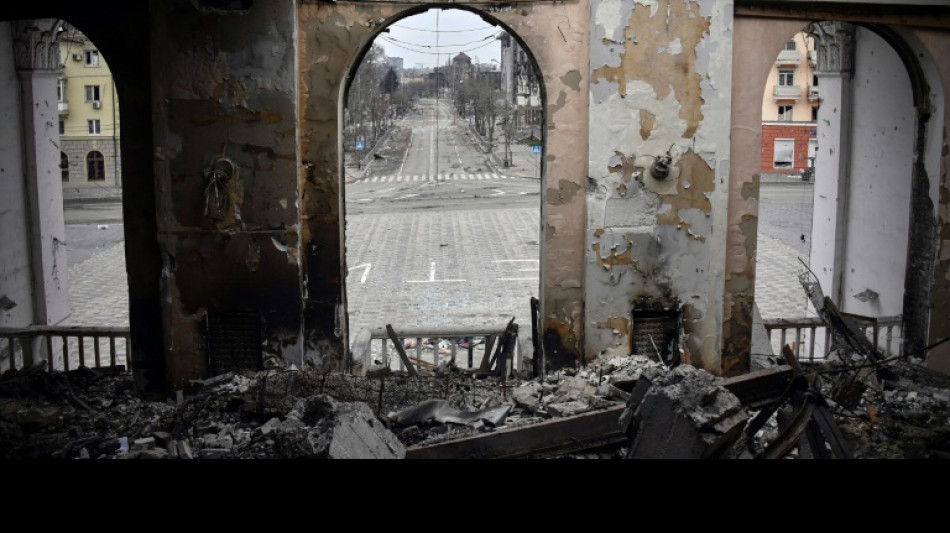
Is Russia as isolated as Ukraine's allies hope? / Photo: © AFP

 Jailed Pakistan ex-PM Khan moved to hospital on court order: party
 Pogacar eyes 'missing' piece ahead of Vuelta return
 US, Canada 'very close' to trade deal, Ottawa says, as details emerge
 Ronaldinho returns in search of 'beautiful' 300th goal
 US pushes allies, China to back Trump's economic war on Iran
 Former NBA MVP Harden reportedly set to return to Cavaliers

 Brook makes Pakistan pay for drop as England dominate first Test
 MemeCore Arrives on Nasdaq Through $1 Billion Landmark Treasury Transaction
 First US deportees land in Liberia
 US, Canada resume talks to finalize trade deal as details emerge
 Europe heatwaves scorch 80 million with 40 C heat: AFP analysis

 Carrick insists Man Utd will make more signings after quiet transfer window

 US warns allies, China to back economic war on Iran
 Manifesto defends Germany's iconic Bauhaus against 'populist attacks'
 Kenya's Kipyegon ends season with hamstring injury
 Nord Stream bomb suspect arrested while working on movie about attack: media
 German football fans plan widespread VAR protests
 Scorching summer triggers record rockfalls in Alps, scientist says
 Newly-crowned European champ Werro turns focus on 800m record
 Hamilton 'fittest ever' as he chases eighth F1 title
 Stocks retreat as bond yield fears persist, oil rises
 ARKBRIDGE’s David Mali Highlights AI-Driven Risk Management at the Finance Magnates London Summit
 Zuckerberg buys Gothic castle in Ireland: spokesman
 Belgium's fire of the century now 'under control'
 Evergrande's Xu Jiayin: from real-estate tycoon to life in prison
Two months into Russia's invasion of Ukraine, US President Joe Biden's claim that Moscow is more isolated than ever looks more like wishful thinking.
Efforts to ostracise Moscow have faced resistance from a reluctant section of the international community.
"There's a very clear isolation of Russia from the Western bloc, especially due to the series of successive sanctions that have complicated commercial and financial exchanges," said Sylvie Matelly, deputy director at the French Institute for International Relations and Strategic Affairs.
"As for Russia's isolation on the international scene, the situation is quite different, with a number of very cautious countries that have refused to give in to Western pressure," the French researcher added.
Russia's invasion, launched on February 24 with the stated objective to "denazify" and demilitarise Ukraine, provoked immediate outrage in Europe and North America, where leaders vowed to isolate Moscow and impose "unprecedented" sanctions.
In the weeks that followed, NATO and EU airspace closed to Russian planes and the United States ordered bans on importing Russian oil and gas, as well as seafood, vodka and diamonds.
Some Russian banks were excluded from the Swift international payment system and hundreds of prominent figures were prohibited from touching down on European soil.
- 'Fantasy of the free world' -
But outside the West, the response has been more cautious.
At the UN General Assembly on March 2, India and South Africa abstained during a vote demanding Russia's withdrawal from Ukraine.
In Latin America, Brazil and Mexico refused to participate in the barrage of sanctions.
"There are a growing number of countries that are more willing to assert their independence in spite of the fact that they aspire to closer cooperation with the West and are even in need of Western support," Chris Landsberg, a professor of international relations at the University of Johannesburg, was quoted as saying by the Washington Post.
"It's one thing to condemn the invasion of Ukraine -– it's another to launch an economic war against Russia, and many countries in South America, Africa and Asia are not ready to cross the line," the former Chilean ambassador to India and South Africa Jorge Heine added.
"They don't want to be pushed into a position that would go against their own interests, economic or otherwise."
This appears to be the case for Saudi Arabia and the UAE, which have so far avoided taking a stand against Russia. It could also be said for India, which abstained during a vote condemning the Russian invasion at the UN Security Council in February.
"For India, the war has posed a stark and unwelcome choice between the West and Russia, a choice that it has done everything possible to avoid making," explained Shivshankar Menon, former national security adviser to Indian Prime Minister Manmohan Singh.
"The United States is an essential and indispensable partner in India's modernisation, but Russia remains an important partner for geopolitical and military reasons," he wrote in an article published at the beginning of April, entitled: "The Fantasy of the Free World: Are Democracies Really United Against Russia?"
- Limited results -
For former French ambassador Michel Duclos, this tendency is nothing new -- even if it takes on a whole new dimension in Ukraine.
"Already in 2015 with the Syrian crisis and the first Ukrainian crisis, we had neither India nor Brazil with us," he said. "We have to ask ourselves: why is this the case, and what can we do to build stronger bridges with these countries? The question is more relevant than ever before".
Western powers are making efforts on the ground.
UNESCO has been ramping up discussions over the past two months to relocate the meeting of the World Heritage Committee, which was set to take place in Russia in June.
But it's yielded limited results: the announcement of an indefinite postponement, so far with no guarantee to prevent Russia hosting the meeting once the invasion is over.
A similar attempt was made with the G20 grouping of major economies. The Indonesian presidency was urged to exclude Moscow from the forum, but ultimately refused to do so in the name of impartiality.
The lack of short-term effects of economic sanctions is not helping the West convince hesitant countries either.
"Yes, the sanctions are tough, but they do not deter Putin from extending his siege on Mariupol... or shelling other cities," said Judy Dempsey, an analyst at the Carnegie Europe think tank.
"If the objective was to sway Putin so he withdraws from Ukraine, it's got to be said it hasn't worked," Matelly said. "He has certainly scaled down his ambitions, but not so much in response to the sanctions as to the determination of Ukrainian forces on the ground."
It will take more time to see the full impact of the sanctions.
"The situation with the Russian economy will be clearer in June or July, because now the economy is still functioning off the back of its reserves," said Russian financial analyst Alexey Vedev of the Gaidar Institute for Economic Policy.
"The reserves are dwindling, but as long as they still exist, the sanctions are not fully felt," he added.
F.Pavlenko--BTB