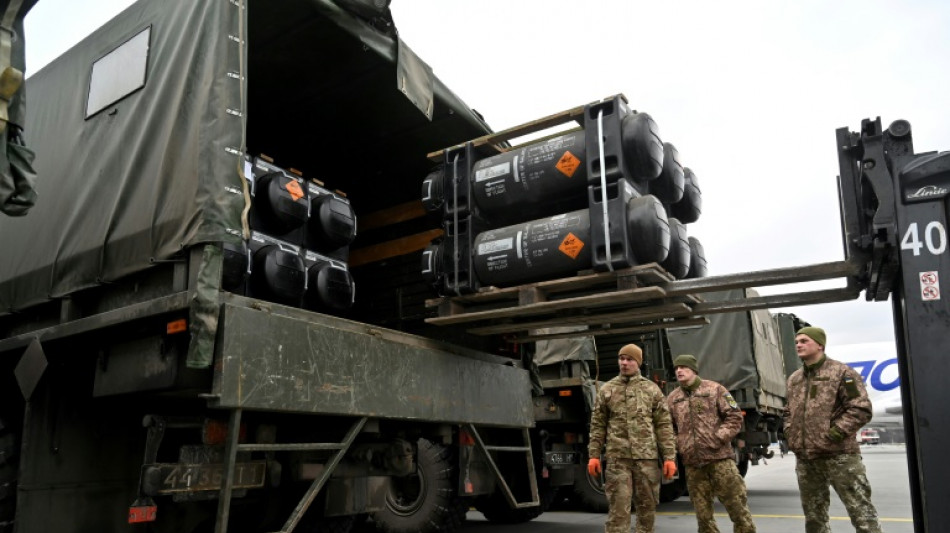
US ships artillery to Ukraine to destroy Russian firepower / Photo: © AFP/File

 Jailed Pakistan ex-PM Khan moved to hospital on court order: party

 Pogacar eyes 'missing' piece ahead of Vuelta return

 US, Canada 'very close' to trade deal, Ottawa says, as details emerge

 Ronaldinho returns in search of 'beautiful' 300th goal

 US pushes allies, China to back Trump's economic war on Iran

 Former NBA MVP Harden reportedly set to return to Cavaliers

 Brook makes Pakistan pay for drop as England dominate first Test

 MemeCore Arrives on Nasdaq Through $1 Billion Landmark Treasury Transaction

 First US deportees land in Liberia

 US, Canada resume talks to finalize trade deal as details emerge

 Europe heatwaves scorch 80 million with 40 C heat: AFP analysis

 Carrick insists Man Utd will make more signings after quiet transfer window

 US warns allies, China to back economic war on Iran

 Manifesto defends Germany's iconic Bauhaus against 'populist attacks'

 Kenya's Kipyegon ends season with hamstring injury

 Nord Stream bomb suspect arrested while working on movie about attack: media

 German football fans plan widespread VAR protests

 Scorching summer triggers record rockfalls in Alps, scientist says

 Newly-crowned European champ Werro turns focus on 800m record

 Hamilton 'fittest ever' as he chases eighth F1 title

 Stocks retreat as bond yield fears persist, oil rises

 ARKBRIDGE’s David Mali Highlights AI-Driven Risk Management at the Finance Magnates London Summit

 Zuckerberg buys Gothic castle in Ireland: spokesman

 Belgium's fire of the century now 'under control'

 Evergrande's Xu Jiayin: from real-estate tycoon to life in prison

The push by the United States to send artillery to Ukraine aims to degrade Russian forces -- not only on the immediate battlefield but over the longer term, according to US Defense Secretary Lloyd Austin and military experts.
The United States, France, Czech Republic and other allies are sending scores of the long-range howitzers to help Ukraine blunt Russia's mounting offensive in the eastern Donbas region.
Backed by better air defense, attack drones and Western intelligence, the allies hope that Kyiv will be able to destroy a large amount of Russia's firepower in the looming showdown.
After returning from Kyiv, where he met Ukraine defense chiefs and President Volodymyr Zelensky, Austin told journalists in Poland early Monday that Washington's hopes are larger than that.
Russia "has already lost a lot of military capability, and a lot of its troops, quite frankly. And we want to see them not have the capability to very quickly reproduce that capability," Austin said.
"We want to see Russia weakened to the degree that it can’t do the kinds of things that it has done in invading Ukraine."
- 'War of attrition' -
That is a shift from Washington's initial approach, when they simply hoped to help prevent Moscow's seizure of the Ukrainian capital and the overthrow of Zelensky's government.
In fact, aided by anti-aircraft and anti-armor missiles supplied by the United States and European allies, Ukrainian troops forced the Russian military to withdraw from northern Ukraine within six weeks of the February 24 invasion.
But Moscow now controls significant swathes of eastern and southern Ukraine, apparently aiming to expand to the center of the country by sending in more troops and equipment.
Their plan, experts believe, is to use long-range shelling to drive back most of Ukraine's forces and only then send in ground troops and tanks to secure the land.
Ukraine's best option is to fight back with superior artillery -- backed by protection from air assaults -- to destroy Russian firepower, according to Mike Jacobson, a US civilian expert in field artillery.
Jacobson predicted that this would lead to a "war of attrition" in which Ukraine, with ally-supplied equipment with longer ranges and more accurate targeting, could stop the Russians cold.
"I believe that superior artillery will decrease the Russians' ability to sustain this fight," Jacobson told AFP.
Phillips O'Brien, a University of St. Andrews professor of strategic studies who posts daily analyses of the war on Twitter, wrote that the coming artillery fight will resemble World War I, each side trying to wear the other down with grueling shelling.
The Russian army "is considerably smaller and suffered major equipment losses. Ukrainian army is smaller, but about to be much better armed," he said.
"Russia needs to change that dynamic or it loses the attrition war."
- Rapid deployment -
The US and allies are moving fast with the supplies to take advantage of the slow regrouping of Russian forces after their setback in northern Ukraine.
Already at least 18 of the 90 towed artillery pieces Washington promised in the past two weeks have been delivered to Ukrainian forces, and more are being rushed in early this week, according to a Pentagon official.
Washington is also supplying nearly 200,000 rounds of howitzer ammunition, and is arranging for ammunition supplies for the Russian-made artillery that Ukraine forces currently operate.
Some 50 Ukraine troops have already been trained to use the US howitzers, and more are being trained this week.
Meanwhile France is sending its ultra-advanced Caesar mobile howitzer, and the Czech Republic is delivering its older self-propelled howitzers.
Canada too is sending howitzers and advanced, guided "Excalibur" shells that can travel more than 40 kilometers and deliver munitions precisely on target.
"The fight they're in in the Donbas is going to be heavily reliant on what we call long-range fires, artillery particularly," a senior US defense official said.
"That's why we're focusing them on getting them artillery as well as tactical UAVs," the official said.
That was a reference to allies supplying "suicide drones," bomb-armed unmanned aerial vehicles that can be directed for hours to search out and then explode themselves on Russian targets.
But no one is saying such a strategy will allow Ukraine to fully drive out the Russians.
If Kyiv does prevail in the artillery showdown, it will "eventually force them (Russia) to either escalate or negotiate realistically," said Jacobson.
"Russia will be frustrated but not defeated."
W.Lapointe--BTB