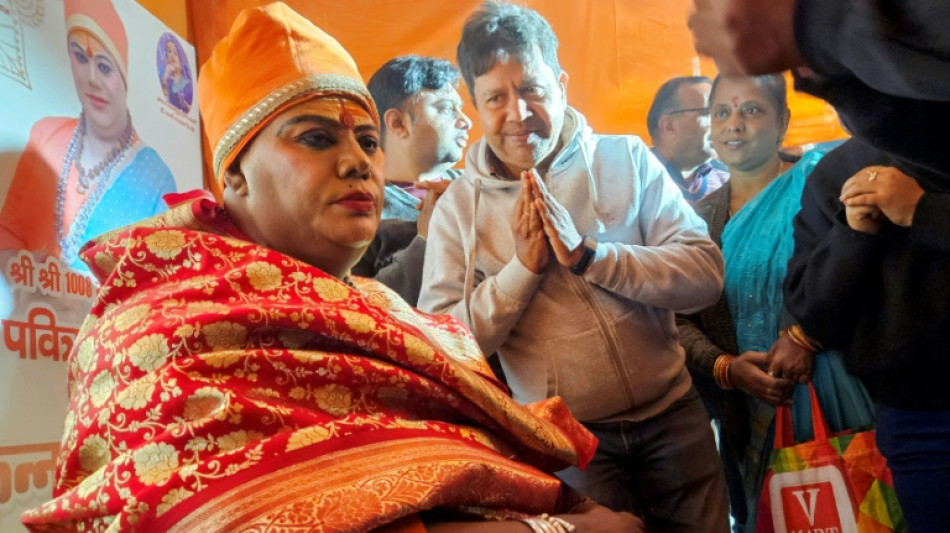
Transgender religious order gets rare approval at India Hindu festival / Photo: © AFP

 Kayla Harrison Defeats Amanda Nunes via Submission at UFC 334

 GTA 6 Advertising Strategy and Disc Version Controversy

 From First Date to Wedding Day: How a TV Quote Sparked a Lifetime Commitment

 Malta Stuns Sweden with Late Penalty Comeback in Rugby Europe Trophy

 BingX: Major Announcement of Far-Reaching Significance

 Élan Opens as Late-Night Wine Bar in Honolulu

 Shiv Sena (UBT) Criticizes NCP Merger Talks as 'Ridiculous Laughing Stock'
Transgender activists often shunned by society say they have found rare acceptance at India's Hindu Kumbh Mela festival by giving blessings to pilgrims attending the world's largest religious gathering.
Among the many millions who have attended the six-week-long Hindu celebration of prayer and bathing held every 12 years is a unique "akhada" -- or religious order -- a camp of transgender individuals.
Surveying crowds from her lion throne, Vaishnavi Jagadamba Nand Giri showers blessings on pilgrims standing in long queues to her colourful tent.
"It is very difficult to survive as a transgender person in society, since most people cannot understand how we feel," Giri said, one of around 100 members of the group at the festival.
"As visibility increases for us, the acceptance will also increase."
South Asia has a long history of people designated as male at birth but who identify as female -- known as kinnar or hijra.
In India's last census in 2011, more than 487,000 people were members of the third gender.
India recognised a third gender in 2014, but members still face severe discrimination.
- 'Very auspicious' -
The festival in the northern Indian city of Prayagraj, which ends Wednesday, is a sea of humanity.
Enthusiastic officials say that more than 560 million Hindu devotees have attended -- numbers impossible to verify independently.
That includes naked naga sadhus, wandering monks who walked for weeks from the remote mountains and forests where they are usually devoted to meditation.
It also includes the transgender Kinnar Akhada.
Traditionally, Hinduism had only 13 religious akhada groups which only included men.
The transgender Kinnar Akhada changed that when they were accepted as the 14th member in 2019.
Hindus believe that those who immerse themselves in the river waters at the Kumbh Mela cleanse themselves of sin, breaking free from the cycle of rebirth and ultimately attaining salvation.
After bathing, pilgrims come to the camps of religious orders seeking blessings.
"A blessing from a kinnar is considered very auspicious," said 38-year-old pilgrim Mangesh Sahu, queueing for a bead from the group.
"I will tie the bead around my daughter's neck to keep her protected from the evil eye -- the kinnar prayers are powerful," he said.
But challenges to full acceptance still remain.
"They seek blessings from a transgender person, but they will shun an individual like me in their family," Giri said.
P.Anderson--BTB