Gene Hackman, intense, 'uncommon' everyman actor / Photo: © AFP/File

 South Korea volleyball team latest to be bussed to wrong Games venue
 Malaysia starts sending Myanmar migrants home
 8.3 mn refugees at risk due to 'severe' funding cuts: UN
 Stocks drop and oil rises as Hormuz hopes fade

 OpenAI cancels release of newest model due to safety concerns

 AI bosses head to White House as safety pressure builds
 Batista sacked as Costa Rica coach after six months

 Flooding, power cuts and evacuations as Hurricane Polo slams Mexico

 NFL Giants obtain QB McCarthy from Vikings

 Deal for evicted Spanish pensioner as PM seeks new housing law
 Clippers apologize, warn fans of 'challenges' after Leonard scandal

 Turkish comedian convicted for Erdogan 'insult' freed pending appeal

 Trump announces 'biggest' US steel plant in battleground Iowa

 Olise wonder strike gives Zidane's France win in Belgium

 US stocks fall, bond yields rise as Middle East war drags on

 Trump denies offering to sell arms to China's Xi
 Wemby ready for NBA Spurs to move rivals in climb to top

 Ukraine to postpone some spending amid delays in aid: PM
 Tuchel says Czech Republic game 'not yet a must-win'
 MaXhosa puts South Africa on the Paris fashion map

 Rose, Scott among 2027 World Golf Hall of Fame finalists
 Brunson says NBA champion Knicks can't get satisfaction

 France puts out largest wildfire since 1949

 Real Madrid's Perez summoned over Barcelona referee payments comments

 Oil takes off again, Wall Street dips after Trump rejects Iran truce offer
Gene Hackman, who has been found dead in his home in New Mexico at the age of 95, was once voted as likely to flop in showbiz but instead went on to enjoy a storied, Oscar-winning career as an everyman actor who mined personal pain to give intense, edgy performances.
Hackman is perhaps best known for his portrayal of the tough and vulgar New York cop Jimmy "Popeye" Doyle in the 1971 crime thriller "The French Connection."
Its five-and-a-half-minute car chase scene -- in which Doyle crashes his way through bustling city streets, grunting, grimacing and honking as he pursues a bad guy who has commandeered an elevated train -- is the stuff of Tinseltown legend.
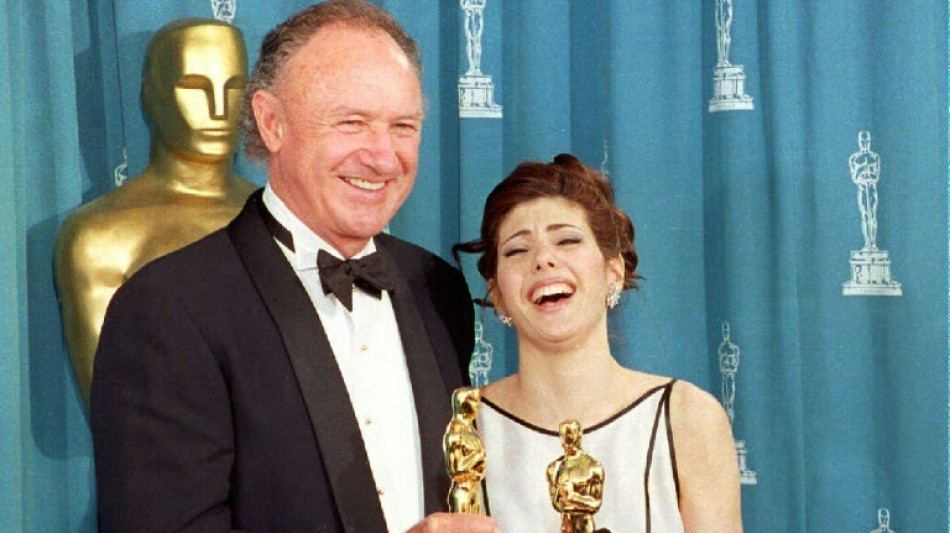
Hackman won his first best actor Oscar for that film. He won another golden statuette two decades later for best supporting actor for his portrayal of the brutal small-town sheriff "Little Bill" Daggett in the 1992 western "Unforgiven."
He earned three more Oscar nominations during a five-decade career in which he appeared in 80-odd films.
"He's incapable of bad work," Alan Parker, who directed Hackman in the 1988 civil rights drama "Mississippi Burning," told Film Comment magazine that year.
"Every director has a short list of actors he'd die to work with, and I'll bet Gene's on every one."
- Midwestern roots -
Hackman was a native Midwesterner, born during the Great Depression in Illinois.
He came from a broken family -- his father left when he was 13, waving enigmatically as he drove away one day. Hackman said he knew right then that the man was never coming back.
Hackman's mother died in a fire before he had established himself as an actor.
He also served an unpleasant stint in the US Marines, which he joined at 16 by lying about his age.
He used his personal turmoil as fuel to flesh out his characters.
"Dysfunctional families have sired a number of pretty good actors," Hackman told The Guardian in 2002.
Arthur Penn, who directed Hackman in "Night Moves" (1975) and "Target" (1985), called him an "extraordinarily truthful actor."
"He has the skill to tap into hidden emotions that many of us cover over or hide -- and it’s not just skill but courage," Penn said.
- 'An actor, not a star' -
Hackman was an unlikely star -- he came to acting relatively late after dabbling in a series of jobs, and only attracted attention in his 30s.
In fact after his enrollment at the Pasadena Playhouse in California in the late 1950s, Hollywood legend tells that he and a fellow student, one Dustin Hoffman, were voted the "least likely to succeed."
Later, they would pal around with Robert Duvall in New York when all three were struggling actors.
Not blessed with leading man good looks, Hackman instead drew on his talents and versatility, taking on gritty roles and delivering thoughtful, intelligent performances.
"I wanted to act, but I'd always been convinced that actors had to be handsome. That came from the days when Errol Flynn was my idol. I'd come out of a theater and be startled when I looked in a mirror because I didn't look like Flynn. I felt like him," Hackman once said.
After studying journalism at the University of Illinois, he first tried television production, before going to acting school in Pasadena.
Upon graduation, Hackman moved back to New York, where he worked off-Broadway and began to turn heads.
In 1964, he was cast on Broadway in the play "Any Wednesday," which led to a small role in the film "Lilith" starring Warren Beatty.
A few years later, Beatty was casting for "Bonnie and Clyde" and chose Hackman as Clyde's brother Buck Barrow.
That landmark 1967 film won Hackman his first Oscar nomination for best supporting actor, and put him firmly on track for stardom.
A second Academy Award nomination came for "I Never Sang For My Father" (1970), in which he played a professor who feels he has never won his father's approval.
"I was trained to be an actor, not a star. I was trained to play roles, not to deal with fame and agents and lawyers and the press," Hackman said.
Hackman notched up dozens of film credits in his career, working well into his 60s and 70s although he stayed out of the limelight, living with his second wife in Santa Fe, writing and painting. His wife was found dead with him at their home.
Into the 21st century, he starred in "The Heist" and "The Royal Tenenbaums" in 2001, the latter winning him his third competitive Golden Globe, before announcing his retirement in 2008.
"It really costs me a lot emotionally to watch myself on screen," Hackman once said.
"I think of myself, and feel like I'm quite young, and then I look at this old man with the baggy chins and the tired eyes and the receding hairline and all that."
J.Fankhauser--BTB