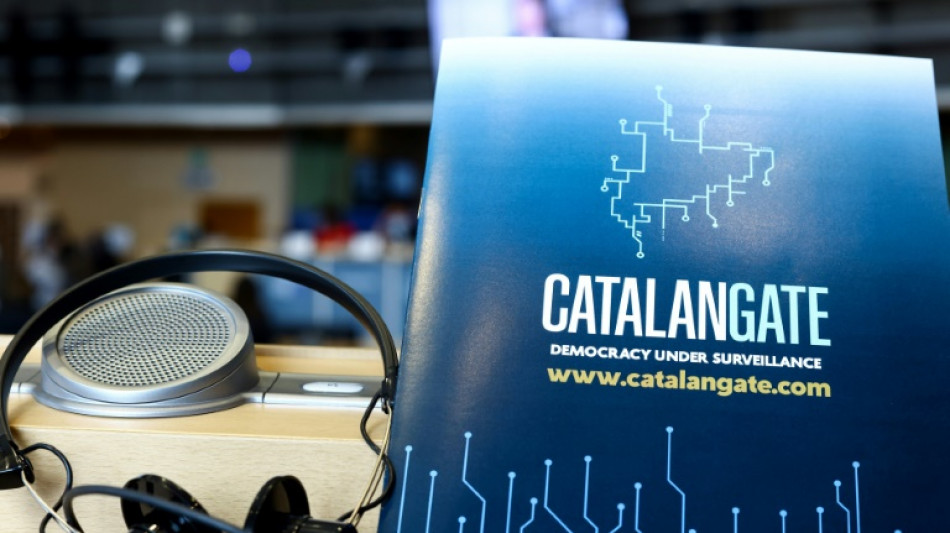
Spyware allegations poison Spain's ties with Catalan separatists / Photo: © AFP

 Ronaldinho returns in search of 'beautiful' 300th goal

 US pushes allies, China to back Trump's economic war on Iran

 Former NBA MVP Harden reportedly set to return to Cavaliers

 Brook makes Pakistan pay for drop as England dominate first Test

 MemeCore Arrives on Nasdaq Through $1 Billion Landmark Treasury Transaction
 First US deportees land in Liberia

 US, Canada resume talks to finalize trade deal as details emerge

 Europe heatwaves scorch 80 million with 40 C heat: AFP analysis

 Carrick insists Man Utd will make more signings after quiet transfer window

 US warns allies, China to back economic war on Iran

 Manifesto defends Germany's iconic Bauhaus against 'populist attacks'

 Kenya's Kipyegon ends season with hamstring injury

 Nord Stream bomb suspect arrested while working on movie about attack: media

 German football fans plan widespread VAR protests

 Scorching summer triggers record rockfalls in Alps, scientist says

 Newly-crowned European champ Werro turns focus on 800m record

 Hamilton 'fittest ever' as he chases eighth F1 title

 Stocks retreat as bond yield fears persist, oil rises

 ARKBRIDGE’s David Mali Highlights AI-Driven Risk Management at the Finance Magnates London Summit

 Zuckerberg buys Gothic castle in Ireland: spokesman

 Belgium's fire of the century now 'under control'

 Evergrande's Xu Jiayin: from real-estate tycoon to life in prison

 Spurs eyeing move for Man City's Savinho and Marmoush - reports

 Springboks captain Kolisi to miss first All Blacks Test

 Japan to launch probe for Mars moons in October: space agency

Catalan separatists have accused Spain's intelligence services of using spyware to snoop on their mobile phones, reviving tensions with Prime Minister Pedro Sanchez's minority leftist government which relies on their support to pass legislation.
Canada's Citizen Lab group said Monday that at least 65 people linked to the Catalan separatist movement had been targets of Pegasus spyware in the wake of a failed independence bid in 2017.
Elected officials, including current and former Catalan regional leaders, were among those targeted by the controversial spyware made by Israel's NSO group.
Citizen Lab, which focuses on high-tech human rights abuses, said it could not directly attribute the spying operations, but that circumstantial evidence pointed to Spanish authorities.
But Catalan leader Pere Aragones said Wednesday that "you don't have to be Sherlock Holmes" to point the finger at Spain's intelligence service, known as CNI.
"We have suspected for a long time that we were the target of the state intelligence service," he added during an interview with Catalan radio RAC1.
Catalonia, in northeast Spain, has been for several years at the centre of a political crisis between separatists, who control the executive and the regional parliament, and the central government in Madrid.
Pegasus silently infiltrates mobile phones to extract data or activate a camera or microphone to spy on their owners.
NSO Group, the owner of Pegasus, claims the software is only sold to government agencies to target criminals and terrorists, with the green light of Israeli authorities.
The company has been criticised by global rights groups for violating users' privacy around the world and it faces lawsuits from major tech firms such as Apple and Microsoft.
The Spanish government has denied illegally spying on the Catalan independence leaders, but was silent on whether the secret services had undertaken any court-approved electronic surveillance.
Defence Minister Margarita Robles, who oversees the country’s intelligence apparatus, said all actions carried out by the CNI "are subjected to judicial control and authorisation".
But she would not say if the CNI has access to Pegasus, saying this information is protected by law and classified.
"I can’t confirm if it has it or not, because I would be violating the law," she said during an interview with Spanish public television.
- 'Need guarantees' -
Spanish daily newspaper El Pais reported that CNI paid 6 million euros ($6.5 million) for Pegasus to use it outside of Spain, and Catalan separatists suspect they were spied on in various European countries.
Catalan separatist politicians and activists announced a legal offensive in several countries Tuesday against Spain and NSO Group.
Aragones called the explanations given so far by the central government "insufficient" and warned that "parliamentary stability" could end unless it takes responsibility.
His own phone was among those allegedly targeted with Pegasus during his previous role as Catalonia's vice president.
Sanchez's leftist minority government relies on Catalan separatist party ERC, which is headed by Aragones, to pass legislation in parliament.
Aragones told news radio Ser on Thursday that he had exchanged messages with Sanchez to set up a meeting to discuss the alleged spying.
"It is serious, we need guarantees that it is not happening now and that it won't happen in the future," he added.
But Oriol Bartomeus, a political scientist at the Autonomous University of Barcelona, said this affair was unlikely to inflame the Catalan separatist base.
"The pro-independence base has been showing rapidly growing fatigue for some time now, since 2019. As a result, episodes like this produce less and less reaction," he told AFP.
Polls show support for independence has waned since Catalonia's failed 2017 secession bid.
A survey published in March by the Catalan government's Centre for Opinion Studies found that 53.3 per cent of those questioned were against independence, versus 38.8 per cent in favour.
W.Lapointe--BTB